
Macrotech Developers: Leveraging Debt for Sustained Growth in India's Real Estate Landscape
Macrotech Developers Limited (MDL) has positioned itself at the intersection of aggressive growth and financial discipline, defying conventional wisdom that rising debt automatically signals risk. In Q1 2025, the company's net debt surged 43.5% to ₹4,320 crore, yet its leverage ratio of 0.24 times equity remains comfortably below its 0.5x ceiling. This calculated move reflects a strategy to capitalize on India's urbanization boom, particularly in key markets like Bengaluru and Pune, while maintaining a fortress-like balance sheet. Let's dissect whether this debt-fueled expansion is a recipe for shareholder value or a risky gamble.
The Debt Dilemma: Strategic vs. Speculative Borrowing
Debt is often a double-edged sword, but Macrotech's case tilts toward the strategic. The ₹4,320 crore debt increase funded 10 new land parcels across the Mumbai Metropolitan Region (MMR), Bengaluru, and Pune, with a combined potential revenue of ₹23,700 crore. These acquisitions aren't speculative; they're anchored in data. Bengaluru and Pune are among India's fastest-growing cities, with annual residential demand growth of 8-10%, driven by IT job creation and industrialization. Meanwhile, MMR remains its cash cow, contributing 60-70% of revenue, ensuring steady cash flows to service debt.
The company's cost of funds also improved, dropping 30 basis points to 9.1%, thanks to refinancing and lower interest rates. This reduction mitigates the burden of higher debt, while its robust operating cash flow—bolstered by a 21% year-on-year rise in FY24 sales bookings to ₹17,630 crore—provides a cushion. In Q1 2025 alone, sales bookings hit ₹4,030 crore (+20% YoY), with collections up 12% to ₹2,690 crore. These figures underscore a core strength: the ability to convert land investments into cash quickly.
The Expansion Play: Diversification Beyond Real Estate's Cycles
Macrotech's strategy isn't confined to residential real estate. Its pipeline now includes 85 million square feet across residential, office, retail, and warehousing segments—a diversification that shields it from housing market volatility. Warehousing, in particular, is a growth lever: India's e-commerce sector is projected to hit $200 billion by 2026, driving demand for logistics space. By Q4 2025, warehousing projects could contribute 15-20% of revenue, according to management.
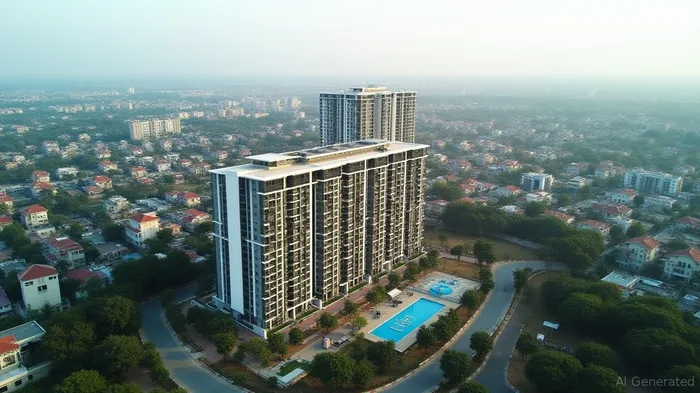
The Pune and Bengaluru expansions are also about scale. The company's land bank of over 4,080 acres ensures it can develop large-scale townships, a model that maximizes economies of scale and branding. The resolution of its legal dispute with HoABL removes a lingering overhang, allowing Macrotech to retain the “Lodha” brand—a trusted name in urban development.
Credit Ratings and Market Validation
The ICRA upgrade to AA (Stable) from AA- (Positive) in early 2025 is a critical seal of approval. The agency highlighted MDL's improved debt-to-CFO ratio (1.09x vs. 1.49x a year ago), reflecting better cash generation. This rating upgrade lowers borrowing costs further and opens access to cheaper debt, creating a virtuous cycle.
Investors have taken notice: shares rose 18% in the six months following the Q1 2025 results, outperforming the Nifty Realty Index by 10 percentage points. The stock's price-to-book ratio of 1.5x remains reasonable for a growth-oriented developer, especially given its balance sheet strength.
Risks and the Path Forward
No strategy is without risks. Macrotech's heavy land investments require flawless execution to avoid overhangs. A slowdown in Bengaluru or Pune's economic growth, or a sharp rise in interest rates, could strain margins. However, management has demonstrated prudence: 70% of land acquisitions are pre-committed to projects with 30-40% pre-sales, reducing inventory risks.
Investment Thesis: A Long-Term Play on Urban India
For investors seeking exposure to India's urbanization story, Macrotech offers a compelling mix of growth and safety. Its debt is purposeful, its cash flows are resilient, and its diversification into high-growth sectors like warehousing provides a moat against cyclicality. The ICRA upgrade and land portfolio suggest this is a company primed to outperform in the next cycle.
Recommendation: Buy Macrotech Developers for a 3-5 year horizon. Investors should monitor quarterly collections growth and execution in new markets, but the current valuation and financial discipline make this a standout play in an otherwise volatile sector.
This article is for informational purposes only. Always conduct independent research or consult a financial advisor before making investment decisions.







Comentarios
Aún no hay comentarios