
Macron's Call for Unity: Navigating Political Turmoil to Unlock Eurozone Market Opportunities
The political landscape in France has become a focal point for investors navigating the Eurozone's evolving economic terrain. President Emmanuel Macron's recent decision to call a snap election in June 2025, following a weakened showing for his centrist alliance in the European Parliament, has sent shockwaves through financial markets. The CAC 40 index plummeted over 6% within 72 hours of the announcement, reflecting heightened uncertainty about France's ability to implement critical reforms amid fragmented governance, according to a Skilling analysis. This volatility underscores the delicate balance between political instability and market resilience, particularly as Macron's calls for unity aim to stabilize both domestic and European economic priorities.
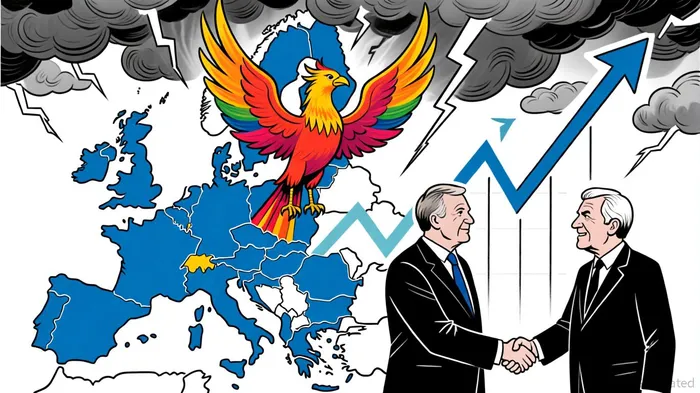
Political Instability and Investor Sentiment
Macron's snap election has exacerbated concerns about fiscal discipline and EU cohesion. The widening OAT–Bund spread-a key metric of sovereign risk in the euro area-signals increased perceptions of France as a riskier borrower, the Skilling analysis found. This trend is compounded by broader political turmoil in Germany, where shifting alliances and policy debates have further dampened investor confidence. According to a Wealth Insights report, the combination of these factors has led to a risk-off sentiment in European stock markets, with equity valuations underperforming relative to global benchmarks.
However, the Eurozone's economic fundamentals remain cautiously optimistic. The European Central Bank (ECB) has initiated rate cuts in response to declining inflation, which fell to 1.8% year-on-year in September 2024, according to the AEW outlook. These cuts are expected to reduce borrowing costs, benefiting both equity and debt markets. For instance, the Eurozone's average 10-year government bond yield is projected to decline to 3.0% by 2029, from 3.2% at the end of Q3 2024, AEW projects. This environment presents opportunities for investors willing to navigate short-term volatility.
The Capital Markets Union: A Path to Integration
Macron's collaboration with German Chancellor Friedrich Merz on the Capital Markets Union (CMU) initiative has reinvigorated efforts to integrate European financial markets, according to a Procapitas article. The CMU aims to streamline regulations, improve cross-border investment, and reduce reliance on traditional bank lending. While progress has been historically sluggish due to resistance from Germany and Luxembourg, the renewed Franco-German partnership signals a potential breakthrough.
The Consilium initiative suggests the CMU could lower financing costs for businesses, strengthen economic resilience, and facilitate the green and digital transitions. For investors, this means enhanced access to high-quality European equities, particularly in sectors like technology and sustainability. DelMorgan & Co. notes a 15% rise in M&A activity in 2025, driven by these strategic sectors, a trend also highlighted in the AEW outlook. However, the success of the CMU hinges on overcoming political fragmentation and securing broader EU support.
Equity and Debt Market Opportunities
The Eurozone's equity markets have shown resilience in 2025, with European equities outperforming U.S. counterparts in the first half of the year, the Allianz outlook reports. This is partly attributed to structural reforms and ECB easing. For example, the real estate sector is projected to see prime office rental growth of 2.6% annually through 2029, AEW projects. High-quality issuers insulated from U.S. tariffs and global trade dynamics continue to attract capital, despite broader uncertainties, the Wealth Insights report notes.
In the debt market, Eurozone sovereign issuance is expected to rise in 2025, with Spain, Italy, and Portugal adjusting funding strategies, the Consilium initiative states. While institutional Term Loan B (TLB) markets face volatility, new issuances are pricing around E+400bps or higher, the Consilium initiative adds. Investors with a long-term horizon may find value in these instruments, particularly as fiscal stimulus in Germany and France targets growth in defense and infrastructure, the Allianz outlook suggests.
Navigating the Risks
Despite these opportunities, investors must remain cautious. Ongoing U.S.-China trade tensions and retaliatory tariffs pose risks to trade-dependent sectors, the Allianz outlook warns. Additionally, the rise of far-right parties in France and Germany could further delay reforms, prolonging market uncertainty, the Consilium initiative cautions. The ECB's risk appetite indicator highlights this duality, showing strong co-movement with U.S. sentiment but lingering caution about global economic shifts, the Allianz outlook shows.
Conclusion
Macron's call for unity in France, while fraught with immediate challenges, signals a pivotal moment for the Eurozone. Political instability has undoubtedly shaken investor sentiment, but the ECB's accommodative policies and the CMU's potential to integrate markets offer a counterbalance. For investors, the key lies in balancing short-term risks with long-term opportunities-particularly in sectors aligned with European sovereignty and technological leadership. As the Eurozone navigates this turbulent phase, those who position themselves to capitalize on structural reforms and resilient sectors may find themselves well-placed for a recovery.







Comentarios
Aún no hay comentarios