
Macroeconomic Uncertainty and Altcoin Vulnerability in 2026: The Case for Bitcoin Dominance in High-Rate Environments
The macroeconomic landscape in 2026 remains a battleground of divergent forces. While the U.S. GDP growth projections for 2026 hover around 2.3% (FOMC median) and 1.8% (Philadelphia Fed's SPF), the Federal Reserve's policy stance remains anchored in caution, with the federal funds rate projected to stay at 3.4% through year-end. This environment-marked by high interest rates and a Fed divided between inflation and employment priorities-has created a unique stress test for risk assets, particularly in the crypto sector. Altcoins, long seen as speculative plays, are increasingly exposed to liquidity pressures and volatility, while Bitcoin's role as a relative safe haven is gaining institutional credibility.
Altcoin Vulnerability: Liquidity Crunch and Structural Weakness
The Federal Reserve's policy tightening in 2025 and early 2026 has had a cascading effect on altcoin markets. A $340 billion contraction in the Fed's balance sheet in 2025 triggered capital reallocation, with investors shifting from BitcoinBTC-- ETFs to stablecoins and altcoins in search of yield and regulatory clarity. However, this shift proved short-lived. By late 2025, Bitcoin ETFs lost $3.79 billion in inflows, while altcoins like SolanaSOL-- and XRPXRP-- initially attracted capital but failed to sustain momentum.
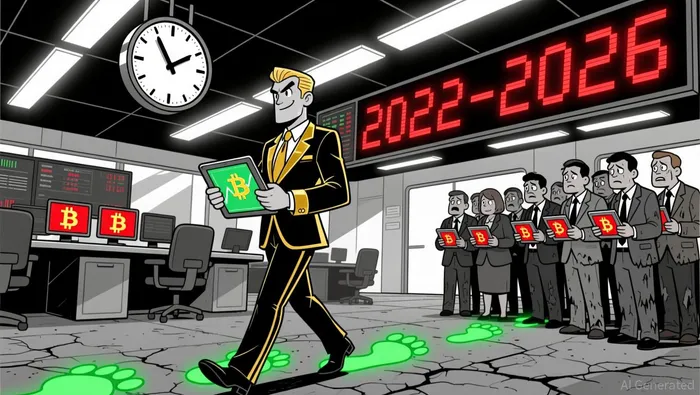
The broader trend is stark: altcoins have underperformed Bitcoin for four consecutive years, with the CoinMarketCap Altcoin Season Index at 20/100 as of early 2026. This metric indicates that 80% of the top 100 crypto assets lagged Bitcoin in the last 90 days, a sign of structural fragility. Analysts attribute this to macroeconomic headwinds, subdued retail participation, and the dominance of institutional flows favoring Bitcoin's perceived stability. The Grayscale 2026 Digital Asset Outlook underscores this, noting that Bitcoin and EtherETH-- are increasingly viewed as diversification tools amid inflationary pressures.
Bitcoin's Safe Haven Role: Stability Amid Chaos
Bitcoin's price action in 2025-down 6% year-to-date-belied its growing role as a macroeconomic hedge. Despite the decline, on-chain data revealed robust adoption, with 3.42 million new non-empty wallets added in 2025. This suggests that Bitcoin is being accumulated as a store of value rather than a speculative asset. The asset's correlation with traditional financial markets has also tightened, mirroring equity and bond market movements during periods of Fed policy uncertainty.
Technical indicators reinforce this narrative. Bitcoin's MACD analysis for 2026 shows fading momentum, reflecting a shift from speculative trading to structural consolidation. This contrasts with altcoins, which often exhibit exaggerated volatility and liquidity gaps under macroeconomic stress. For instance, the Atlanta Fed's Q4 2025 GDPNow model projected 5.4% growth for the quarter, yet Bitcoin's price remained range-bound, highlighting its decoupling from short-term macro noise.
Inflation Dynamics and the Fed's Tightrope
Inflation expectations in 2026 remain a double-edged sword for crypto liquidity. While Bitcoin is increasingly seen as a hedge against fiat devaluation-particularly in a world of rising public sector debt- its price remains sensitive to liquidity conditions. If inflation reaccelerates or credit markets tighten, Bitcoin could face renewed downward pressure. Conversely, a Fed pivot toward rate cuts (anticipated once or twice in 2026) might boost risk appetite and drive capital into crypto.
Regulatory clarity is another critical factor. The GENIUS Act's passage in 2025 provided a framework for crypto ETFs, but broader legislation like the Clarity Act could further stabilize the sector. Such measures are expected to enhance institutional participation, potentially improving liquidity for Bitcoin while leaving altcoins in the shadows.
Strategic Implications for Investors
The 2026 macroeconomic environment demands a recalibration of crypto portfolios. Altcoins, already vulnerable to liquidity crunches and regulatory ambiguity, are likely to underperform in a high-rate, risk-off climate. Bitcoin, by contrast, is emerging as a de facto safe haven, supported by institutional adoption, on-chain growth, and its alignment with traditional market dynamics.
Investors should prioritize Bitcoin as a core holding, leveraging its resilience against macroeconomic shocks. Altcoins may still offer niche opportunities but require rigorous due diligence and smaller allocations. As the Fed's policy path remains uncertain, the key to navigating 2026's crypto markets lies in balancing risk with the growing structural advantages of Bitcoin.






Comentarios
Aún no hay comentarios