
Macroeconomic Sensitivity in Crypto Markets: Why Utility-Driven Tokens Like SUBBD Outperform Speculative Altcoins
The Fed's 2025 Hawkish Pivot and Market Reactions
The Federal Reserve's aggressive monetary tightening in late 2025 triggered a sharp sell-off across crypto markets. BitcoinBTC-- (BTC) fell below $100,000 for the first time since May 2025, while Ethereum (ETH) dropped by over 11% in 24 hours. The broader market capitalization plummeted from $4.28 trillion to $3.27 trillion within a month, with speculative altcoins bearing the brunt of the decline. Over $1.2 billion in liquidations occurred in derivatives markets, reflecting panic selling and a flight to safety. This volatility underscores the growing correlation between crypto assets and traditional macroeconomic indicators, challenging the narrative of crypto as a purely uncorrelated asset class.
Utility Tokens vs. Speculative Altcoins: A Tale of Two Models
The distinction between utility-driven tokens and speculative altcoins has never been clearer. Speculative altcoins, often lacking intrinsic value or real-world adoption, are highly sensitive to liquidity-driven macroeconomic events. For example, during the November 2025 hawkish pivot, high-beta altcoins like XRPXRP-- experienced steeper declines than BTCBTC--, with Ethereum falling 7.23% to 11.5% in a single day. In contrast, utility tokens-particularly those with robust fundamentals and diversified monetization models-have shown greater stability.
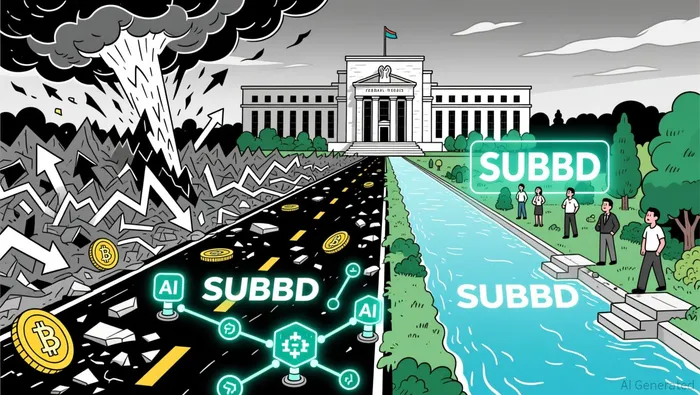
SUBBD, a utility token targeting inefficiencies in the creator economy, exemplifies this resilience. By combining AI tools, on-chain governance, and diversified monetization avenues, SUBBD has attracted capital even amid market turbulence. Its presale raised $1.3 million, and a 20% staking APY in the first year provides a buffer against volatility. This utility-driven model contrasts sharply with speculative altcoins, which often lack such intrinsic value and are vulnerable to liquidity contractions.
Regulatory Tailwinds and Market Maturity
Regulatory advancements are further amplifying the divide between utility tokens and speculative assets. Europe's MiCA framework and the U.S. SEC's efforts to regulate crypto tokens are fostering trust in projects with clear use cases and technological robustness. These developments are likely to favor utility tokens during periods of monetary tightening, as investors seek assets with verifiable real-world applications.
Moreover, the tightening environment acts as a "washout" for weak projects, creating a healthier foundation for cryptocurrencies with strong fundamentals. For instance, the rise in centralized exchange (CEX) trading volumes-reaching their highest levels since January-fueled demand for utility tokens tied to CEX infrastructure, such as BNBBNB-- and CRO. Decentralized perpetual futures platforms like Hyperliquid also gained traction, highlighting the market's preference for projects with tangible utility.
SUBBD's Resilience During Macroeconomic Shocks
While specific beta coefficients for SUBBD during the November 2025 Fed pivot are not publicly available, its performance metrics suggest a lower volatility profile compared to speculative altcoins. During the same period, BTC and ETHETH-- mirrored traditional risky assets like tech stocks, reflecting institutional capital flows. In contrast, SUBBD's integration with an AI-driven creator ecosystem-offering tools for content creation, governance, and monetization-has insulated it from extreme volatility.
This resilience is further supported by macroeconomic trends. As the Fed transitions from quantitative tightening (QT) to quantitative easing (QE) in late 2025, liquidity is expected to return to risk assets, benefiting projects with strong fundamentals. Tokens like SUBBD, which are underpinned by real user demand and diversified revenue streams, are better positioned to absorb volatility than speculative altcoins, which often lack intrinsic value.
Investment Implications
The 2023–2025 fiscal cycle has revealed a clear shift in investor sentiment toward utility-driven tokens. Projects with tangible use cases and technological robustness are increasingly favored over speculative plays, particularly during periods of monetary tightening. For investors, this suggests a strategic reallocation toward utility tokens that address real-world inefficiencies, such as SUBBD's focus on the creator economy.
Speculative altcoins, while historically volatile, remain exposed to liquidity-driven corrections. In contrast, utility tokens offer a more stable foundation, particularly in a regulatory environment that prioritizes transparency and real-world adoption. As the Fed's policy trajectory continues to evolve, the ability of utility tokens to weather macroeconomic shocks will likely become a defining factor in long-term investment success.
Conclusion
The 2025 Fed hawkish pivot has exposed the fragility of speculative altcoins in the face of macroeconomic volatility. Meanwhile, utility-driven tokens like SUBBD-backed by real-world applications, regulatory tailwinds, and diversified monetization models-are demonstrating superior resilience. As the crypto market matures, investors are increasingly prioritizing projects with verifiable utility, signaling a paradigm shift toward fundamentals over speculation.






Comentarios
Aún no hay comentarios