
Macro-Driven Crypto Positioning: Seizing Opportunities Before the Fed's Next Move
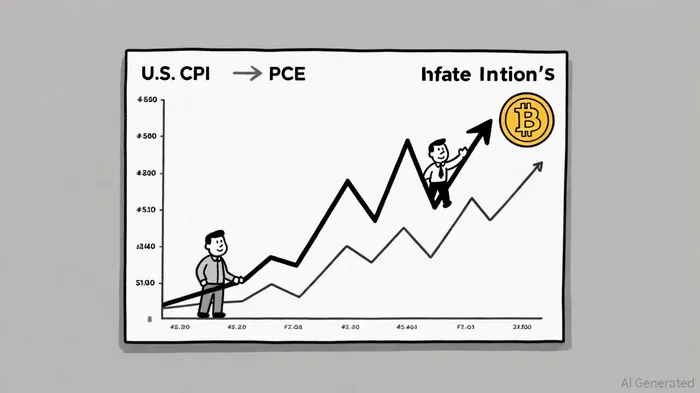
The U.S. Federal Reserve's cautious approach to inflation and its gradual rate-cutting path are creating a fertile ground for crypto markets to rally. With core PCE inflation at 3.1% in 2025 and CPI inflation at 2.7%, the Fed has signaled a measured reduction in rates, projecting a decline to 3.6% by 2026 and 3.4% by 2027 . These developments, combined with evolving regulatory clarity and macroeconomic tailwinds, position cryptocurrencies as a compelling asset class for investors seeking asymmetric upside.
Inflation Dynamics and the Fed's Tightrope Walk
The Fed's June 2025 projections underscore its balancing act: taming inflation without stifling growth. While CPI inflation has stabilized at 2.7% (July 2025), core CPI remains elevated at 3.1%, reflecting persistent demand-side pressures . Meanwhile, PCE inflation—its preferred metric—remains at 2.6%, below the 2% target but still above pre-pandemic norms . This divergence between CPI and PCE highlights the Fed's challenge in interpreting inflation signals.
The Fed's July 2025 decision to hold rates at 4.25–4.50% reflects its focus on monitoring the inflationary impact of tariffs and global supply chain shifts . However, the FOMC's median projection for 2026 (3.6%) and 2027 (3.4%) suggests policymakers are preparing for a soft landing scenario . This gradual easing cycle is critical for crypto markets, as lower rates typically boost risk appetite and liquidity—a dynamic that has historically favored BitcoinBTC-- and altcoins.
Historical Correlations: Rates, Risk, and Crypto
Bitcoin's price history reveals a nuanced relationship with Fed policy. During the 2024–2025 rate cut cycle (from 5.33% to 4.33%), Bitcoin surged 95%, driven by a combination of lower borrowing costs and regulatory tailwinds like Bitcoin ETF approvals . This aligns with broader patterns: lower rates create a “risk-on” environment, diverting capital from traditional assets (e.g., bonds) to high-growth, high-volatility assets like crypto .
Conversely, the 2022–2023 rate-hiking cycle saw crypto markets plummet alongside equities, as higher rates reduced liquidity and increased the cost of leveraged positions . Yet, the Fed's pivot in 2023–2024—signaling rate cuts and a shift toward accommodative policy—sparked a crypto rebound, with Bitcoin and EthereumETH-- regaining lost ground within 18 months . These cycles illustrate that while Fed policy is a key driver, crypto markets are also influenced by regulatory developments, macroeconomic sentiment, and technological innovation.
Regulatory Tailwinds and Institutional Legitimacy
The U.S. and EU's evolving regulatory frameworks are amplifying crypto's appeal. The STABLE Act and GENIUS Act, which impose stricter reserve requirements on stablecoins while fostering innovation, are expected to enhance institutional trust in digital assets . Additionally, the Fed's exploration of granting stablecoin issuers access to master accounts could institutionalize crypto as a systemic financial tool .
These developments are critical for macro-driven positioning. As stablecoins gain legitimacy, their role as a bridge between traditional finance and crypto will expand, potentially boosting demand for Bitcoin as a store of value. Meanwhile, the EU's MiCA (Markets in Crypto-Assets) framework, set to finalize in 2025, will further normalize crypto adoption, encouraging cross-border institutional flows .
Positioning for the Fed's Next Move
Investors should focus on three levers to capitalize on the Fed's easing cycle:
1. Bitcoin as a Macro Hedge: With the Fed's rate cuts likely to continue in 2026, Bitcoin's role as a hedge against low-yielding traditional assets will strengthen. Historical data suggests a 1% rate cut could add ~1.2% to crypto markets, though this is amplified by regulatory and macroeconomic catalysts .
2. Altcoin Exposure via Innovation: Projects leveraging blockchain for cross-border payments, tokenized real assets, and DeFi 2.0 are poised to benefit from increased institutional participation.
3. Stablecoin Arbitrage and Yield Strategies: As stablecoins gain regulatory clarity, opportunities in yield-generating stablecoin protocols and cross-chain arbitrage will emerge.
Conclusion
The Fed's gradual rate cuts, coupled with regulatory progress and macroeconomic stability, are creating a “Goldilocks” scenario for crypto. While inflation remains a near-term concern, the path to a crypto rally is increasingly macro-driven. Investors who position early—leveraging rate cuts, regulatory clarity, and innovation—stand to capture outsized returns as the Fed's next move reshapes the financial landscape.
Source:
[1] The Fed - June 18, 2025: FOMC Projections materials, [https://www.federalreserve.gov/monetarypolicy/fomcprojtabl20250618.htm]
[2] The Stablecoin Revolution: 12 Predictions That Will..., [https://futuristspeaker.com/future-of-banking/the-stablecoin-revolution-12-predictions-that-will-transform-money-forever/]
[3] Federal Reserve Calibrates Policy to Keep Inflation in Check, [https://www.usbank.com/investing/financial-perspectives/market-news/federal-reserve-tapering-asset-purchases.html]
[4] Global Crypto-Asset Regulation Outlook (May 2025), [https://insights4vc.substack.com/p/global-crypto-asset-regulation-outlook]
[5] Personal Consumption Expenditures Price Index, [https://www.bea.gov/data/personal-consumption-expenditures-price-index]






Comentarios
Aún no hay comentarios