
The Macro-Driven Bitcoin Sell-Off: Is the Downtrend Sustainable?
The BitcoinBTC-- sell-off in late 2025 has sparked intense debate among investors and analysts, with macroeconomic forces and technical patterns converging to shape the cryptocurrency's trajectory. As the asset fell below $86,000 in early November 2025-a 32% drop from its October peak of $126,300-the market grappled with questions about the sustainability of the downtrend. This analysis examines the interplay between macroeconomic interdependencies, institutional adoption, and technical indicators to assess whether the current correction signals a deeper bearish phase or a temporary setback.
Macroeconomic Headwinds: Fed Policy and Inflation
Bitcoin's performance in 2025 has been inextricably linked to the Federal Reserve's policy stance and inflation dynamics. The Fed's hawkish posture, maintaining rates at 5.5% through much of the year, increased the opportunity cost of holding non-yielding assets like Bitcoin. By December 2025, the Fed cut rates to 3.5%–3.75%, yet Bitcoin's muted response-trading around $92,000-highlighted its evolving identity as a high-beta asset rather than a traditional inflation hedge.
Persistent inflation, with a year-over-year CPI of 3.8%, reinforced Bitcoin's narrative as a "digital gold" store of value. However, its 60-day correlation with gold (0.65) and the S&P 500 (0.72) suggested deeper integration with traditional markets. This synchronization exposed Bitcoin to broader risk-off sentiment, particularly after Trump's 100% tariffs on Chinese imports triggered a $19 billion liquidation event in October 2025. Analysts argue that Bitcoin's behavior now mirrors tech stocks, amplifying its sensitivity to liquidity conditions and macroeconomic uncertainty.
Technical Patterns and Market Structure
Technical analysis further complicates the outlook. A bear flag pattern on Bitcoin's daily chart, with a potential price target of $76,000, signaled short-term bearish momentum. 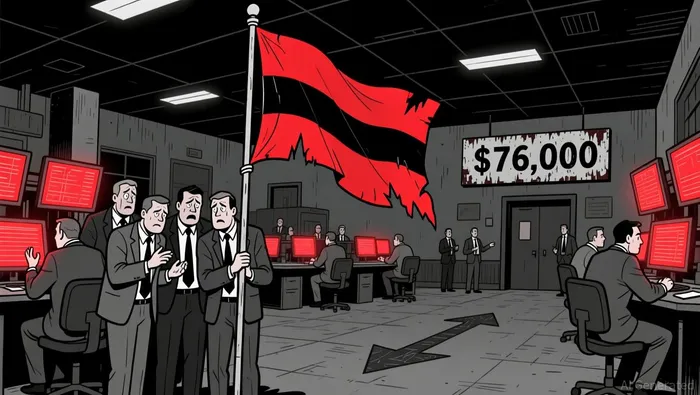 However, historical precedents suggest caution. For instance, Bitcoin's 2025 bear market-defined by a 27% decline from its peak-aligned with past cycles, where the asset averaged a 6% return over six months and 1% over a year. The current consolidation around $90,000–$99,000 reflects a tug-of-war between bearish technical signals and institutional demand.
The bear flag's validity hinges on macroeconomic catalysts. If the Fed's projected rate cuts in 2026 materialize-three cuts by year-end, per J.P. Morgan and Goldman Sachs-Bitcoin could see a rally. However, the pattern's sustainability depends on whether the market views these cuts as a liquidity-driven boost or a sign of economic fragility. For example, the December 2025 rate cut failed to trigger a sustained rally, with Bitcoin's price settling back to $92,000 after a brief spike. This suggests that technical patterns alone may not override macroeconomic headwinds.
Institutional Adoption: A Tailwind Amid Turbulence
Despite the sell-off, institutional adoption remains a critical tailwind. Bitcoin's market capitalization of $1.65 trillion in November 2025 underscored its role as a cornerstone of the crypto ecosystem. Regulatory clarity, including the GENIUS Act and the approval of spot Bitcoin ETFs, has facilitated institutional access, with 68% of institutional investors planning to allocate to BTC exchange-traded products.
However, ETF inflows have been inconsistent. November 2025 saw net outflows, contrasting with earlier optimism. This highlights a structural issue: while institutional demand supports Bitcoin's long-term value, short-term volatility remains tied to macroeconomic shifts. For example, MicroStrategy's increased holdings and BlackRock's ETF inflows provided stability, but these gains were offset by macro-driven sell-offs triggered by tariff announcements.
The Path Forward: Balancing Macro and Technical Forces
The sustainability of Bitcoin's downtrend hinges on three factors:
1. Fed Policy: If the Fed's dovish pivot in 2026 aligns with historical liquidity-driven cycles, Bitcoin could rebound. However, persistent inflation above 2% and internal policy disagreements at the Fed introduce uncertainty.
2. Institutional Demand: Continued ETF inflows and corporate adoption (e.g., MicroStrategy's BTC purchases) could offset macroeconomic headwinds. Yet, the recent outflows suggest that institutional confidence is not immune to market stress.
3. Technical Resilience: A breakdown below $90,000 could validate the bear flag pattern, but a higher low-similar to previous rebounds-might signal a temporary correction rather than a bear market.
Historical parallels offer mixed signals. The 2024 halving event and ETF approvals drove Bitcoin to record highs, but the 2025 sell-off revealed vulnerabilities in its inflation-hedge narrative. Meanwhile, Bitcoin's correlation with AI stocks and equities underscores its role as a risk-on asset, complicating its identity as a safe-haven store of value.
Conclusion
Bitcoin's current downtrend reflects a complex interplay of macroeconomic pressures, technical patterns, and institutional dynamics. While the bear flag and Fed policy suggest short-term bearishness, the asset's long-term resilience-bolstered by institutional adoption and regulatory clarity-cannot be ignored. Investors must weigh the likelihood of Fed rate cuts in 2026 against persistent inflation and geopolitical risks. For now, the market remains in a consolidation phase, with the sustainability of the downtrend contingent on whether macroeconomic conditions improve or deteriorate further.






Comentarios
Aún no hay comentarios