
Macquarie's Strategic Data Center Plays in the AI Era: Why Now is the Time to Invest in European and U.S. AI-Ready Infrastructure
The global economy is undergoing a structural transformation driven by artificial intelligence (AI), with data centers emerging as the critical infrastructure underpinning this shift. As AI workloads intensify, demand for high-performance computing (HPC) and AI-ready facilities is surging, creating a unique inflection point for institutional investors. Macquarie Group, through its asset management arm, has positioned itself at the forefront of this transition, leveraging strategic capital deployments to capitalize on the confluence of technological innovation and macroeconomic tailwinds.
The AI Infrastructure Boom: A Structural Shift in Demand
The case for AI-ready data centers is rooted in the exponential growth of compute-intensive applications. According to S&P Global Research, data center investments accounted for 80% of U.S. private domestic demand growth in the first half of 2025, driven by construction, equipment, and R&D expenditures. This trend is underpinned by the U.S. leading in data center capacity, holding over 40% of the global total. Meanwhile, U.S. tech giants are projected to invest over $350 billion in data centers in 2025, with expectations to reach $400 billion by 2026. MicrosoftMSFT-- alone has committed $80 billion in fiscal 2025 to AI-specific facilities, reflecting the sector's strategic importance.
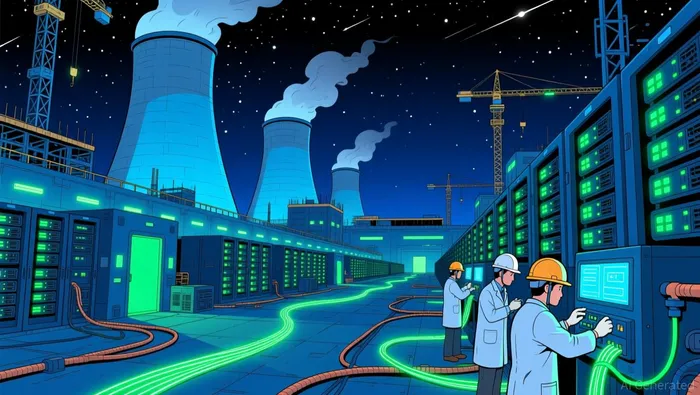 AI data centers differ fundamentally from traditional facilities. They operate at power densities of 50–150 kilowatts per rack and require advanced cooling and power systems to manage heat dissipation. This technical complexity creates a barrier to entry for conventional infrastructure providers, amplifying the role of specialized developers and institutional capital in scaling capacity.
Macquarie's Strategic Capital Allocations: A Dual-Pronged Approach
Macquarie Asset Management (MAM) has adopted a dual strategy to secure its position in this high-growth market. In early 2025, MAM announced a $5 billion investment in Applied Digital's HPC infrastructure, including $900 million for the Ellendale HPC Campus in North Dakota-a project expected to support over 2 gigawatts of HPC capacity. Simultaneously, MAM secured $12 billion in financing for Aligned Data Centers to accelerate AI-ready infrastructure development across the Americas, targeting 5+ gigawatts of capacity.
These investments are not isolated bets but part of a broader thesis. By January 2025, MAM had allocated $13 billion in just one week to Applied DigitalAPLD-- and Aligned, signaling confidence in the sector's long-term potential. A subsequent $100 million development loan facility in December 2025 further underscores Macquarie's commitment to funding pre-lease costs for new projects. The sale of Aligned Data Centers at a $40 billion enterprise value in late 2025 highlights the asset class's scalability and the growing appetite for institutional-grade data center holdings.
Institutional Capital as a Catalyst for Expansion
The role of institutional capital in this transition cannot be overstated. Data from Hanwha Data Centers indicates that global AI infrastructure spending reached $47.4 billion in the first half of 2024 and is projected to exceed $200 billion by 2028. This trajectory reflects a shift in capital allocation priorities, with institutional investors increasingly viewing data centers as a core component of their portfolios. Macquarie's expertise in structuring long-term, asset-backed investments aligns perfectly with the sector's capital intensity and regulatory complexity.
Moreover, the U.S. and Europe are emerging as key battlegrounds for AI infrastructure. While the U.S. dominates current capacity, Europe's regulatory environment and energy transition goals are creating opportunities for greenfield developments. Macquarie's focus on North America-where it has secured over 2 gigawatts of HPC capacity-positions it to benefit from both existing demand and future regulatory tailwinds.
Why Now Is the Time to Invest
The convergence of three factors makes the current moment pivotal:
1. Structural Demand: AI's integration into industries from healthcare to finance is driving irreversible demand for compute power.
2. Capital Efficiency: Institutional investors like Macquarie are uniquely positioned to fund the capital-intensive, long-term projects required to meet this demand.
3. Regulatory Tailwinds: Governments are incentivizing AI infrastructure through tax credits and green energy mandates, reducing the cost of compliance for developers.
Macquarie's strategic investments in Applied Digital and Aligned Data Centers exemplify how institutional capital can bridge the gap between technological ambition and physical infrastructure. By securing rights to develop AI-ready facilities at scale, the firm is not merely responding to market trends but actively shaping them.
For investors, the implications are clear: the AI era demands a rethinking of infrastructure ownership. Macquarie's plays in the U.S. and Europe offer a compelling case study in how to navigate this transition profitably. As the global economy pivots toward AI-driven productivity, those who align with the infrastructure underpinning this shift will find themselves at the vanguard of a new economic paradigm.





Comentarios
Aún no hay comentarios