
LyondellBasell's 12% Dividend Yield: Reward or Risk?
Operating Cash Flow vs. Net Loss: A Tale of Two Metrics
LyondellBasell's Q3 results highlight a stark dichotomy. While the company posted a net loss of $2.77 per share, it generated $983 million in operating cash flow, achieving a robust 135% cash conversion rate according to Q3 earnings. This discrepancy underscores the role of non-recurring items: excluding $480 million in identified charges (such as goodwill impairment), LYB's adjusted net income was $1.01 per share (according to earnings call). The company returned $443 million to shareholders via dividends during the quarter, a payout that appears supported by its operating cash flow. However, the net loss-driven by aggressive cost-cutting and asset sales-raises questions about the long-term health of its balance sheet.
Debt Load and Interest Coverage: A Double-Edged Sword
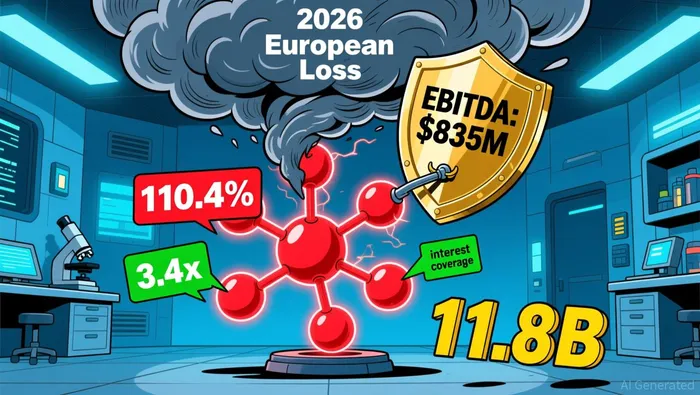 LyondellBasell's leverage remains a critical concern. With $11.8 billion in debt and a debt-to-equity ratio of 110.4%, the company's capital structure is heavily weighted toward debt. Yet, its interest coverage ratio of 3.4x-calculated using $835 million in EBITDA-suggests that operating income can cover interest expenses multiple times over. This metric provides some reassurance, but it masks the broader risks of high leverage, particularly as LYBLYB-- faces a $700–$900 million loss from the sale of European assets in 2026 according to financial analysis.
Dividend Sustainability: Payout Ratio and Strategic Priorities
The key to dividend sustainability lies in the payout ratio. LYB's Q3 dividend of $443 million consumed roughly 53% of its $835 million in EBITDA (excluding non-recurring items). While this ratio is not alarmingly high, it assumes that operating cash flow remains stable. The company's "Cash Improvement Plan," which aims to generate $600 million in 2025 savings and $1.1 billion by 2026, is critical to maintaining this balance. However, LYB's plan to reduce 2026 capital expenditures to $1.2 billion-a 20% cut from prior years-signals a shift toward cost discipline over growth according to earnings call. This strategy may preserve short-term cash flow but could undermine long-term competitiveness in a cyclical industry.
Risks on the Horizon: Asset Sales and Market Conditions
LyondellBasell's reliance on asset sales and write-downs to fund dividends introduces significant uncertainty. The $1.2 billion in non-cash impairments in Q3 2025 reflects deteriorating asset values, a trend that could accelerate in a weak demand environment, particularly in Europe. Additionally, the company's exposure to volatile feedstock costs and global economic slowdowns-factors it explicitly cited as headwinds-poses a risk to future earnings according to financial analysis. For investors, the question is whether LYB's current dividend is a bridge to a stronger future or a desperate bid to maintain shareholder returns amid declining fundamentals.
Conclusion: A High-Yield Gamble
LyondellBasell's 12% yield is tempting, but it comes with caveats. The company's strong operating cash flow and disciplined cost-cutting efforts provide a buffer for dividend payments. However, its high debt load, reliance on non-recurring gains, and exposure to macroeconomic risks suggest that the payout may not be as secure as it appears. For risk-tolerant investors who can stomach potential volatility, LYB offers a compelling reward. For others, the risks of a dividend cut or restructuring may outweigh the immediate benefits. As LYB navigates a challenging landscape, the sustainability of its yield will depend on its ability to execute its cost-reduction plans and adapt to shifting market conditions.





Comentarios
Aún no hay comentarios