
Lyft's Strategic Pivots and Valuation Dilemmas: Catalysts and Opportunities in Q3 2025
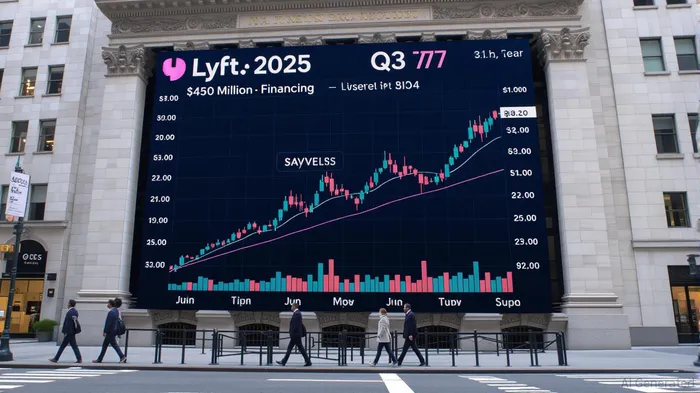
In the dynamic landscape of mobility tech, Lyft's recent stock performance underscores the interplay between strategic innovation and financial pragmatism. The company's 12.2% surge on September 17, 2025, following its partnership with Waymo to launch autonomous ride-hailing in Nashville by 2026[1], exemplifies how technological alliances can recalibrate market sentiment. This collaboration—leveraging Waymo's autonomous vehicles and Lyft's Flexdrive fleet management—positions the company at the forefront of the robotaxi revolution, a sector projected to grow exponentially in the coming decade[2].
Strategic Catalysts: Innovation and Capital Infusion
The Waymo partnership is not merely a PR win; it represents a structural shift in Lyft's value proposition. By integrating autonomous vehicles into its platform, LyftLYFT-- addresses a critical pain point in urban mobility: scalability. Autonomous fleets reduce labor costs and enhance operational efficiency, two metrics that have historically constrained ride-hailing profitability[3]. According to a report by The Economic Times, this move is “a game-changer for robotaxis and fleet management,” with analysts projecting a 15–20% revenue uplift for Lyft in 2026 as the service expands[4].
Complementing this innovation is Lyft's $450 million convertible senior notes offering on September 9, 2025[5]. While such debt raises eyebrows in an era of cautious capital allocation, the proceeds are earmarked for strategic initiatives and share repurchases—a dual strategy to fuel growth while signaling confidence to shareholders. This financial maneuver coincided with a 3.13% stock rally, reflecting investor optimism about near-term value creation[6].
Valuation Realities: Growth vs. Profitability
Despite these positives, Lyft's financials reveal a company still grappling with profitability. Its net margin of 2.54% and ROA of 0.73% lag behind industry benchmarks[7], while a debt-to-equity ratio of 1.05 highlights structural vulnerabilities[8]. These metrics contrast sharply with its lofty P/E ratio of 59.50, a figure that suggests the market is pricing in future growth rather than current earnings[9].
Analyst sentiment is similarly divided. A consensus “Hold” rating from 30 Wall Street analysts reflects skepticism about near-term profitability, with an average 12-month price target of $16.87 implying an 8.26% downside from current levels[10]. However, recent upgrades—such as Oppenheimer's 41.18% increase in its price target to $24.00—signal growing confidence in Lyft's long-term potential[11]. This divergence underscores the tension between short-term financial metrics and long-term strategic bets.
Navigating the Investment Landscape
For investors, Lyft presents a paradox: a high-growth story shackled by operational inefficiencies. The key lies in assessing whether the company's strategic moves—autonomous tech integration, capital raises—can catalyze a transition from growth-at-all-costs to sustainable profitability. Historical data offers mixed signals: while Q2 2025 revenue grew 10.6% year-over-year to $1.59 billion[12], earnings missed estimates by 40.7%[13].
A critical inflection point will be the 2026 rollout of the Waymo partnership. If successful, it could transform Lyft from a cost-inefficient ride-hailer into a tech-driven mobility platform, potentially unlocking higher valuations. Conversely, delays or integration challenges could exacerbate existing weaknesses.
Conclusion: Balancing Risk and Reward
Lyft's stock is a case study in the risks and rewards of disruptive innovation. The recent partnership with Waymo and capital infusion are compelling catalysts, but they must be weighed against persistent profitability challenges and a polarized analyst outlook. For risk-tolerant investors, the current valuation—despite its P/E premium—may offer asymmetric upside if the company executes its autonomous vision. For others, the path to profitability remains a work in progress.





Comentarios
Aún no hay comentarios