
Lyft's Shift from Growth to Profitability: A Billion-Dollar Signal from Wall Street
PorAinvest
miércoles, 20 de agosto de 2025, 3:33 pm ET2 min de lectura
LYFT--
Lyft's Q2 2025 results underscore a broader trend in the company's governance and strategic priorities. In 2025, Lyft restructured its governance by converting co-founders' super-voting shares to equal voting rights and appointing independent board chair Sean Aggarwal. This move aligns governance with institutional investor expectations and fosters a culture of disciplined execution under CEO David Risher's leadership [1]. The company's strategic pivot toward autonomous vehicles (AVs) is anchored in partnerships with Baidu and BENTELER Mobility, positioning it to capture early-mover advantage in the robotaxi market and expand its mobility ecosystem [1].
Lyft's financial momentum is evident in its Q2 2025 earnings report, which showed $1.59 billion in revenue, a 10.6% YoY increase. The company's forward guidance for Q3 2025 projects adjusted EBITDA of $125–$145 million, with gross bookings expected to reach $4.65–$4.80 billion. These metrics suggest a company in transition—from a growth-at-all-costs model to a profit-driven, innovation-led business [1].
Investment analysts have a mixed but optimistic outlook on Lyft. While some caution against its narrower focus compared to Uber, others highlight its strategic advantages. Morgan Stanley raised its 2026 EBITDA forecast, citing the company's AV partnerships and FreeNow integration [1]. RBC Capital and BofA Global Research have assigned positive ratings, with price targets implying 20–30% upside from current levels. The stock's forward P/E ratio of 12.5x and EBITDA margin of 3.0% by 2026 suggest an undemanding valuation relative to its growth ambitions [1].
For investors seeking exposure to the future of mobility, Lyft's 2025 transformation offers a rare combination of governance alignment, technological innovation, and financial discipline. The company's focus on electric and autonomous mobility also aligns with global decarbonization trends, offering long-term tailwinds [1]. However, risks remain, including regulatory delays in AV deployment and competitive pressure from Uber. Yet, Lyft's hybrid model—combining AVs with human drivers—offers flexibility to adapt to these challenges.
References:
[1] https://www.ainvest.com/news/lyft-strategic-leadership-transition-av-ambitions-chapter-ride-hailing-2508/
[2] https://seekingalpha.com/article/4814426-lyft-quality-name-that-offers-margin-of-safety-trading-at-a-reasonable-price
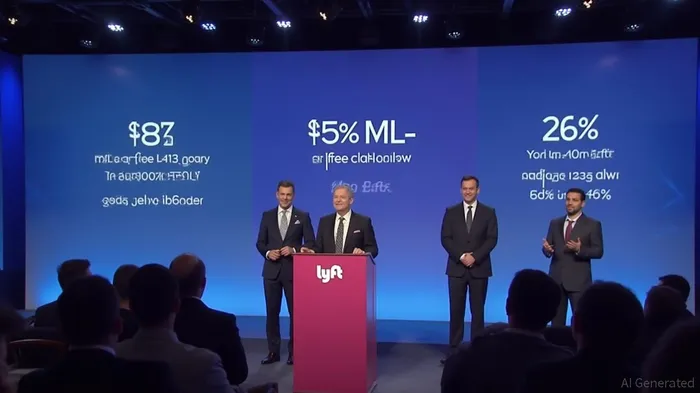
Lyft has shifted from a growth-at-all-costs model to one of disciplined profitability, with Q2 2025 results showing $329.4 million in free cash flow and a 26% YoY increase in adjusted EBITDA. The company's focus on operational controls and sustainable profitability has validated its business model and attracted Wall Street attention, with a recent 8% stock gain and increased bullish options activity. Lyft's financial strength is now being returned to shareholders through stock repurchases.
Lyft Inc. (NASDAQ: LYFT) has shifted its strategy from a growth-at-all-costs model to one focused on disciplined profitability, as evidenced by its Q2 2025 results. The company reported $329.4 million in free cash flow and a 26% year-over-year (YoY) increase in adjusted EBITDA, reflecting improved operational efficiency and cost discipline. This financial turnaround has validated Lyft's business model and garnered attention from Wall Street, leading to an 8% stock gain and increased bullish options activity. The company is now returning this financial strength to shareholders through stock repurchases.Lyft's Q2 2025 results underscore a broader trend in the company's governance and strategic priorities. In 2025, Lyft restructured its governance by converting co-founders' super-voting shares to equal voting rights and appointing independent board chair Sean Aggarwal. This move aligns governance with institutional investor expectations and fosters a culture of disciplined execution under CEO David Risher's leadership [1]. The company's strategic pivot toward autonomous vehicles (AVs) is anchored in partnerships with Baidu and BENTELER Mobility, positioning it to capture early-mover advantage in the robotaxi market and expand its mobility ecosystem [1].
Lyft's financial momentum is evident in its Q2 2025 earnings report, which showed $1.59 billion in revenue, a 10.6% YoY increase. The company's forward guidance for Q3 2025 projects adjusted EBITDA of $125–$145 million, with gross bookings expected to reach $4.65–$4.80 billion. These metrics suggest a company in transition—from a growth-at-all-costs model to a profit-driven, innovation-led business [1].
Investment analysts have a mixed but optimistic outlook on Lyft. While some caution against its narrower focus compared to Uber, others highlight its strategic advantages. Morgan Stanley raised its 2026 EBITDA forecast, citing the company's AV partnerships and FreeNow integration [1]. RBC Capital and BofA Global Research have assigned positive ratings, with price targets implying 20–30% upside from current levels. The stock's forward P/E ratio of 12.5x and EBITDA margin of 3.0% by 2026 suggest an undemanding valuation relative to its growth ambitions [1].
For investors seeking exposure to the future of mobility, Lyft's 2025 transformation offers a rare combination of governance alignment, technological innovation, and financial discipline. The company's focus on electric and autonomous mobility also aligns with global decarbonization trends, offering long-term tailwinds [1]. However, risks remain, including regulatory delays in AV deployment and competitive pressure from Uber. Yet, Lyft's hybrid model—combining AVs with human drivers—offers flexibility to adapt to these challenges.
References:
[1] https://www.ainvest.com/news/lyft-strategic-leadership-transition-av-ambitions-chapter-ride-hailing-2508/
[2] https://seekingalpha.com/article/4814426-lyft-quality-name-that-offers-margin-of-safety-trading-at-a-reasonable-price
Divulgación editorial y transparencia de la IA: Ainvest News utiliza tecnología avanzada de Modelos de Lenguaje Largo (LLM) para sintetizar y analizar datos de mercado en tiempo real. Para garantizar los más altos estándares de integridad, cada artículo se somete a un riguroso proceso de verificación con participación humana.
Mientras la IA asiste en el procesamiento de datos y la redacción inicial, un miembro editorial profesional de Ainvest revisa, verifica y aprueba de forma independiente todo el contenido para garantizar su precisión y cumplimiento con los estándares editoriales de Ainvest Fintech Inc. Esta supervisión humana está diseñada para mitigar las alucinaciones de la IA y garantizar el contexto financiero.
Advertencia sobre inversiones: Este contenido se proporciona únicamente con fines informativos y no constituye asesoramiento profesional de inversión, legal o financiero. Los mercados conllevan riesgos inherentes. Se recomienda a los usuarios que realicen una investigación independiente o consulten a un asesor financiero certificado antes de tomar cualquier decisión. Ainvest Fintech Inc. se exime de toda responsabilidad por las acciones tomadas con base en esta información. ¿Encontró un error? Reportar un problema


SOBRE NOSOTROS
Nuestra historiaAutores de noticiasBase de conocimientosPolítica de privacidadTérmino de usoDescargo de responsabilidad de corretaje de tercerosTérminos de uso de AIMEDivulgaciones de riesgos de AInvest AICarrerasCONTÁCTENOS
Email: support@ainvest.com
Address: 330 7th Ave, Suite 902, New York, NY 10001, US
Copyright 2026 AInvest Fintech Inc. All rights reserved.


Comentarios
Aún no hay comentarios