
Lyft's Insider Sales and Market Implications: A Deep Dive into Investor Sentiment and Sector Trends
The recent surge in insider stock sales at LyftLYFT--, Inc. (NASDAQ: LYFT) has sparked debate among investors about the implications for the company's stock price and broader market confidence. While insiders-including executives, directors, and trusts-have collectively sold over $58 million worth of shares in September 2025 through Rule 144 filings, the company's financial performance and the evolving ride-hailing sector suggest a nuanced picture. This analysis evaluates the interplay between insider sentiment, market fundamentals, and industry trends to determine whether these sales signal caution or are part of a broader strategic realignment.
Lyft's Insider Sales: A Closer Look
Lyft's insider activity in September 2025 has been both significant and concentrated. John Patrick Zimmer, a board member, filed to sell 2.43 million shares ($54.9 million) through Fidelity Brokerage Services LLC, while Erin M. Brewer, the CFO, sold 30,000 shares ($467,100) via Morgan Stanley, according to the StockTitan Form 144. These transactions, alongside sales by trusts and other executives, represent a net outflow of capital by insiders, with total shares sold exceeding 1.1 million, per MarketBeat insider trades.
Such activity often raises red flags, as insider selling can reflect pessimism about a company's short-term prospects. However, Lyft's insiders have also demonstrated a history of strategic selling, particularly through 10b5-1 trading plans, which automate sales based on predefined criteria. For example, Zimmer's recent sales align with a pre-announced plan, suggesting these transactions are part of long-term wealth management, according to a WhaleWisdom filing.
Market Fundamentals: A Strong Foundation
Despite the insider sales, Lyft's financial performance in 2025 has been robust. The company reported $1.6 billion in Q2 revenue, an 11% year-over-year increase, and a $40.3 million net profit, up from $5 million in Q2 2024, according to a Morningstar report. Its share repurchase program, expanded to $750 million, and strategic acquisitions like Freenow (€204 million) underscore management's confidence in capital allocation. Analysts have also upgraded their price targets, with Wells Fargo raising LYFT's target to $16.00 and Canaccord Genuity to $18.00, reflecting optimism about its growth trajectory, according to a QuiverQuant note.
The ride-hailing sector itself is on a growth path, with the global market projected to expand from $181.72 billion in 2025 to $441.20 billion by 2032 (CAGR of 13.5%), according to Coherent Market Insights. Key drivers include electric vehicle (EV) adoption, autonomous vehicle (AV) partnerships, and micro-mobility integration. Lyft's commitment to sustainability-such as its EV fleet expansion and partnerships with Baidu and United Airlines-positions it to benefit from these trends (Morningstar).
Sector Comparisons: How Lyft Stacks Up
To contextualize Lyft's insider activity, it's instructive to compare it with industry peers. Uber, for instance, has maintained a dominant market share (67.5% globally) and demonstrated stronger earnings consistency, partly due to diversified revenue streams like Uber Eats, as noted in a Fundo comparison. However, Uber's insiders have also engaged in strategic selling, with no single transaction matching the scale of Zimmer's LYFT sale. Didi Global, meanwhile, faces regulatory headwinds in China but has seen insider buying increase as it navigates market share recovery, according to TGM Research.
Lyft's insider sales, while notable, are not anomalous in the sector. For example, Tesla insiders sold $200 million in shares in 2025, yet the company's stock price remained resilient due to its technological leadership and growth prospects, according to an iLoveTesla analysis. Similarly, Lyft's sales appear to reflect personal financial planning rather than a lack of confidence in its core business.
Stock Price Reactions and Analyst Insights
Lyft's stock price has shown mixed signals around the insider sales. On September 3, LYFT closed at $17.24 after CFO Erin Brewer sold 15,000 shares, while the stock rose to $20.00 on September 15 following Zimmer's 10b5-1 sales (QuiverQuant). Analysts attribute this resilience to broader market optimism about the ride-hailing sector and Lyft's improving margins. For instance, forecast models predict LYFT could reach $25.46 by October 2025, a 16.7% increase from its projected opening price of $21.82 (LongForecast).
However, some analysts caution against over-optimism. Shyam Patil of Susquehanna recently lowered LYFT's price target to $14.00 from $18.00, citing risks like rising insurance costs and the end of the Delta partnership (QuiverQuant). These challenges highlight the need for investors to balance insider activity with a critical evaluation of Lyft's operational efficiency and competitive positioning.
Conclusion: Navigating the Signal Amid the Noise
Lyft's insider sales in September 2025 are significant but must be interpreted in context. While the sheer volume of shares sold raises questions, the use of 10b5-1 plans and the company's strong financial performance suggest these transactions are part of long-term strategic planning rather than a lack of confidence. The ride-hailing sector's growth trajectory-driven by EVs, AVs, and micro-mobility-further supports a bullish outlook for LYFT, provided the company executes on its sustainability and expansion goals.
For investors, the key takeaway is to look beyond the headlines. Insider selling is a common practice, especially in high-growth sectors, and should be evaluated alongside fundamentals. Lyft's ability to maintain profitability, innovate in sustainability, and navigate regulatory challenges will ultimately determine whether these sales are a blip or a warning sign. 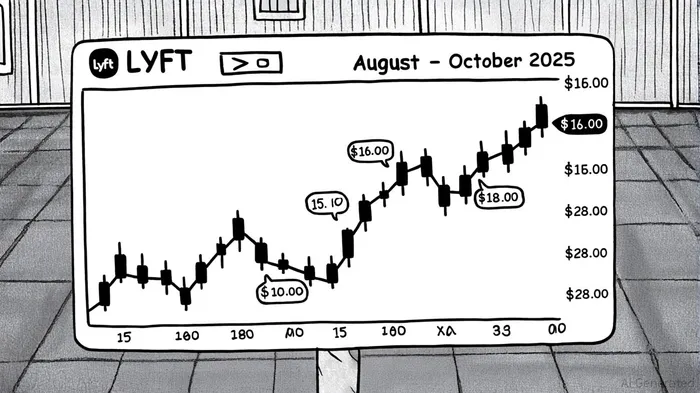





Comentarios
Aún no hay comentarios