
Lyft's Foray into Autonomous Rides in Atlanta: Strategic Positioning in the Autonomous Mobility Race
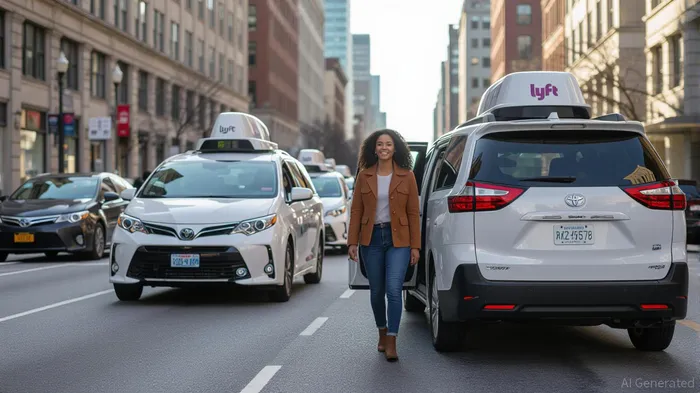
Lyft's recent foray into autonomous rides in Atlanta has sparked a critical question for investors: Can this asset-light, partnership-driven strategy outpace the tech-first approaches of Waymo and UberUBER-- in the high-stakes race for autonomous mobility dominance? The answer lies in Lyft's ability to balance innovation, scalability, and regulatory agility while navigating the competitive landscape shaped by giants like Alphabet's Waymo and Uber's evolving partnerships.
Strategic Positioning: Partnerships Over In-House Development
Lyft's approach to autonomous vehicles (AVs) is a masterclass in leveraging external expertise. By partnering with May Mobility, MobileyeMBLY--, and BaiduBIDU-- Apollo Go, the company avoids the capital-intensive pitfalls of in-house R&D. For instance, its collaboration with May Mobility in Atlanta—a pilot involving retrofitted ToyotaTM-- Sienna minivans—has already demonstrated operational feasibility. These vehicles, equipped with 360-degree sensor suites and managed by May Mobility, operate within a 7-square-mile area, with fares comparable to traditional rides. This phased rollout, starting with a small fleet and scaling to hundreds of vehicles, mirrors a cautious yet scalable strategy.
In contrast, Waymo's in-house development has led to a fleet of 1,500+ robotaxis by 2025, but at a cost of $175,000 per unit. While Waymo's sixth-generation AVs outperform 99% of Uber's human drivers in trip productivity, their high unit costs limit scalability. Uber, meanwhile, has pivoted to a partnership model after selling its Advanced Technologies Group (ATG) to Aurora. Its “Waymo on Uber” model in Austin and Atlanta leverages existing AV tech but lacks the proprietary control of Waymo.
Lyft's asset-light model offers a middle ground. By outsourcing AV development to partners like May Mobility and Mobileye, it reduces upfront costs while maintaining platform control. This strategy aligns with its broader vision of a hybrid network where AVs and human drivers coexist, addressing both technological and human-centric use cases.
Technological Readiness: A Phased, Community-Focused Rollout
Lyft's Atlanta pilot is a testament to its focus on rider trust and operational safety. The inclusion of in-vehicle operators during the initial phase—gradually phased out as technology matures—addresses public skepticism. This approach mirrors Waymo's cautious deployment but with a key difference: Lyft's integration of AVs into its existing app ecosystem. Riders can hail autonomous vehicles alongside traditional rides, creating a seamless user experience.
Technologically, Lyft's partnerships are paying dividends. May Mobility's Multi-Policy Decision Making (MPDM) platform, which mimics human reasoning, is a strong differentiator. Meanwhile, Mobileye's Drive technology, set to power Dallas deployments by 2026, offers cost-effective solutions for urban environments. These partnerships position LyftLYFT-- to scale AVs without sacrificing safety or user experience.
However, challenges remain. Unlike Waymo's fully driverless operations in Phoenix and San Francisco, Lyft's AVs still require human oversight in complex scenarios. This could slow adoption in unpredictable environments like heavy rain or construction zones.
Regulatory Environment: Navigating a Fragmented Landscape
Regulatory hurdles are a wildcard for all AV players, but Lyft's focus on Atlanta and European markets offers a strategic edge. In the U.S., the company has engaged local officials and held AV Driver Forums to build community buy-in—a critical step in regions where AVs face public resistance. In Europe, Lyft's acquisition of FREENOW—a multi-mobility platform operating in 150 cities—provides access to a fragmented but growing market. The company's partnership with Baidu Apollo Go to deploy electric AVs in Germany and the UK by 2026 aligns with European decarbonization goals and EV subsidies, such as Germany's €9,000 incentives for electric fleets.
Yet, regulatory delays and data privacy concerns (e.g., GDPR compliance) could slow expansion. Uber's struggles with driver classification lawsuits and Waymo's high costs highlight the risks of overreliance on automation. Lyft's hybrid model, which retains human drivers for complex tasks, may mitigate these risks while maintaining regulatory flexibility.
Valuation Implications: A Long-Term Play with Near-Term Catalysts
Lyft's Q2 2025 revenue of $1.59 billion—a 11% year-over-year increase—shows its core ride-hailing business remains resilient. However, the real value lies in its AV partnerships. By 2026, the company aims to deploy thousands of AVs globally, including Holon shuttles in the U.S. and Baidu-powered vehicles in Europe. These initiatives could reduce per-ride costs and unlock new revenue streams, such as first-mile/last-mile logistics and airport shuttles.
Investors should watch for key metrics:
1. AV Deployment Costs: If partnerships with Marubeni and Mobileye reduce unit costs below Waymo's $175,000, Lyft's scalability could outpace competitors.
2. Regulatory Timelines: Delays in European AV approvals could impact 2026 expansion plans.
3. Driver Retention: Lyft's emphasis on hybrid networks must balance AV efficiency with driver satisfaction to avoid attrition.
Investment Thesis: A Cautious Bull Case
Lyft's strategy is not without risks—EV tariffs, regulatory delays, and competition from Waymo and Uber loom large. However, its asset-light model, strategic partnerships, and focus on hybrid mobility position it as a long-term winner in the autonomy economy. For investors, the key is patience: AVs are a multi-year play, but Lyft's phased approach and regulatory agility make it a compelling bet.
Actionable Advice: Consider a cautious buy for long-term horizons, with a focus on 2026 milestones (e.g., Dallas and European AV rollouts). Monitor partnerships with Mobileye and Baidu, as well as regulatory updates in key markets. For now, Lyft's stock offers exposure to the future of mobility without the near-term volatility of pure-play AV companies.
In the race for autonomous dominance, Lyft's blend of pragmatism and innovation could prove to be its greatest asset.





Comentarios
Aún no hay comentarios