
LVMH's Strategic Reinvention: How the Luxury Titan is Weathering the Post-Pandemic Storm
The luxury sector has long been a barometer for global economic health, and LVMH Moët Hennessy Louis Vuitton (LVMH) has once again proven why it's the industry's undisputed leader. Despite a 4% revenue decline in the first half of 2025 compared to the same period in 2024, the company's 22.6% operating margin and €9 billion in recurring profits underscore its ability to navigate macroeconomic headwinds, as LVMH reported in its investor release. But what's truly remarkable is how LVMH has recalibrated its strategy to align with shifting consumer sentiment and the slow but steady recovery of discretionary spending post-pandemic. Let's break down the playbook.
Digital Transformation: The New Silk Road
LVMH's $1.3 billion investment in information and communication technology (ICT) in 2023 isn't just a number-it's a declaration of war on the analog past, according to a GlobalData report. By partnering with Google Cloud to refine demand forecasting and optimize inventory, the company has slashed inefficiencies while boosting agility. Louis Vuitton's foray into the metaverse, where it launched virtual campaigns and NFTs, isn't a gimmick; it's a calculated move to engage Gen Z and millennials, who crave digital-first experiences, a point the GlobalData report also highlights. These efforts are paying off: online sales, projected to account for one-third of the luxury market by 2030, are now a cornerstone of LVMH's growth strategy, according to a 1xmarketing analysis.
Brand Collaborations: The Youth Premium
The luxury market's lifeblood is desirability, and LVMH has mastered the art of staying relevant. Collaborations like Dior x ERL and Louis Vuitton's streetwear partnerships aren't just about short-term sales-they're about embedding the brand in the cultural zeitgeist of younger consumers, as noted in the 1xmarketing analysis. According to LVMH's investor release, these alliances have helped LVMH limit damage to its Fashion & Leather Goods division, which saw a 7% sales drop while some competitors fared worse. The key insight? For millennials and Gen Z, luxury isn't just about status; it's about identity and community.
Asia's Resurgence: Beyond China
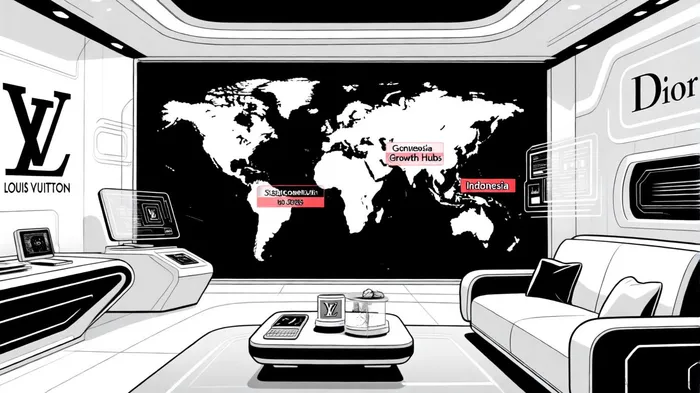
While China's recovery has lagged, LVMH has pivoted to India and Indonesia, where rising high-net-worth populations are driving demand, the 1xmarketing analysis observes. New stores, localized marketing, and celebrity ambassadors (think Bollywood stars for India) are paying dividends. This geographic diversification is critical: as the Wines & Spirits division struggles in the West, Asia's appetite for premium goods acts as a buffer, a trend LVMH's investor release also points to.
Sustainability as a Profit Center
The Heristoria platform, which promotes a circular economy through vintage and pre-owned goods, isn't just ethical-it's economic. By tapping into the $30 billion secondhand luxury market, LVMH is future-proofing its revenue streams while aligning with consumers' growing environmental consciousness, a strategy underscored by the 1xmarketing analysis. This dual-purpose strategy is a masterstroke, blending ESG goals with profit motives.
The Bottom Line: Resilience in a Fragile World
LVMH's success isn't accidental. It's the result of a multi-pronged strategy that addresses both the how and why of modern luxury consumption. While inflation and economic uncertainty have dampened discretionary spending, LVMH's digital-first approach, cultural agility, and geographic diversification have insulated it from the worst. For investors, this is a company that doesn't just ride the luxury wave-it creates the wave.







Comentarios
Aún no hay comentarios