
LVMH's Nine-Month Revenue Decline: A Signal or a Slip?
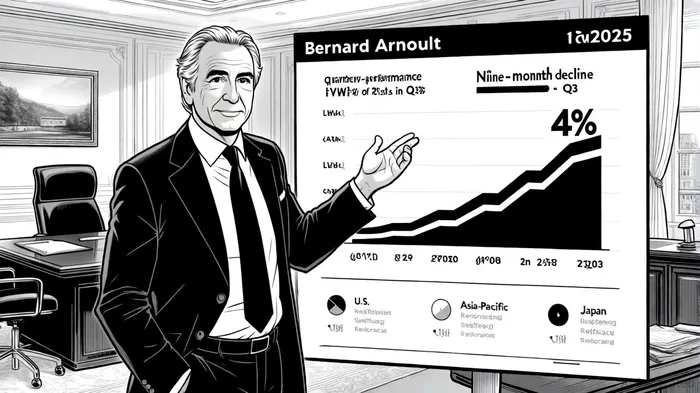
The luxury goods sector has long been a barometer of global economic confidence, and LVMH Moët Hennessy Louis Vuitton's nine-month revenue decline of 4% in 2025 has sparked debate about whether this reflects a broader industry slowdown or a temporary misstep for the world's largest luxury group. While the first-half results were weighed down by a challenging macroeconomic environment and a weak Japanese market, the third-quarter rebound-marked by a 1% organic revenue increase-suggests resilience in key segments and regions. For investors, the question is whether this decline is a warning sign or a short-term blip in a sector still underpinned by strong long-term brand value.
A Mixed Picture: Q3 Resilience Amid Broader Weakness
LVMH's third-quarter performance defied expectations, with organic revenue growth of 1% driven by outperforming segments like Watches & Jewelry (+2%) and Wines & Spirits (+1%), according to a DFNI report. The Fashion & Leather Goods division, which includes Louis Vuitton and Christian Dior, saw a 2% sales decline-better than the forecasted 4% drop-thanks to "good resilience with local customers," the report added. This contrast between the nine-month decline and Q3 improvement highlights the uneven nature of the luxury market's current dynamics.
Regionally, the U.S. and Asia-Pacific (excluding Japan) posted 3% and 2% organic growth, respectively, while Japan's 13% slump-linked to a strong 2024 tourism-driven base and a weaker yen-dragged on overall results, the DFNI report noted. These regional disparities underscore the importance of local demand in an era where global macroeconomic volatility and shifting consumer priorities are reshaping the luxury landscape.
Broader Industry Trends: A Sector at a Crossroads
The luxury market's broader slowdown is well-documented. A McKinsey report notes that the sector's historical 5% compound annual growth rate (2019–2023) has contracted to 1–3% projections for 2024–2027, driven by price sensitivity, weakened aspirational demand, and economic instability in key markets like China. Meanwhile, North America is emerging as a bright spot, with Bain & Company forecasting the region's luxury goods market to reach $197.08 billion by 2033; Bain also highlights a rise of experiential luxury (e.g., private jets, high-end travel) in early 2025 that suggests shifting consumer priorities.
LVMH's performance aligns with these trends. While Chinese demand-once an 18% annual growth driver-has flattened, the group's focus on local European and U.S. markets has cushioned its decline.
Strategic Strengths: Brand Equity and Innovation
Despite the near-term challenges, LVMH's long-term prospects remain robust. The group's operating margin of 22.6% in the first half of 2025-despite a 4% revenue drop-demonstrates pricing power and cost discipline, according to reporting on the results. CEO Bernard Arnault has emphasized the enduring value of LVMH's "iconic brands" and its commitment to innovation and quality in an LVMH statement, which remain critical in an industry grappling with overexposure and eroded exclusivity.
The company's investments in digitalization and sustainability also position it to adapt to evolving consumer expectations. For instance, AI-driven personalization and virtual shopping experiences are becoming key differentiators, and LVMH's early adoption of these technologies could reinforce its market leadership, the company has argued.
Conclusion: A Slip, Not a Signal
LVMH's nine-month revenue decline is a symptom of broader macroeconomic and consumer shifts rather than a fundamental weakness in its business model. The third-quarter rebound, coupled with the group's strategic focus on brand excellence, digital innovation, and regional diversification, suggests that the decline is a temporary setback rather than a long-term trend. For investors, the key takeaway is that LVMH's deep brand equity and operational agility provide a strong foundation to navigate the current slowdown and emerge stronger in a redefined luxury market.







Comentarios
Aún no hay comentarios