
LUNR: Positioning for a Lunar Boom in Trump's Space Policy Era
The Trump administration's sweeping executive order, Ensuring American Space Superiority, has redefined the trajectory of U.S. space exploration, with lunar infrastructure and commercial development at its core. Central to this policy is a 2028 deadline for returning American astronauts to the Moon and establishing the "initial elements of a permanent lunar outpost" by 2030, alongside the deployment of nuclear reactors for energy production on the lunar surface according to Breaking Defense. For companies like Intuitive MachinesLUNR-- (trading under the ticker LUNR), this represents a seismic shift in opportunity. 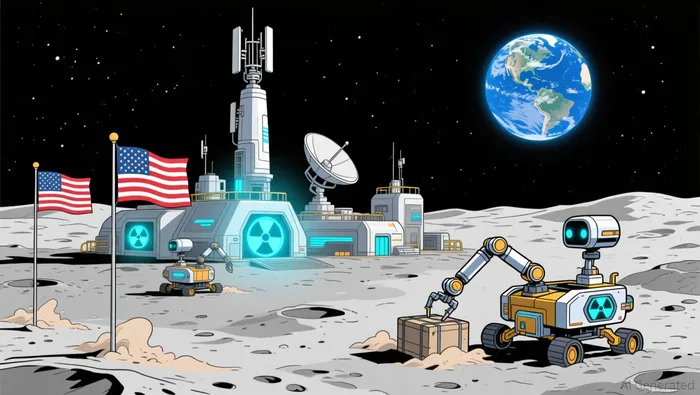 With a portfolio of government contracts, strategic acquisitions, and partnerships aligned with the administration's lunar ambitions, LUNRLUNR-- is uniquely positioned to capitalize on what could become a multidecade boom in space infrastructure.
Strategic Alignment with Government Contracts
LUNR's recent $8.2 million contract extension from the U.S. Air Force Research Laboratory (AFRL) to develop next-generation nuclear power systems for lunar infrastructure underscores its direct alignment with Trump's policy priorities according to Yahoo Finance. This builds on a prior $9.5 million AFRL program, signaling sustained federal confidence in the company's technological capabilities. Similarly, a $2.5 million NASA contract under the NextSTEP Appendix R initiative to advance lunar logistics and surface mobility further cements LUNR's role in enabling the administration's 2028 Moon landing and 2030 lunar outpost goals. These contracts are not isolated wins but part of a broader strategy to streamline procurement and prioritize commercial solutions, as outlined in the executive order.
Expanding Capabilities Through Acquisitions and Partnerships
LUNR's acquisition of Lanteris Space Systems in 2025 for $800 million has expanded its footprint beyond lunar landers into deep-space navigation and communication systems according to Reuters. This move aligns with the administration's emphasis on developing a commercial successor to the International Space Station and ensuring robust lunar communication networks according to the White House. Additionally, a strategic cooperation agreement with Leonardo and Telespazio to enhance interoperable lunar communication and navigation systems highlights LUNR's ability to integrate into a global supply chain of lunar infrastructure as reported by Intuitive Machines. Such partnerships are critical for meeting the Trump policy's aggressive timelines, which require not only technological innovation but also rapid scaling of industrial capacity.
Policy-Driven Growth and Market Potential
The administration's goal of attracting $50 billion in private investment in American space markets by 2028 according to Satellite Today creates a fertile environment for companies like LUNR. By reducing the cost of lunar access-demonstrated through successful landings at the lunar south pole in 2024 and 2025-LUNR is positioning itself as a key enabler of both government and commercial lunar activity as detailed in Intuitive Machines' press release. The policy's focus on nuclear reactors for lunar energy also opens new revenue streams, as LUNR's AFRL collaboration suggests the company is already pivoting to meet this demand as reported in Intuitive Machines' announcement.
Risks and Challenges
While the policy's ambitions are clear, the pace of execution remains a wildcard. The 2028 Moon landing deadline is notably aggressive, and technical hurdles-such as developing reliable nuclear reactors for the lunar surface-could delay timelines. Additionally, LUNR's reliance on government contracts exposes it to shifts in political priorities or budget constraints. However, the administration's explicit commitment to commercial partnerships and its directive for federal agencies to address supply chain gaps within 90 days as stated in the executive order suggest a strong likelihood of continued support.
Conclusion
LUNR's strategic alignment with Trump's lunar policy-from its government contracts and technological innovations to its expanding partnerships-positions it as a prime beneficiary of the administration's space agenda. As the U.S. accelerates its push for lunar dominance, companies that can deliver scalable, cost-effective solutions will thrive. For investors, LUNR represents not just a bet on a single firm but a stake in the broader infrastructure revolution that will underpin America's return to the Moon.







Comentarios
Aún no hay comentarios