
Lundin Mining: Strategic Rotation and Long-Term Copper Growth Catalysts
In an era of surging demand for copper driven by the global energy transition, Lundin Mining (TSX: LM) has positioned itself as a compelling case study in disciplined capital allocation and strategic resource development. The company's dual focus on low-cost brownfield expansion and the high-impact Vicuña Project-a joint venture with BHP-offers a rare combination of near-term operational efficiency and long-term growth potential. For investors seeking exposure to copper's structural tailwinds, Lundin's roadmap merits close scrutiny.
Low-Cost Expansion: The Foundation of Sustainable Growth
Lundin's 2025 guidance underscores its commitment to maintaining a low-cost base while scaling production. The company forecasts a consolidated C1 cash cost of $1.95–$2.15 per pound of copper, with individual sites like Chapada (C1 cash cost of $1.10–$1.30/lb) and Candelaria ($1.80–$2.00/lb) reinforcing its competitive positioning according to operational reports. These metrics are not merely cost benchmarks but strategic levers. By optimizing underground mining at Candelaria and enhancing oxide leaching at Caserones, Lundin aims to boost copper output by 10% and 7,000–10,000 tonnes annually, respectively as highlighted in company updates. Such brownfield initiatives require relatively modest capital-$530 million of 2025's total $795 million capex budget is earmarked for sustaining expenditures-while delivering material production gains as reported in guidance.
This approach aligns with a broader industry trend: miners prioritizing operational efficiency to hedge against commodity price volatility. Lundin's 2025 exploration budget of $40 million further illustrates this logic, targeting resource growth at its core assets to extend mine life and reduce reliance on external price swings according to company guidance. For capital-constrained investors, the company's ability to generate incremental output without commensurate capital intensity is a critical differentiator.
Vicuña Project: A Transformational Catalyst
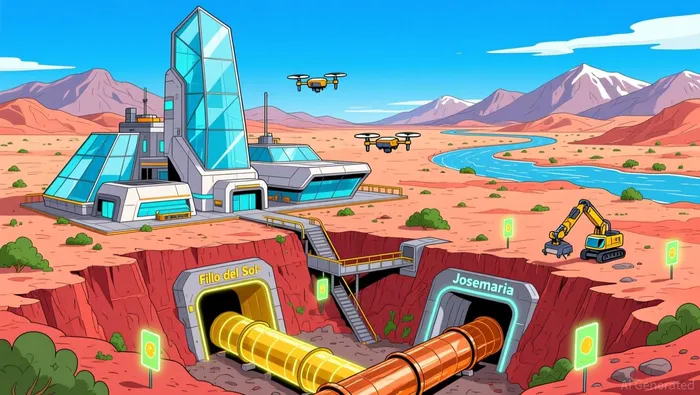 . While low-cost expansion provides stability, the Vicuña Project represents a quantum leap in scale. This 50/50 joint venture with BHP encompasses the Filo del Sol and Josemaria deposits in Argentina, which according to company updates collectively host one of the world's largest copper, gold, and silver resources. The project's potential to become a globally ranked mining complex is not speculative; it is underpinned by parallel technical studies and as reported in Q3 2025 results a projected integrated technical study completion by Q1 2026.
The 2025 capital allocation for Vicuña-$265 million of the $795 million expansionary capex-reflects its strategic centrality according to guidance. This funding supports drilling, engineering, and permitting activities, all critical to de-risking a project that could redefine Lundin's production profile. Notably, Vicuña Corp. recently applied for inclusion under Argentina's RIGI regime. If approved, this would provide fiscal and regulatory stability, mitigating a key jurisdictional risk in a country historically prone to policy shifts.
The project's significance extends beyond copper. With gold and silver by-products, Vicuña could diversify Lundin's revenue streams, enhancing resilience during periods of copper price weakness. For context, the combined resource base is comparable to some of the world's largest copper projects, suggesting the potential to elevate Lundin into the top ten global producers-a stated goal for 2025.
Strategic Alignment and Capital Reallocation Logic
Lundin's strategy exemplifies the "rotation" thesis gaining traction in the mining sector: shifting capital from high-cost, marginal projects to low-cost, high-margin assets with clear growth trajectories. The company's 2025 capex split-$530 million sustaining, $265 million expansionary-demonstrates a balanced approach. While sustaining expenditures preserve operational cash flow, the Vicuña allocation ensures exposure to a multi-gigaton copper resource as outlined in operational reports.
This duality is particularly attractive in a capital-starved sector. By leveraging BHP's co-ownership in Vicuña, Lundin mitigates upfront capital requirements while retaining upside potential. For shareholders, this structure reduces downside risk compared to standalone greenfield projects. Meanwhile, the company's emphasis on disciplined spending-evidenced by its $40 million exploration budget-ensures that growth is not pursued at the expense of balance sheet health according to industry analysis.
Risks and Considerations
No investment thesis is without caveats. Vicuña's permitting process, though advanced, remains subject to regulatory delays or community opposition. Additionally, Argentina's economic volatility-marked by inflation and currency controls-could complicate long-term planning. However, the RIGI application as reported in company updates and the project's joint-venture structure provide partial hedges against these risks.
On the cost front, Lundin's 2025 C1 cash cost guidance assumes stable commodity prices and exchange rates. A sharp rise in energy or reagent costs could pressure margins, though the company's low base costs offer a buffer. Investors should monitor quarterly reports for signs of operational stress.
Conclusion: A Dual-Engine Growth Model
Lundin Mining's strategic rotation-from high-cost marginal producers to low-cost, high-margin assets-positions it as a prime beneficiary of the copper supercycle. The Vicuña Project, with its potential to become a top-tier mining complex, is the linchpin of this strategy. For investors, the company's disciplined capital allocation, transparent guidance, and jurisdictional safeguards make it an attractive candidate for capital reallocation in the copper sector. As the integrated technical study for Vicuña nears completion in early 2026, the next phase of this growth story will likely unfold with clarity and conviction.







Comentarios
Aún no hay comentarios