
Lumos Diagnostics' Strategic Partnership with WellStreet and Its Implications for Market Growth
The diagnostics sector is witnessing a transformative shift as companies leverage strategic partnerships to unlock new value in decentralized healthcare. Lumos Diagnostics (ASX: LDX) has positioned itself at the forefront of this movement with its recent collaboration with WellStreet Urgent Care, a partnership that could redefine the commercial trajectory of its flagship product, FebriDx®. By aligning with WellStreet-a national urgent care network with 140 U.S. locations-Lumos is not only accelerating the deployment of its rapid host-response test but also creating a blueprint for scalable, evidence-based reimbursement strategies in a fragmented healthcare landscape.
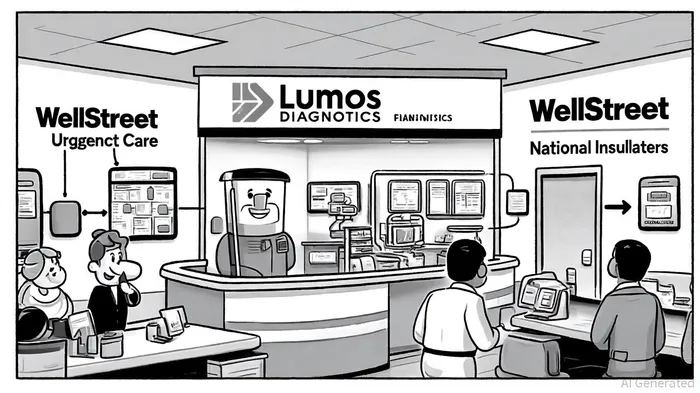
Partnership Structure and Operational Synergy
According to a Proactive Investors report, Lumos and WellStreet have initiated a joint venture with Piedmont Urgent Care in Atlanta, Georgia, to pilot FebriDx at a high-volume site treating approximately 50 respiratory-infection patients daily. This collaboration is designed to generate real-world data to refine operational workflows and payer engagement. WellStreet will procure the tests through PHASE Scientific and submit reimbursement claims, while Prospectus will handle billing and claims analysis to evaluate outcomes. This division of labor underscores a strategic alignment of capabilities: Lumos brings its cutting-edge diagnostic technology, while WellStreet contributes its extensive network and reimbursement expertise.
The partnership's immediate goal is to establish robust evidence for national insurers to adopt coverage policies for FebriDx. This is critical in a sector where reimbursement barriers often stifle innovation. By demonstrating the test's clinical utility and cost-effectiveness in a real-world setting, Lumos and WellStreet aim to create a self-sustaining pathway for broader adoption.
CLIA Waiver Milestone and Market Expansion
A pivotal enabler of this partnership is Lumos' recent submission of a CLIA waiver application for FebriDx to the U.S. Food and Drug Administration (FDA) on September 10, 2025, according to a JHConline report. Data from JHConline indicates that the clinical study supporting this submission exceeded performance targets, with 99.1% concordance for bacterial-positive patients and 98.4% for non-bacterial patients between trained and untrained operators. This high level of accuracy and ease of use positions FebriDx for deployment in decentralized settings such as physician offices and urgent care clinics-a market Lumos estimates to exceed $1 billion by 2025.
The CLIA waiver, if approved, would eliminate regulatory hurdles for point-of-care testing, enabling rapid scaling. As stated by Lumos in its press release, the waiver is a "cornerstone for nationwide commercialization," with the potential to expand the test's addressable market from specialized labs to over 140 WellStreet locations. This regulatory milestone also validates the test's reliability, a critical factor for insurers and providers hesitant to adopt new technologies without proven operational simplicity.
Market Implications and Growth Potential
The partnership's long-term value lies in its ability to create a flywheel effect: data from the Atlanta pilot will inform payer negotiations, while the CLIA waiver will unlock new distribution channels. If successful, this model could be replicated across WellStreet's network, accelerating FebriDx's penetration into the $10 billion respiratory diagnostics market.
A key metric to watch is the reimbursement rate achieved through Prospectus's claims analysis. High reimbursement rates would not only validate the test's economic value but also incentivize other insurers to follow suit. Additionally, the partnership's focus on respiratory infections-a category with significant antibiotic overuse-aligns with payer priorities to reduce healthcare costs and combat antimicrobial resistance.
Conclusion
Lumos Diagnostics' partnership with WellStreet exemplifies how strategic alliances can drive value creation in the diagnostics sector. By combining innovative technology with operational expertise and regulatory milestones, the collaboration addresses critical barriers to adoption-reimbursement, scalability, and ease of use. As the CLIA waiver process unfolds and the Atlanta pilot generates actionable insights, investors should closely monitor reimbursement outcomes and market expansion metrics. If these align with expectations, the partnership could catalyze a paradigm shift in how rapid diagnostics are integrated into mainstream healthcare, positioning Lumos as a leader in the decentralized diagnostics revolution.







Comentarios
Aún no hay comentarios