
Luminar Technologies: Strategic Restructuring, Leadership Shift, and Path to Profitability in a High-Stakes LiDAR Market
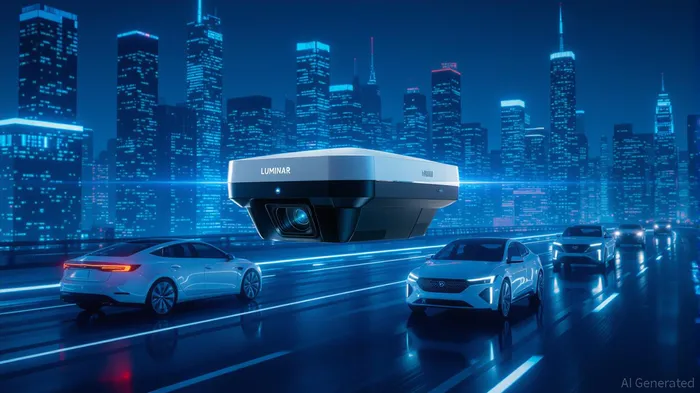
The autonomous vehicle (AV) ecosystem is a high-stakes arena where technological innovation, operational agility, and financial discipline collide. Luminar TechnologiesLAZR-- (NASDAQ: LAZR), a key player in the LiDAR market, has recently undergone a seismic shift in leadership and strategy, raising critical questions about its ability to navigate a volatile industry and restore investor confidence. This article examines Luminar's operational and financial transformation, evaluates its strategic pivot under new CEO Paul Ricci, and assesses the company's potential to create long-term value in a market defined by rapid disruption.
Leadership Transition: A Strategic Reset
Luminar's abrupt leadership change in May 2025 marked a pivotal moment. Founder and former CEO Austin Russell resigned following an ethics inquiry, leaving a void in both vision and operational continuity. His departure, while not directly impacting financial results, cast uncertainty over the company's R&D pipeline and key product milestones, such as the Halo LiDAR platform. The board's swift appointment of Paul Ricci—a seasoned executive with a 19-year tenure at Nuance Communications, where he scaled the company to $2 billion in revenue—signals a deliberate shift toward operational rigor and commercial execution.
Ricci's track record in transforming Nuance into a global leader in speech and AI solutions suggests a focus on streamlining operations, accelerating time-to-market, and fostering strategic partnerships. His emphasis on “operational excellence” and “innovation” aligns with Luminar's need to balance technical ambition with financial prudence. However, the challenge lies in reconciling Ricci's operational expertise with the technical vision required to maintain Luminar's edge in LiDAR innovation.
Financial Restructuring: Cost-Cutting and Liquidity Management
Luminar's financial strategy in 2025 has centered on aggressive cost reduction and liquidity preservation. The company announced a new round of layoffs in May 2025, adding to a 30% workforce reduction in 2024. These measures, while painful, aim to align expenses with business priorities and improve free cash flow. Q1 2025 results reflected progress: free cash flow improved to -$44 million from -$62 million in Q4 2024, and non-GAAP operating expenses were trimmed to the low $30 million range per quarter.
Luminar's liquidity position remains a critical factor. As of Q1 2025, the company held $188 million in cash and liquidity, with access to an additional $50 million in undrawn credit facilities. This runway, combined with a revised 2025 revenue guidance of 10–20% growth, suggests a disciplined approach to capital management. However, the company still requires up to $100 million in additional capital to achieve profitability, a hurdle that could test investor patience.
Strategic Reorientation: The Halo Platform and Market Positioning
Luminar's pivot to the Halo LiDAR platform represents a strategic reorientation. By consolidating its product architecture around Halo, the company aims to reduce development costs, accelerate production timelines, and standardize offerings for automakers. This shift is critical in an industry where customization has historically inflated costs and delayed scalability.
The Halo platform's adoption by OEMs like Volvo and Mercedes-Benz underscores its commercial viability. Luminar's 1550 nm wavelength technology, which delivers 17 times more photon density than traditional 905 nm systems, positions it as a leader in high-performance LiDAR. However, the success of Halo hinges on its ability to convert prototypes into production contracts and demonstrate cost efficiency at scale.
Investor Sentiment: Volatility and Cautious Optimism
Luminar's stock has been a rollercoaster for investors. Despite a 5.08% rise during regular trading hours following Q1 2025 earnings, the stock fell 3.15% in after-hours trading, reflecting skepticism about revised guidance. The company's 83% decline over the past year—a beta of 2.06—highlights its sensitivity to market fluctuations and sector-specific risks.
The downward revision of FY2025 revenue guidance from $82M–$90M to $67M–$74M, coupled with a 12% post-earnings drop, underscores the challenges of balancing ambition with execution. Yet, the strategic focus on Halo, cost discipline, and partnerships with major automakers offers a foundation for renewed confidence.
Path to Profitability: Risks and Opportunities
Luminar's path to profitability is fraught with risks. Legal challenges, including securities lawsuits tied to Russell's conduct, could drain resources. Additionally, the LiDAR market is intensely competitive, with rivals like Velodyne and InnovizINVZ-- vying for market share. Macroeconomic pressures, such as supply chain disruptions and regulatory scrutiny, further complicate the outlook.
However, the company's strengths—superior LiDAR technology, strategic OEM partnerships, and a leaner cost structure—position it to capitalize on the growing demand for Level 2+ and Level 3+ autonomous systems. The expansion into commercial trucking and robo-taxi markets, bolstered by the acquisition of Civil Maps' mapping assets, diversifies revenue streams and reduces reliance on the passenger vehicle segment.
Investment Implications
For investors, LuminarLAZR-- represents a high-risk, high-reward proposition. The company's strategic restructuring and leadership shift under Ricci offer a plausible path to operational stability and profitability. Key metrics to monitor include:
1. Halo LiDAR Commercialization: Timely production ramp-ups and customer adoption.
2. Cost Management: Sustained reduction in operating expenses and cash burn.
3. Liquidity Position: Ability to maintain $150 million in cash and liquidity by year-end.
4. Legal and Leadership Risks: Resolution of lawsuits and retention of key R&D talent.
While Luminar's journey is far from certain, its focus on innovation, operational efficiency, and strategic partnerships aligns with the long-term trajectory of the AV ecosystem. Investors with a medium-term horizon and a tolerance for volatility may find value in Luminar's transformation, provided the company can execute on its roadmap and navigate its current challenges.
In a market where the future of mobility is being redefined, Luminar's ability to adapt and execute will determine whether it emerges as a leader or a cautionary tale. For now, the stakes remain high, but the potential rewards for those who believe in its vision are equally compelling."""







Comentarios
Aún no hay comentarios