
Lucid's Strategic Pivot to Mainstream EV Markets with its $50k 'Earth' SUV: Assessing the Potential to Disrupt Tesla's Dominance Through Innovation, Cost Control, and Self-Driving Differentiation
Lucid Motors, long positioned as a luxury electric vehicle (EV) disruptor, is now pivoting toward the mass-market segment with its upcoming $50,000 "Earth" SUV. This midsize EV, slated for production in late 2026 and launch by 2027, represents a calculated move to challenge Tesla's dominance in the EV space. By leveraging cost-control strategies, advanced self-driving technology, and a compelling value proposition, LucidLCID-- aims to carve out a niche in the fiercely competitive $50k price range-a segment dominated by the TeslaTSLA-- Model Y.
Innovation in Design and Range: A Direct Threat to Tesla
The Lucid Earth's core differentiator lies in its combination of range, efficiency, and design. With an EPA-estimated 350–400 miles per charge, the Earth outperforms the Tesla Model Y's 348-mile range in the Long Range variant according to Car and Driver. This extended range is critical for mainstream adoption, as range anxiety remains a barrier for many buyers. Additionally, the Earth's aerodynamic design and advanced battery technology-leveraging Lucid's proprietary 900V architecture-position it as a more energy-efficient option compared to Tesla's offerings.
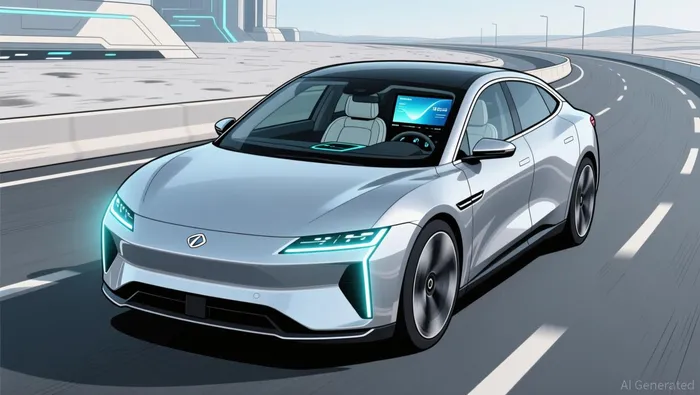
The vehicle's interior also emphasizes luxury and tech integration, featuring Apple CarPlay, Android Auto, and a 34-inch touchscreen-far exceeding the Model Y's 15.4-inch display according to electric SUV comparisons. Lucid's commitment to standard features, such as synthetic leather seats and a 9-speaker surround sound system, further differentiates it from Tesla's minimalist approach as noted in 2025 car comparisons. For families and tech-savvy buyers, these attributes could tip the scales in Lucid's favor.
Cost Control: Strategic Production and Tariff Avoidance
Lucid's cost-control strategy hinges on its decision to manufacture the Earth in Saudi Arabia. This move allows the company to bypass U.S. tariffs on Chinese components, which have historically inflated production costs for EVs according to InsideEVs. By sourcing parts from local and regional suppliers, Lucid aims to maintain a competitive price point of $50,000 for the base model-a figure that aligns with the Model Y's starting price but offers superior range and features as reported in electric SUV analysis.
This strategy mirrors Tesla's own global production model, which has leveraged manufacturing hubs in China and Europe to reduce costs. However, Lucid's focus on a single, tariff-advantaged location could streamline operations and reduce overhead, enabling it to undercut Tesla on pricing while maintaining profitability according to industry analysis. Analysts note that such cost advantages are essential for competing in the mass-market segment, where price sensitivity is acute according to market research.
Self-Driving Differentiation: Bridging the Gap with Nvidia
While Tesla's Full Self-Driving (FSD) system remains the gold standard in automation, Lucid's DreamDrive Pro offers a compelling alternative. Currently, DreamDrive Pro excels in highway driving, with users praising its smoothness and lack of "phantom braking" issues common in Tesla's system according to Lucid owner forums. However, it lags in urban environments, lacking features like automatic lane changes and traffic light recognition as reported on Reddit.
To close this gap, Lucid has partnered with Nvidia to integrate the Drive AGX Thor platform into the Earth. This collaboration aims to enable Level 4 autonomy-where the vehicle can operate without human supervision under specific conditions-within a few years of the Earth's launch according to EV industry news. Unlike Tesla's iterative software-only approach, Lucid's hardware-software integration with Nvidia's cutting-edge AI could accelerate its path to higher-level autonomy.
Cost-wise, Lucid's self-driving system may also hold an edge. While Tesla charges $8,000 for FSD or $99/month for a subscription according to GreenDrive analysis, Lucid's DreamDrive Pro is likely to be bundled at a lower cost, given its reliance on in-house hardware and strategic partnerships. This could appeal to budget-conscious buyers who prioritize affordability over the most advanced automation.
Market Positioning and Risks
Lucid's Earth is not just a product-it's a strategic gambit. By targeting the $50k segment, Lucid aims to replicate Tesla's early success with the Model 3 while leveraging its strengths in range, luxury, and cost control. However, challenges remain. Consumer Reports' reliability scores, which gave the Lucid Air a dismal 7/100 compared to Tesla's 35/100 according to top speed comparison, highlight the need for Lucid to address quality concerns. Additionally, Tesla's brand loyalty and first-mover advantage in software updates could slow the Earth's adoption.
That said, Lucid's partnership with Saudi Arabia's government and its focus on global supply chains position it to scale production rapidly. With $1.2 billion in projected 2025 revenue according to market analysis, the company appears financially stable enough to weather initial market skepticism.
Conclusion: A Credible Challenger in the Making
Lucid's Earth SUV represents a well-calculated attempt to disrupt Tesla's dominance in the mainstream EV market. By combining superior range, cost advantages, and a strategic pivot to Level 4 autonomy, Lucid is positioning itself as a viable alternative to Tesla's Model Y and Model X. While it may not yet match Tesla's software prowess, its hardware-driven approach and aggressive pricing could attract a broad customer base. For investors, the Earth's success hinges on Lucid's ability to execute its production plans and refine its self-driving tech-both of which appear within reach.







Comentarios
Aún no hay comentarios