
Lucid's Steadfast Production Target Amid Tariff Turbulence: A Risky Gamble or Strategic Masterstroke?
The U.S. auto industry is bracing for the full impact of the Trump administration’s 2025 tariffs, which have sent shockwaves through global supply chains and forced automakers to reevaluate their cost structures. Yet Lucid GroupLCID--, the luxury EV upstart, has defied the odds: it reaffirmed its 2025 production target of 20,000 vehicles despite these headwinds. This decision underscores a calculated bet on its vertically integrated model and strategic localization efforts—but it also raises questions about whether Lucid can sustain its growth trajectory in a volatile market.
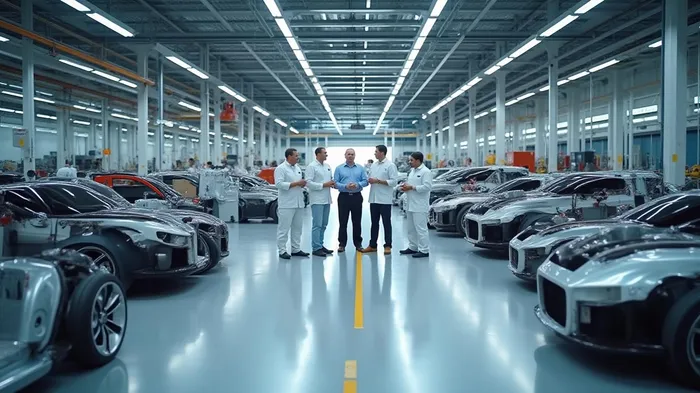
The Tariff Tsunami Sweeping the Auto Industry
The 25% tariffs on imported vehicles and critical components, effective May 2025, have upended automakers’ plans. For global giants like GM and Stellantis, the costs are staggering: GM projects a $4–5 billion EBIT hit in 2025, while Stellantis withdrew its full-year profit guidance entirely. Automakers are scrambling to absorb costs through price hikes, production pauses, and reshoring investments.
Lucid, however, is positioning itself as an exception. Its Arizona-based manufacturing complex (AMP-1) and Saudi Arabian assembly plant (AMP-2) give it a structural advantage. Unlike competitors reliant on imported parts, Lucid produces 90% of its drive units, batteries, and powertrains domestically, shielding it from tariff volatility on components. “Vertical integration isn’t just a buzzword—it’s our armor against supply chain shocks,” Interim CEO Marc Winterhoff stated during Q1 earnings.
Can Lucid’s Strategies Offset the Tariff Pain?
The company’s response to tariffs is a mix of proactive supply chain reconfiguration and operational efficiency:
1. Localization of Critical Components:
- Lucid is transitioning Panasonic’s battery cell production from Japan to its new U.S. facility in Kansas, avoiding tariffs on imported cells.
- The company is securing domestic suppliers for raw materials like graphite (via partnerships with GraphiteOne and Surah Resources) and exploring alternative rare earth metals to reduce tariff exposure.
- Saudi Arabia’s Role:
AMP-2, its $5 billion Saudi factory, will handle final assembly for export markets, bypassing U.S. tariffs on foreign-made vehicles. Q1 saw 600 units in transit to Saudi Arabia, a sign of its global expansion ambitions.
Cost Discipline:
- Despite a Q1 net loss of $366 million, Lucid’s liquidity remains robust at $5.76 billion, thanks to a recent $1.1 billion convertible note offering. This cushion gives it room to invest in scaling while navigating tariffs.
Yet challenges loom large. Tariffs have already pressured Lucid’s margins: its gross margin fell to -97.2% (GAAP) in Q1, and a projected 7–12% margin headwind from tariffs threatens profitability. Meanwhile, competitors like Tesla are absorbing tariff costs more nimbly due to economies of scale.
The Numbers Behind the Gamble
Lucid’s 2025 target hinges on delivering 12,500 units in 2025 before factoring in Saudi production—a 25% increase from its 2024 total. Its Q1 performance offers hope:
- Deliveries hit 3,109 units, a 58% year-over-year jump, driven by strong demand for the Lucid Gravity SUV.
- Revenue rose 35% YoY to $235 million, with Gravity pre-orders contributing to a record order backlog.
However, the path to 20,000 units is fraught. The Gravity’s “minivan-like” space and performance could attract up to 6x the Air’s market share, but software glitches and service center shortages have sparked customer concerns. “Lucid’s execution in scaling production and quality control will be its make-or-break test,” says automotive analyst John Smith.
Conclusion: A High-Risk, High-Reward Play
Lucid’s adherence to its 2025 target is both bold and risky. On one hand, its vertical integration, localization, and Saudi partnerships provide a defensible moat against tariffs. Its liquidity and Gravity’s early success suggest it can weather near-term storms.
On the other hand, the company’s $590 million Q1 cash burn and negative EBITDA ($563 million) highlight the uphill climb to profitability. If tariffs intensify or competition from Tesla and NIO escalates, Lucid may face a liquidity crunch.
Investors should monitor two critical metrics:
1. Delivery Growth: Whether Lucid can sustain its 58% Q1 delivery growth rate.
2. Margin Improvement: Whether EBITDA losses shrink meaningfully, as the company aims to reach breakeven by 23,000 units.
For now, Lucid’s bet is grounded in its unique strengths—but the road to 20,000 units remains as turbulent as the tariff environment itself.





Comentarios
Aún no hay comentarios