
Lucid's Saudi Partnership: A Strategic Play for EV Dominance?
Lucid Group’s collaboration with Saudi Arabia’s King Abdullah University of Science and Technology (KAUST) signals a bold move in the global race for electric vehicle (EV) supremacy. Announced in May 2025, the partnership combines Lucid’s EV expertise with KAUST’s cutting-edge research infrastructure, aiming to accelerate advancements in autonomous driving, battery technology, and next-generation materials. For investors, the deal raises critical questions: Does this alliance position Lucid to challenge Tesla and BYD in the EV market, or does it expose the company to geopolitical and technical risks?
The Technical Ambition
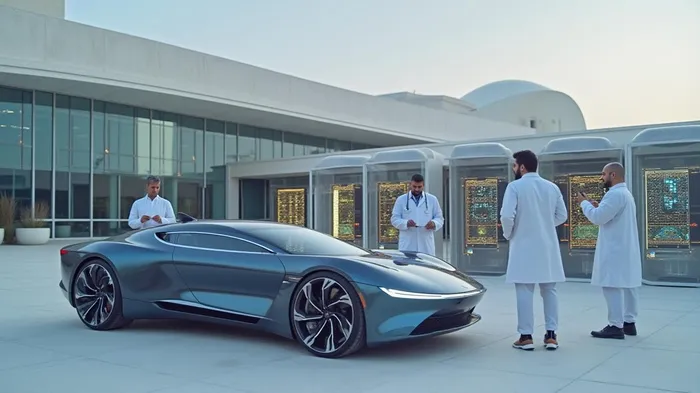
The partnership’s scope is ambitious. Lucid will leverage KAUST’s high-performance computing resources to tackle challenges in materials science, simulation, and AI. Key areas include:
- Advanced Materials: Developing composites and coatings to improve vehicle efficiency, such as heat-reflective glass and lightweight polymers.
- AI-Driven Simulations: Training digital twins of EV systems to optimize crash safety, thermal management, and electromagnetic performance.
- Autonomous Systems: Enhancing Lucid’s ADAS capabilities using KAUST’s AI and data centers, potentially leapfrogging competitors in software-defined vehicles.
The collaboration is rooted in KAUST’s labs in King Abdullah Economic City (KAEC), where Lucid’s AMP-2 plant—already producing semi-knocked-down (SKD) EVs—will transition to full build-unit (CBU) manufacturing. This integration positions Saudi Arabia as a hub for EV production, aligning with the kingdom’s Vision 2030 goal to diversify its economy.
Strategic Gains for Lucid
Lucid’s interim CEO, Marc Winterhoff, has emphasized the partnership’s role in bolstering its R&D prowess. By accessing KAUST’s supercomputing power—critical for AI and material science—the company aims to reduce development cycles and outpace rivals. Eric Bach, Lucid’s SVP of Product, called the collaboration “transformative,” highlighting breakthroughs in AI-driven engineering processes.
While Lucid’s stock has lagged behind Tesla and BYD in recent years, the KAUST partnership could shift momentum. The alliance also benefits from the Saudi Public Investment Fund (PIF), which holds a significant equity stake in Lucid and has committed $3.4 billion to its Saudi operations. This funding could support scaling production at AMP-2, which aims to reach 150,000 annual units by mid-decade—a scale that would rival Tesla’s Gigafactories.
Geopolitical and Technical Risks
The deal is not without risks. First, the partnership lacks disclosed financial terms or a defined timeline, leaving uncertainty about costs and deliverables. Second, U.S. export controls classify Saudi Arabia as a Tier 2 country, restricting access to advanced AI chips—a critical limitation for autonomous systems. Lucid may face bottlenecks unless the U.S. eases restrictions or the company finds alternative suppliers.
Third, geopolitical tensions between the U.S. and Saudi Arabia could disrupt the partnership. While the alliance reflects growing U.S.-Saudi tech cooperation, investor sentiment remains fragile amid ongoing diplomatic disputes. Finally, competition is fierce: Tesla’s AI advancements (e.g., FSD V12) and BYD’s cost leadership in batteries pose existential threats to Lucid’s niche luxury EV strategy.
Market Potential and Challenges Ahead
The EV market is projected to reach $1.3 trillion by 2030, but Lucid must carve out a meaningful slice. Its strategy hinges on differentiation: high-end vehicles with cutting-edge tech, paired with Saudi’s low-cost manufacturing. However, the company’s current production volumes (12,000 units in 2023) pale against Tesla’s 1.8 million. Scaling AMP-2’s CBU capacity will be pivotal.
Saudi Arabia’s Vision 2030 targets 50% of vehicles to be electric by 2030, creating a domestic market worth billions. Lucid’s local supply chain partnerships—supported by the PIF—could secure cost advantages, but execution remains unproven.
Conclusion: A Calculated Gamble
Lucid’s KAUST partnership is a high-stakes bet. On one hand, it grants access to world-class R&D infrastructure, a strategic Saudi manufacturing base, and PIF capital—all vital for competing in a tech-driven EV landscape. The collaboration could accelerate innovations in autonomous systems and materials, potentially turning Lucid into a leader in software-defined vehicles.
However, risks loom large. Unclear financial terms, export control hurdles, and geopolitical volatility could derail progress. Investors must weigh the long-term potential against near-term execution risks. If Lucid can navigate these challenges, the partnership could be a game-changer. But in a market where Tesla and BYD set the pace, the stakes are as high as the rewards.
Final Verdict: For investors, Lucid’s Saudi venture offers growth potential but requires patience and tolerance for risk. Monitor execution metrics—production ramp-up at AMP-2, AI breakthroughs from KAUST, and geopolitical developments—to gauge whether this alliance delivers on its promise.





Comentarios
Aún no hay comentarios