
LSD's Emerging Role in Solana's Post-Liquidity Crisis Recovery
Solana's recovery from the liquidity crisis that followed the 2022 FTX collapse has been marked by a strategic pivot toward AI-driven liquid staking derivatives (LSDs). These protocols have emerged as critical tools for addressing staking complexity, optimizing yield, and restoring liquidity to the network. By automating capital allocation, mitigating risks, and attracting institutional capital, AI-assisted LSDs are reshaping Solana's post-crisis landscape.
The Liquidity Crisis and the Rise of AI-Driven LSDs
The 2022 liquidity crisis, exacerbated by the FTX collapse and Alameda Research's insolvency, left Solana's ecosystem reeling. SOL's price plummeted below $8, and stablecoin liquidity on the network declined sharply. To stabilize the market, the SolanaSOL-- Foundation redistributed tokens through trusted custodians like Kraken and BitGo, reducing sell pressure. However, the long-term solution required innovation in staking infrastructure.
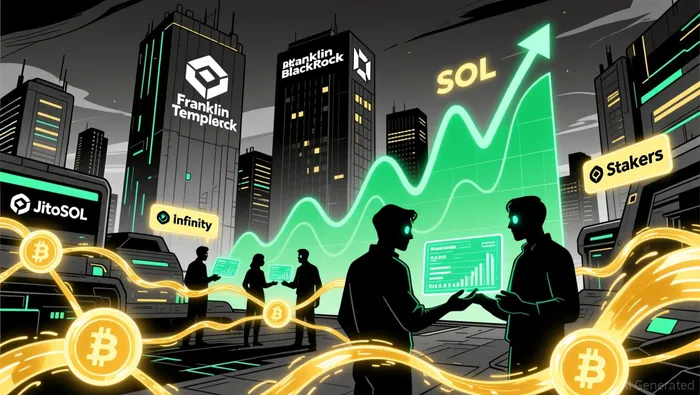
Enter AI-driven LSDs. These protocols, such as JitoSOL, Infinity (INF), and JupSOL, have captured significant market share by offering liquid staking derivatives that allow users to stake SOLSOL-- while retaining liquidity for DeFi activities. By mid-2025, liquid staking tokens accounted for 13% of all staked SOL, with JitoSOL commanding 34% of the LST market. Protocols like INF further disrupted the space by offering competitive APYs (7.1% in some periods) and specialized features, reflecting a dynamic and innovation-driven ecosystem.
Technical Mechanisms: AI as a Staking Optimizer
AI-driven LSDs leverage algorithmic optimization to automate staking decisions. Platforms like LSD (an AI-assisted optimizer) dynamically allocate staked SOL across validators and platforms, factoring in yield rates, incentives, and risk metrics. This approach minimizes manual oversight while maintaining risk-adjusted returns. For instance, LSD continuously evaluates validators, adjusting allocations only when it significantly improves returns or reduces risk exposure. This reduces unnecessary rebalancing and ensures responsiveness to network conditions.
The technical architecture of these protocols is designed for scalability. Solana's upgrades-such as Firedancer and Alpenglow SIMD-have enhanced transaction speeds and block finality, enabling AI algorithms to process real-time data efficiently. Additionally, protocols like Starke Finance's rkSOL token allow instant repositioning of staked assets without cooldown periods, addressing liquidity constraints during volatile markets.
Yield Optimization and Institutional Adoption
AI-driven LSDs have become linchpins for yield optimization. During Q1 2025, when SOL experienced sharp price swings, users with liquid staking derivatives avoided the 2-3 day unstaking cooldown, enabling them to hedge against price drops and redeploy capital swiftly. This flexibility has been critical for maintaining yield stability in a volatile environment.
Institutional adoption has further bolstered the ecosystem. Marinade's institutional-grade product, Marinade Select, attracted $436 million in TVL by November 2025, while Solana's lending markets reached $3.6 billion in TVL, reflecting robust competition and innovation. Major firms like Franklin Templeton and BlackRock have also launched tokenized money market funds on Solana, signaling growing institutional confidence.
Challenges and Risks
Despite their benefits, AI-driven LSDs face risks. Smart contract vulnerabilities and depeg risks remain concerns, particularly during market stress. Users are advised to diversify validator exposure and prioritize reputable staking providers. Additionally, while AI algorithms enhance efficiency, they rely on accurate data inputs and cannot fully mitigate systemic risks like stablecoin liquidity declines.
Conclusion: A Strategic Path Forward
Solana's post-liquidity crisis recovery hinges on its ability to innovate in staking infrastructure. AI-driven LSDs have emerged as strategic solutions, combining algorithmic precision with institutional-grade security to optimize yields and restore liquidity. As the ecosystem evolves, continued technological upgrades and regulatory clarity will be critical for sustaining growth. For investors, the convergence of AI and DeFi on Solana represents a compelling opportunity to capitalize on a network poised for long-term resilience.







Comentarios
Aún no hay comentarios