
Lowe's Customer Engagement Strategy: Building Retail Resilience Through Loyalty-Driven Value Creation
In the evolving post-pandemic retail landscape, where consumer behavior and market dynamics remain fluid, Lowe'sLOW-- has emerged as a case study in strategic adaptation. By prioritizing customer engagement through loyalty programs, digital transformation, and a unified Total Home Strategy, the home improvement retailer is not only weathering macroeconomic headwinds but also redefining the value proposition for both DIY enthusiasts and professional contractors. This analysis examines how Lowe's is leveraging these initiatives to drive retail resilience and long-term value creation.
The Loyalty Ecosystem: A Pillar of Retail Resilience
Lowe's has reimagined its loyalty programs as a cornerstone of customer retention and revenue growth. The 2025 relaunch of its Pro loyalty program as MyLowe's Pro Rewards exemplifies this shift. Designed for small-to-medium professional contractors, the program simplifies reward earning and redemption while offering daily savings of 5% on eligible purchases for cardholders. This targeted approach addresses the unique needs of professional customers, who are incentivized to increase their visit frequency by 10–20 times annually.
For homeowners, the MyLowe's Rewards program has attracted over 30 million members, with participants spending 50% more than non-members. By unifying DIY and Pro loyalty programs under a single currency, Lowe's has created a seamless ecosystem that enhances simplicity and instant value. This integration ensures that loyalty is not merely transactional but a long-term relationship-building tool, fostering habitual engagement.
The financial impact of these efforts is evident. MyLowe's Pro Rewards has driven mid-single-digit growth in professional sales, while the broader loyalty program's 38 million members provide a rich dataset for personalized engagement. According to a report by Modern Retail, this ecosystem reflects the evolving consumer demand for emotional engagement and tailored experiences, moving beyond traditional points-based systems.
Digital Transformation: Enhancing Productivity and Customer Experience
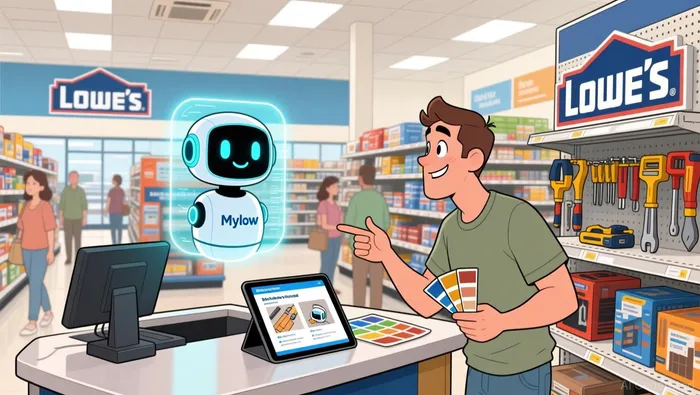 Lowe's digital transformation has been equally pivotal. The company's AI-powered virtual adviser, Mylow, addresses one million customer inquiries monthly, offering product searches and home repair guidance. This tool, alongside the Mylow Companion app, has boosted online sales growth by 11.4% in Q3 2025, contributing to an adjusted diluted EPS of $3.06-a 6% year-over-year increase.
The integration of generative AI into internal workflows has further unlocked productivity gains, with double-digit improvements in code review and engineering operations. These advancements align with Lowe's broader 2025 Total Home Strategy, which emphasizes AI-driven solutions to enhance both customer-facing and operational efficiency. The acquisition of Foundation Building Materials (FBM) and Artisan Design Group (ADG) has also expanded digital fulfillment capabilities, particularly for Pro customers.
Financial Resilience and Future Outlook
Lowe's Q3 2025 results underscore the financial resilience of its strategies. Total sales reached $20.8 billion, with a 0.4% increase in comparable sales and a 34.2% gross margin. Inventory reductions of $400 million year-over-year highlight disciplined capital allocation, while the company's updated 2025 outlook projects total sales of $86.0 billion and adjusted diluted EPS of $12.25.
Looking ahead, Lowe's is positioning itself to capitalize on evolving consumer trends. CEO Marvin Ellison has noted the potential for home equity loans to drive discretionary remodeling projects in 2026, even amid elevated mortgage rates. The company's expansion into rural markets-planning 10–15 new stores annually-further diversifies its reach.
Conclusion: A Model for Post-Pandemic Retail
Lowe's customer engagement strategy exemplifies how loyalty-driven value creation and digital innovation can fortify retail resilience. By aligning its loyalty programs with AI-powered personalization, expanding its physical and digital footprint, and leveraging data-driven insights, the company is not only retaining customers but also fostering long-term loyalty. As the retail sector navigates ongoing uncertainties, Lowe's approach offers a blueprint for sustainable growth in a post-pandemic economy.





Comentarios
Aún no hay comentarios