
The Looming Oil Market Surplus: Assessing Investment Risks and Opportunities in a Shifting Energy Landscape
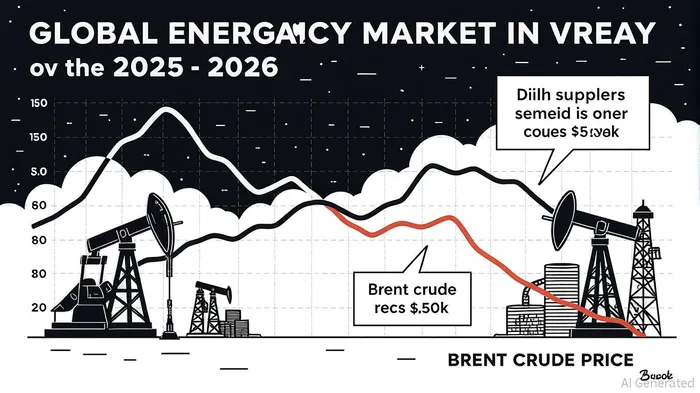
The global oil market in 2025 is teetering on the edge of a structural surplus, driven by a confluence of rising supply and slowing demand. According to the International Energy Agency (IEA), global oil supply is projected to grow by 2.5 million barrels per day (mb/d) in 2025 and 1.9 mb/d in 2026, outpacing demand growth of 680,000 b/d in 2025—the lowest rate since 2009 [1]. This imbalance, exacerbated by OPEC+ production increases and non-OPEC contributions like U.S. shale output, has triggered a sharp decline in crude prices. The U.S. Energy Information Administration (EIA) forecasts Brent crude to fall from $71 per barrel in July 2025 to $58 by Q4 2025 and $49 in early 2026 [4].
Drivers of the Surplus and Investment Risks
The surplus stems from two primary forces: accelerated OPEC+ production and weakening demand in key economies. OPEC+ has unwound 710,000 b/d of cuts in 2025 alone, with Saudi Arabia and Russia leading the charge [4]. Non-OPEC producers, including the U.S., Brazil, and Norway, have also boosted output, pushing global production to record levels. Meanwhile, demand growth has faltered. China, the U.S., and India—collectively accounting for over 40% of global oil consumption—have underperformed expectations, with the IEA attributing this to economic slowdowns and trade policy uncertainties [2].
Investors face mounting risks from this surplus. First, price volatility is intensifying. The EIA notes that falling prices could curb U.S. shale production by late 2026, creating a self-correcting mechanism but also prolonging market instability [1]. Second, inventory builds are straining storage capacity. Global oil inventories have surged by 93 million barrels in May 2025 alone, with the IEA predicting average builds of 1.9 mb/d in the second half of 2025 [3]. Third, geopolitical tensions, such as sanctions on Russian and Iranian oil, add short-term uncertainty but are unlikely to offset the broader surplus [2].
Strategies for Commodity Risk Management
To navigate this volatile landscape, investors must adopt robust risk management frameworks. Hedging tools such as futures contracts, options, and collars are critical. For instance, oil producers can use costless collars—combining put and call options—to lock in price floors while retaining upside potential [5]. Similarly, futures markets allow investors to hedge against price declines by locking in forward prices, a strategy particularly relevant as contango conditions (where future prices exceed spot prices) incentivize storage arbitrage [2].
Diversification is another cornerstone. Energy commodities, including crude oil, have historically served as inflation hedges and portfolio stabilizers. A 6.7% allocation to commodities within a 60/40 portfolio has historically improved risk-adjusted returns, especially during periods of macroeconomic uncertainty [5]. ESG-aligned strategies, such as the Auspice Commodity Evolution (ACE) fund, further capitalize on energy transition themes while mitigating exposure to volatile oil markets [4].
Sector Rotation: Shifting Priorities in a Commodified World
The oil surplus is reshaping sector rotation dynamics. As AI technologies commoditize—driven by open-weight models like DeepSeek and OpenAI—software firms are gaining pricing power, while energy sectors face deflationary pressures [1]. Investors are increasingly favoring Financials, Industrials, and equal-weight S&P 500 sectors, which offer resilience to economic cycles and benefit from productivity gains [1].
Gold, a traditional safe-haven asset, has also gained traction. Its price has surged to record highs in 2025, reflecting investor demand for inflation protection amid oil market instability [3]. Meanwhile, energy-linked sectors like construction and manufacturing face headwinds from delayed projects and tariff-driven supply chain disruptions [2].
Conclusion
The 2025 oil surplus underscores the need for agile investment strategies. While the market faces near-term headwinds, proactive risk management—through hedging, diversification, and sector rotation—can mitigate downside risks. Investors should prioritize flexibility, leveraging tools like options and ESG-aligned funds while capitalizing on sectors poised to benefit from technological and macroeconomic shifts. As the IEA warns, the surplus is not a temporary blip but a structural challenge requiring long-term adaptation [3].
Source:
[1] Oil Market Report - August 2025 – Analysis [https://www.iea.org/reports/oil-market-report-august-2025]
[2] Global oil markets [https://www.eia.gov/outlooks/steo/report/global_oil.php]
[3] IEA warns of mounting oil surplus as demand growth slows ... [https://www.ogj.com/general-interest/economics-markets/news/55309546/iea-warns-of-mounting-oil-surplus-as-demand-growth-slows-supply-surges]
[4] Auspice Commodity Evolution — Auspice [https://www.auspicecapital.com/auspice-commodity-evolution]
[5] The Comeback of Commodities: Why Investors Must [https://resonanzcapital.com/insights/the-case-for-commodities-a-strategic-allocation-for-long-term-investors]







Comentarios
Aún no hay comentarios