
The Looming Market Correction and Precious Metals as a Hedge Against Systemic Risk
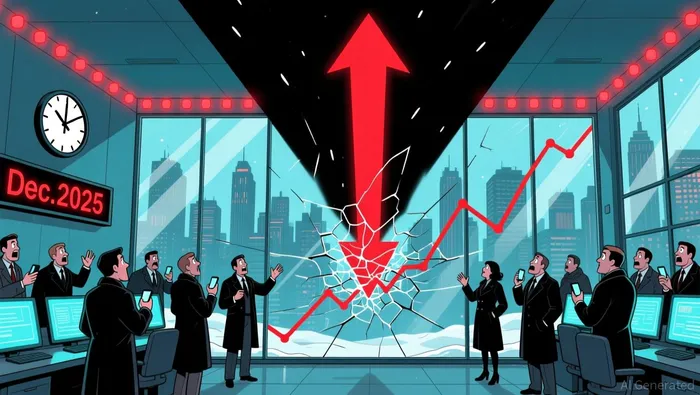
The S&P 500's technical chart in December 2025 has drawn increasing scrutiny from analysts, with a tightening wedge pattern signaling a high probability of a market correction. This pattern, historically associated with trend-line breakouts and subsequent sell-offs, mirrors conditions seen in late 2021, when the index tested key support levels twice before collapsing. Gareth Soloway of Verified Investing warns that a rejection of the wedge's lower boundary in early January 2026 could trigger a "double tap" scenario, amplifying volatility and eroding investor confidence. While the S&P 500 closed December 2025 with its eighth consecutive monthly gain, the consolidation phase-marked by shifting momentum from AI-driven sectors to broader diversification-suggests underlying fragility.
Fed Credibility Erosion and Systemic Risk
The U.S. Federal Reserve's credibility has eroded significantly in 2025, as markets increasingly fear fiscal dominance. A report by the Organisation for Monetary Freedom highlights concerns that monetary policy may become subordinated to fiscal needs, leading to perpetual debt monetization and loss of control over inflation. This dynamic has fueled a global shift toward safe-haven assets, with investors questioning the long-term stability of fiat currencies. The Fed's perceived inability to balance inflationary pressures with economic growth has created a vacuum, driving capital into tangible assets like gold and silver while undermining the dollar's traditional role as a reserve currency.
Precious Metals: Gold and Silver as Reliable Hedges
Gold's dominance in 2025 underscores its enduring appeal as a hedge against systemic risk. The metal surged 69% year-to-date, reaching an all-time high above $4,550 per ounce, driven by central bank purchases, geopolitical tensions, and inflationary fears. Technically, gold's breakout in 2025 was supported by a 13-year consolidation phase, with institutional buying and short-covering amplifying its rally. In contrast, Bitcoin's 5% annual decline highlighted its failure to function as a reliable safe haven during crises, as it remained range-bound while gold attracted defensive capital flows.
 Silver's performance further reinforces the case for precious metals. The metal reached a 13-year high of $36 per ounce in June 2025, surging 151% by year-end as industrial demand and speculative trading drove volatility. Unlike BitcoinBTC--, which underperformed by 7% in the same period, silver's price action reflected its dual role as both an industrial commodity and a store of value. This divergence underscores a broader trend: investors are prioritizing physical assets over digital alternatives during periods of macroeconomic uncertainty.
Bitcoin's Safe-Haven Failure and Strategic Implications
Bitcoin's underperformance in 2025 has exposed its limitations as a systemic risk hedge. Despite its narrative as "digital gold," the cryptocurrency failed to attract capital during geopolitical crises, behaving more like a risk asset than a stable store of value. Regulatory headwinds, institutional disinterest, and its inherent volatility have further weakened its appeal. Meanwhile, gold's consistent inflows during market stress-such as the U.S.-China trade tensions and European energy crises- reinforce its role as a benchmark for safe-haven demand. For investors, this suggests that Bitcoin's current positioning is incompatible with a portfolio designed to withstand a market rupture.
Positioning for the Correction: Precious Metals and Dollar-Dependent Assets
Given the confluence of technical and macroeconomic factors, a strategic shift toward precious metals and away from dollar-dependent assets appears prudent. The S&P 500's wedge pattern, coupled with the Fed's credibility erosion, creates a high-probability environment for a correction in early 2026. Investors should consider long positions in gold and silver, which have demonstrated resilience amid systemic risks, while shorting dollar-denominated assets such as U.S. Treasuries and equities with weak fundamentals.
The coming months will test the durability of the current bull market. As history shows, markets often correct when technical patterns align with macroeconomic vulnerabilities. For those prepared, the combination of gold's technical breakouts and the Fed's waning influence offers a compelling case for hedging against the inevitable.






Comentarios
Aún no hay comentarios