
The Looming Jobs Recession: Implications for Sectoral Exposure and Investment Strategy
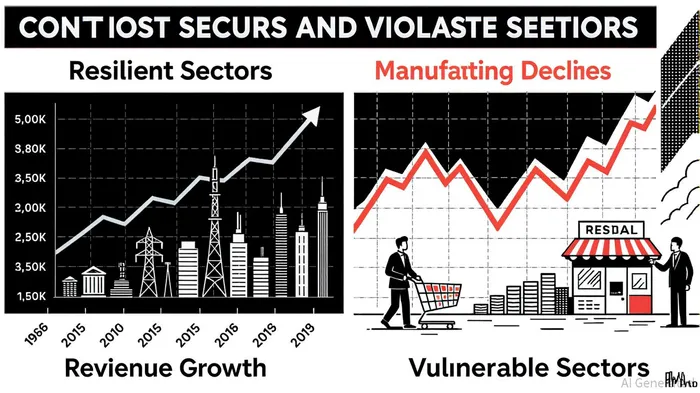
The global economic landscape in 2025 is marked by fragility, with the U.S. labor market showing signs of a stall and global growth projected to decelerate to 2.3% [4]. As trade policy uncertainty, inflationary pressures, and geopolitical tensions converge, investors must recalibrate their strategies to prioritize resilience. This analysis identifies sectors poised to withstand a potential jobs recession while flagging those at heightened risk, offering actionable insights for portfolio reallocation.
Recession-Resistant Sectors: Stability in Turbulent Times
1. Telecommunications and Regulated Utilities
Essential services remain a cornerstone of economic stability. VerizonVZ-- (VZ), a telecommunications giant, exemplifies this resilience through its subscription-based model and inelastic demand for connectivity [1]. Similarly, regulated utilities like WEC EnergyWEC-- (WEC) benefit from non-discretionary consumption and limited competition, with earnings growth projections outpacing broader market averages [1]. These sectors are insulated from cyclical downturns, as households and businesses maintain spending on critical infrastructure.
2. Midstream Energy and Aerospace/Defense
Midstream energy companies, such as Enterprise Products PartnersEPD-- (EPD), operate under long-term fixed-fee contracts, reducing exposure to commodity price swings [1]. Meanwhile, aerospace and defense firms like Lockheed MartinLMT-- (LMT) leverage government contracts and cost-plus pricing mechanisms, ensuring steady cash flows even amid inflation [1]. National security priorities further anchor demand for these sectors, making them attractive during periods of economic uncertainty.
3. Self-Storage REITs
Public Storage (PSA) and its peers in the self-storage861286-- REIT sector continue to thrive as individuals and small businesses seek affordable storage solutions during financial stress [1]. The sector’s low capital intensity and recurring rental income model position it as a defensive play in a tightening labor market.
Vulnerable Sectors: High-Risk Exposures
1. Manufacturing and Retail
Manufacturers and retailers face dual headwinds: tariffs, which inflate input costs, and a hiring freeze driven by economic uncertainty [2]. For example, U.S. job growth in August 2025 slowed to just 22,000, with unemployment rising to 4.3%—a four-year high [5]. These sectors are particularly susceptible to reduced consumer spending and supply chain disruptions, making them high-risk bets in a recessionary environment.
2. Developing Economies
Low-income countries are in a "perfect storm" of debt distress, weak domestic growth, and external shocks [4]. Over half of these nations face high debt risk, with limited capacity to absorb fiscal or monetary policy adjustments. Investors should avoid overexposure to emerging markets, where currency volatility and political instability amplify downside risks.
3. Sectors Dependent on Trade Policy
Global trade policy shifts, now at historic levels of uncertainty, threaten industries reliant on cross-border commerce [2]. Tariffs and protectionist measures not only inflate prices but also disrupt labor markets, as seen in the U.S. services sector’s inflationary pressures [5]. Sectors like textiles, automotive, and electronics are particularly vulnerable to policy-driven shocks.
Strategic Adjustments for Investors
To navigate the looming jobs recession, investors should:
- Divest from cyclical sectors such as manufacturing, retail, and trade-sensitive industries.
- Reallocate capital to defensive sectors with stable cash flows, including utilities, midstream energy, and self-storage REITs.
- Monitor labor market signals, such as the growing gap between job openings and unemployment [3], to anticipate sectoral shifts.
Conclusion
The 2025 economic outlook underscores the need for a defensive investment posture. By prioritizing sectors with inelastic demand and stable revenue streams, investors can mitigate downside risks while capitalizing on long-term value. Conversely, reducing exposure to vulnerable sectors—particularly those tied to trade policy and cyclical consumption—will be critical in preserving capital during a potential jobs recession. As the labor market continues to evolve, agility and strategic foresight will define successful portfolios.
Source:
[1] 20 Best Recession-Proof Dividend Stocks for a 2025 Downturn [https://www.simplysafedividends.com/world-of-dividends/posts/939-20-best-recession-proof-dividend-stocks-for-a-2025-downturn]
[2] Economic Conditions Outlook, June 2025 [https://www.mckinsey.com/capabilities/strategy-and-corporate-finance/our-insights/economic-conditions-outlook]
[3] Why the Job Market Has Weakened — and What to Do About It [https://www.cnbc.com/2025/09/05/job-seekers-face-worst-game-of-musical-chairs.html]
[4] Trade and Development Foresights 2025: Under Pressure [https://unctad.org/publication/trade-and-development-foresights-2025-under-pressure-uncertainty-reshapes-global]
[5] US Economic Outlook July 2025 [https://www.ey.com/en_us/insights/strategy/macroeconomics/us-economic-outlook]







Comentarios
Aún no hay comentarios