
The Looming Dividend Risk for HOG: What Investors Should Do Now
Harley-Davidson (HOG) has long been a staple for income-focused investors, offering a dividend yield that historically outperformed many peers in the automotive sector. However, recent financial data reveals a growing disconnect between the company's cash flow generation and its dividend commitments, raising questions about the sustainability of its payout. While some metrics suggest a conservative approach, others hint at underlying vulnerabilities. Investors must navigate this complexity to assess the true risk to HOG's dividend.
Free Cash Flow: A Mixed Picture
Harley-Davidson's free cash flow (FCF) has shown resilience in 2025, with Q3 reporting $111.56 million in FCF and an annual total of $867.27 million for 2024-a 58.41% increase year-over-year, according to Macrotrends. This growth, driven by improved operational efficiency and reduced capital expenditures, initially appears promising. However, the company's FCF remains subject to cyclical demand for motorcycles and global economic headwinds. For instance, Q3 2025 FCF represents just 25% of the full-year 2024 total, underscoring quarterly volatility as reported by WallStreetNumbers. Such fluctuations complicate long-term planning for dividend sustainability.
Dividend Payout Ratios: Conflicting Signals
The key to evaluating dividend risk lies in reconciling conflicting payout ratios. Panabee calculates HOG's 2025 payout ratio at a seemingly safe 9.8% based on operating free cash flow (OFCF). This metric, calculated by dividing the $0.18 quarterly dividend by OFCF per share ($1.83), suggests ample capacity to maintain the payout. However, alternative calculations paint a grimmer picture: a 25.56% payout ratio based on cash flow, per DividendHistory, and a 21.46% ratio from Macrotrends indicate tighter constraints, particularly if earnings or OFCF decline.
The disparity arises from differing methodologies. The 9.8% figure uses OFCF, which excludes non-operational cash flows, while higher ratios may incorporate broader cash flow metrics or annualized earnings. For example, a 20.5% earnings-based payout ratio (dividend per share divided by diluted EPS of $0.88) is shown by MarketBeat, highlighting the strain on profitability. This inconsistency underscores the need for investors to scrutinize the assumptions behind each metric.
Capital Allocation Priorities: Dividends vs. Strategic Goals
Despite the low OFCF-based payout ratio, Harley-DavidsonHOG-- has prioritized debt reduction and share repurchases over dividend growth. In Q3 2025, the company allocated $65.6 million to capital expenditures and $40 million to share buybacks, according to FullRatio, while maintaining a $0.18 quarterly dividend. This strategy, while prudent for balance sheet health, signals a lack of confidence in reinvesting cash flow into high-growth opportunities. For dividend investors, this raises concerns: if management is unwilling to increase payouts despite strong FCF, the current yield may not be a reliable long-term income source.
Investor Implications and Recommendations
The data suggests a nuanced outlook. On one hand, HOG's 9.8% OFCF payout ratio provides a buffer against short-term shocks. On the other, declining sales and earnings-coupled with management's focus on buybacks-hint at structural challenges. Investors should consider the following steps:
- Monitor FCF Trends: Watch quarterly FCF reports for signs of sustained growth. A repeat of the 2024 58.41% increase would strengthen the dividend's safety net (Macrotrends).
- Assess Capital Allocation Shifts: Track whether management shifts funds from buybacks to dividend increases, which could signal renewed confidence in the business.
- Diversify Income Portfolios: Given the uncertainty, investors should avoid overexposure to HOG's dividend and balance it with higher-quality yield stocks.
Conclusion
Harley-Davidson's dividend appears secure in the near term, but the company's financial strategy and market dynamics introduce meaningful risks. While the 9.8% OFCF payout ratio is reassuring, the broader context-declining sales, volatile cash flows, and management's capital allocation choices-demands caution. For now, HOGHOG-- remains a speculative bet for dividend investors, best approached with a diversified portfolio and a watchful eye on upcoming financial reports.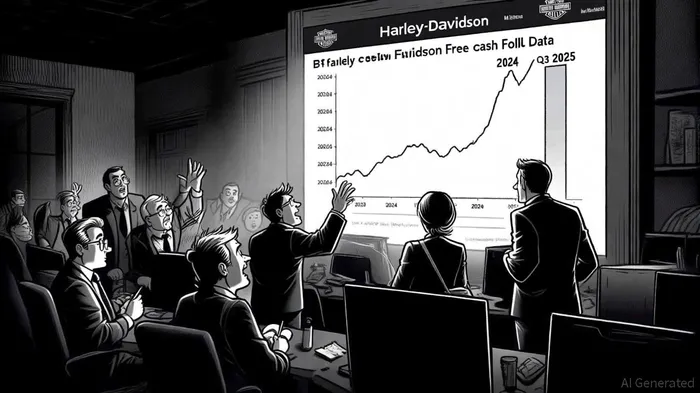





Comentarios
Aún no hay comentarios