
The Looming Credit Crunch: How Stablecoin Loopholes Threaten Traditional Lending Markets
The U.S. financial system is at a crossroads. A $6.6 trillion deposit risk looms over traditional banks as stablecoin adoption accelerates, driven by indirect yield models that blur the lines between payment instruments and investment products according to the American Bankers Association. This shift, if left unchecked, could destabilize local lending ecosystems, tighten credit conditions, and erode the foundational role of community banks in economic growth. The U.S. Treasury's 2025 report, alongside emerging regulatory frameworks like the GENIUS Act, highlights both the urgency of addressing these risks and the opportunities for innovation in a tokenized financial system.
The Deposit Flight Problem
Community banks are sounding the alarm: stablecoins could siphon deposits away from traditional institutions, leaving them with insufficient capital to fund local businesses and mortgages. The mechanics are simple. Stablecoin issuers, often unregulated or lightly regulated, offer indirect incentives such as interest or rewards to users. These yields, generated through re-lending, margin pools, or DeFi protocols, compete directly with bank deposits but lack the prudential safeguards and FDIC insurance that protect traditional savers.
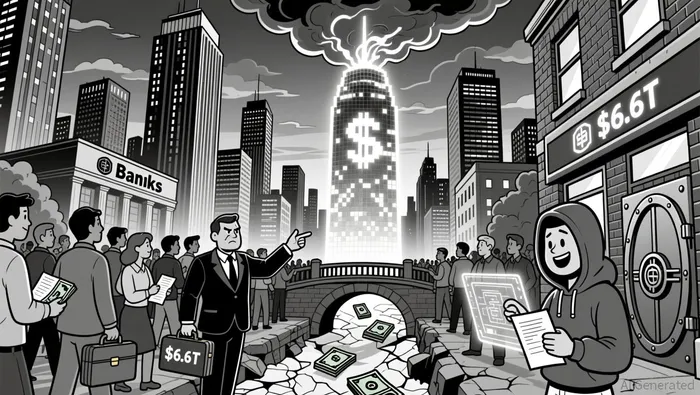
The scale of the risk is staggering. According to the U.S. Treasury's 2025 report, up to $6.6 trillion in deposits could migrate to stablecoin systems, particularly in underbanked regions where traditional banks struggle to compete with the allure of higher returns. This flight of deposits would not only starve banks of liquidity but also disrupt the credit channels that fuel economic activity. In emerging markets, where stablecoins already act as substitutes for local currency, the consequences are even more dire: tighter credit conditions, reduced monetary policy effectiveness, and heightened vulnerability during economic stress.
Systemic Risks in Indirect Yield Models
The indirect yield models powering stablecoins introduce systemic risks that regulators are only beginning to grasp. Unlike traditional banks, which are subject to capital adequacy and liquidity requirements, stablecoin platforms often operate in regulatory gray areas. For example, a stablecoin issuer might lend its reserves to DeFi protocols or repackage them as synthetic assets, creating a cascade of leverage that amplifies market volatility.
This lack of oversight is compounded by the absence of deposit insurance. While some stablecoins claim to be "reserve-backed," users remain exposed to losses during a run-a risk reminiscent of the 19th-century Free Banking era, when unregulated banks collapsed under liquidity pressures according to analysis. The U.S. Treasury's GENIUS Act attempts to address this by mandating that payment stablecoins be backed one-to-one by liquid assets like U.S. Treasury securities and requiring monthly reserve disclosures. However, enforcement remains a challenge, particularly for cross-border stablecoins that exploit jurisdictional loopholes.
Policy Responses and the Path Forward
The U.S. Treasury and federal regulators are racing to close these gaps. The GENIUS Act, passed in June 2025, represents a landmark effort to bring stablecoins under a unified regulatory framework. Key provisions include:
- Reserve Requirements: Payment stablecoins must be fully backed by U.S. currency, short-term Treasuries, or other government-backed instruments according to the St. Louis Fed.
- Issuer Oversight: Only regulated entities-such as OCC-chartered non-bank issuers or subsidiaries of insured depositories-can issue stablecoins according to the St. Louis Fed.
- Transparency Mandates: Monthly reserve disclosures and annual independent audits are now mandatory according to the St. Louis Fed.
These measures aim to align stablecoin practices with traditional banking standards while fostering innovation. However, as the American Bankers Association's Community Bankers Council has emphasized, legislative clarity is still needed to prevent regulatory arbitrage. For instance, indirect yield models that repackage stablecoin reserves into investment products remain a gray area, requiring further guidance from the SEC and CFTC.
Investment Strategies in a Tokenized World
For investors, the transition to a tokenized financial system presents both risks and opportunities. Tokenization of traditional assets-such as stocks, real estate, and treasuries-is accelerating, driven by regulatory clarity and technological advancements. Platforms like Robinhood and CoinbaseCOIN-- are already exploring tokenized equity offerings, enabling 24/7 trading and fractional ownership according to investment analysis.
However, navigating this landscape requires a nuanced approach:
1. Diversify Across Asset Classes: Tokenized assets offer liquidity but remain subject to regulatory and market risks. Investors should balance exposure with traditional, FDIC-insured instruments.
2. Monitor Regulatory Developments: The U.S. Treasury's Request for Comment on AI-driven tools for detecting illicit activity in digital assets signals a focus on compliance. Staying ahead of regulatory shifts will be critical.
3. Leverage Institutional Infrastructure: As tokenization matures, institutional-grade custodians and clearinghouses will play a key role in mitigating counterparty risk.
Conclusion
The $6.6 trillion deposit risk outlined by the U.S. Treasury is not a distant threat-it is a present-day challenge demanding urgent action. While stablecoins offer innovation and efficiency, their unchecked growth could destabilize traditional lending markets and exacerbate credit crunches. The GENIUS Act and emerging regulatory frameworks provide a blueprint for balancing innovation with stability, but their success will depend on rigorous enforcement and global coordination. For investors, the path forward lies in adapting to a tokenized world while remaining vigilant to the systemic risks that persist in this rapidly evolving landscape.





Comentarios
Aún no hay comentarios