
The Looming AI Bubble and Why Super Micro Computer (SMCI) Could Lose 30% of Its Value
The AI Infrastructure Bubble: A Sector on the Brink
The AI infrastructure market is expanding at an unprecedented pace, with companies like Palantir Technologies (PLTR) and (DVLT) leading the charge. Palantir, for instance, has secured a $10 billion U.S. Army contract and partnered with NVIDIA to deploy AI solutions, . Yet, , as critics argue this multiple is disconnected from tangible earnings. Similarly, , . These extremes-skyrocketing valuations for unprofitable firms and speculative bets on AI-driven growth-highlight a sector teetering on the edge of a bubble.
The risks are compounded by the sector's reliance on hype over fundamentals. For example, , according to Morningstar, a class-action lawsuit over alleged governance issues. Such volatility underscores the fragility of valuations built on narrative rather than durable business models.
Super Micro Computer: A Case Study in Margin Erosion
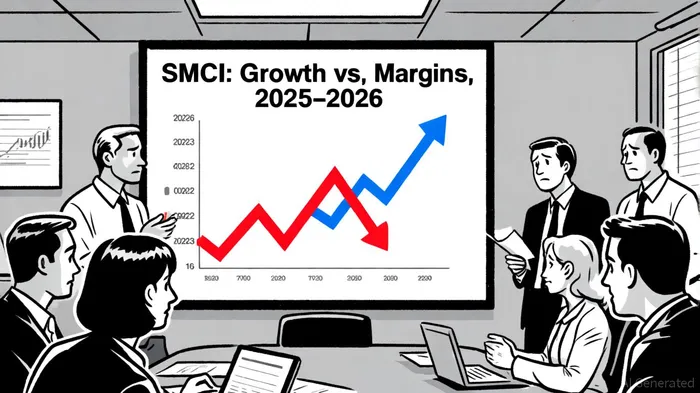
Super Micro Computer (SMCI) epitomizes the tension between growth and profitability in the AI infrastructure race. In FY2025, SMCISMCI-- reported FY2025 revenue , . , , as hyperscalers shift from data center construction to compute deployment. However, this growth is not translating into healthy margins. , . , respectively, further illustrate the company's struggle to monetize its AI-driven sales.
A Discounted Cash Flow (DCF) analysis exacerbates concerns, . , .
Competitive Threats and the Hyperscaler Dilemma
SMCI's challenges are not unique but are amplified by the sector's competitive dynamics. Hyperscalers like Google and Amazon are developing custom AI processors, threatening to displace standardized GPUs from NVIDIA and AMD. This shift could erode SMCI's market share, as hyperscalers prioritize in-house solutions to reduce costs and enhance control. Additionally, SMCI's reliance on a narrow product mix-over 70% of Q4 revenue from AI platforms-leaves it vulnerable to supply chain disruptions or technological obsolescence.
The sector's overvaluation is further evident in SMCI's PE ratio of 31.36, . While this reflects investor optimism, .
Conclusion: A Correction Looms
The AI infrastructure sector is at a crossroads. While the long-term potential of AI remains undeniable, the current market dynamics-excessive valuations, margin compression, and governance risks-suggest a correction is inevitable. For SMCI, the combination of weak margins, competitive threats, and speculative pricing creates a perfect storm. If the sector's growth narrative falters, , aligning with its DCF-derived intrinsic value.
Investors must tread carefully. The AI revolution is real, but not all participants are equally positioned to survive its next phase.





Comentarios
Aún no hay comentarios