
The Long-Term Risks of Aviation Supply Chain Bottlenecks: Implications for Aerospace OEMs and Airline Valuations
The aviation industry is navigating a complex web of supply chain bottlenecks that threaten to reshape its financial and operational landscape over the next decade. These disruptions, driven by shortages of critical components, labor constraints, and geopolitical volatility, are not merely short-term hurdles but structural challenges with profound implications for aerospace original equipment manufacturers (OEMs) and airline valuations. As the sector grapples with these headwinds, investors must assess how these dynamics will influence long-term profitability, stock performance, and strategic resilience.
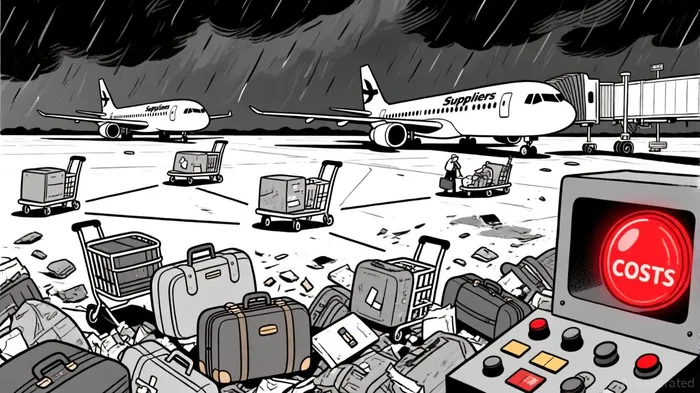
The Financial Toll on Airlines: A $11 Billion Crisis
According to an IATA and Oliver Wyman report, supply chain disruptions in 2025 are projected to cost airlines over $11 billion. This staggering figure is driven by four key factors:
1. Excess fuel costs: Airlines are operating older, less fuel-efficient aircraft due to delayed deliveries of new planes, resulting in $4.2 billion in additional fuel expenses.
2. Maintenance inflation: Aging fleets require more frequent and costly upkeep, adding $3.1 billion in maintenance costs.
3. Engine leasing surges: Prolonged maintenance cycles have pushed engine leasing rates up by 20–30% since 2019, contributing $2.6 billion in costs.
4. Inventory holding expenses: Carriers are stockpiling spare parts to buffer against uncertainty, incurring $1.4 billion in surplus inventory costs.
These pressures are compressing airline EBITDA margins, as operational costs outpace revenue growth. For example, the global fleet's average age has risen to a record 14.8 years, according to a Roland Berger report, further exacerbating maintenance and fuel inefficiencies. Analysts warn that without significant improvements in supply chain resilience, these trends will persist, limiting airlines' ability to expand capacity in line with rising passenger demand-up 10.4% in 2024, per the McKinsey state of aviation.
Aerospace OEMs: Production Delays and Valuation Pressures
The ripple effects of supply chain bottlenecks extend to aerospace OEMs, which face dual challenges: meeting surging demand for new aircraft while managing production constraints. The commercial aircraft backlog now exceeds 17,000 units, as noted in a McKinsey analysis, a record high that will take 14 years to clear at current delivery rates according to the Roland Berger report. This backlog is compounded by shortages of semiconductors, titanium, and skilled labor, which have delayed deliveries by an average of six months for models like Boeing's 787, according to the McKinsey analysis.
For OEMs, these delays translate into revenue shortfalls and margin pressures. Each aircraft delivery delay costs an average of $2.5 million, eroding profitability. Additionally, OEMs are leveraging their dominance in the maintenance, repair, and overhaul (MRO) sector to create controlled bottlenecks, limiting competition and inflating service costs, according to a ScienceDirect study. While this strategy may temporarily boost MRO margins, it risks alienating airlines and regulators, who are increasingly advocating for open aftermarket solutions.
Structural Industry Shifts and Investor Implications
The aviation sector is undergoing a paradigm shift as stakeholders adapt to prolonged supply chain turbulence. Airlines are prioritizing cost containment over fleet expansion, while OEMs are investing in digital tools like AI-driven predictive maintenance to mitigate disruptions, as highlighted in the Deloitte outlook. However, these measures may not be sufficient to address deeper structural issues, such as geopolitical instability and raw material shortages noted in the Roland Berger report.
From an investment perspective, the outlook for aerospace OEMs and airlines is mixed. While defense spending in Europe is diverting supply chain capacity to higher-margin contracts-an effect discussed in an Oliver Wyman article-commercial OEMs face valuation headwinds due to delayed deliveries and rising production costs. For airlines, EBITDA compression and volatile P/E ratios-averaging 12.30 in 2025, according to Investopedia-reflect investor uncertainty about the sector's ability to recover.
Pathways to Resilience
Addressing these challenges requires a collaborative approach. IATA and industry experts recommend:
1. Enhancing supply chain transparency: Leveraging data analytics and AI to predict disruptions and optimize inventory, as outlined in the Deloitte outlook.
2. Diversifying supplier networks: Reducing dependency on single-source providers for critical components, a key point in the McKinsey analysis.
3. Reforming MRO licensing models: Encouraging open competition to lower maintenance costs, as suggested by the IATA and Oliver Wyman report.
4. Investing in workforce development: Mitigating labor shortages through training and automation, per the Roland Berger report.
For investors, the key will be identifying companies that proactively address these risks. OEMs with diversified supply chains and robust digital capabilities, as well as airlines with agile cost structures, are likely to outperform in this environment.
Conclusion
The aviation supply chain crisis is a defining challenge for the industry, with long-term implications for both OEMs and airlines. While short-term stabilization is emerging, structural risks-ranging from geopolitical tensions to aging fleets-demand sustained strategic adaptation. Investors who recognize these dynamics and align their portfolios with resilient, innovative players will be better positioned to navigate the turbulence ahead.





Comentarios
Aún no hay comentarios