
Long-Term Portfolio Construction with $100,000: Why VTI Offers Superior Risk-Adjusted Returns for Buy-and-Hold Investors
Constructing a long-term investment portfolio requires balancing growth potential with risk management. For investors with a $100,000 starting point, the choice of asset allocation can significantly impact outcomes. This analysis argues that broad U.S. market exposure through the Vanguard Total Stock Market ETFVTI-- (VTI) offers superior risk-adjusted returns for buy-and-hold investors, despite its higher volatility compared to alternatives like bonds or international equities.
VTI vs. S&P 500 ETFs: Diversification and Long-Term Resilience
The Vanguard Total Stock Market ETF (VTI) tracks the CRSP US Total Market Index, encompassing large-, mid-, and small-cap U.S. stocks. While the S&P 500-focused Vanguard S&P 500 ETFVOO-- (VOO) has outperformed VTIVTI-- in nominal terms over shorter periods-such as the 16-year span from 2010 to 2026 (453.13% vs. 426.39% total return)-VTI's broader diversification provides unique advantages.
Risk-adjusted metrics like the Sharpe ratio reveal a nuanced picture. From 2018 to 2025, VTI and VOO exhibited similar Sharpe ratios, despite VTI's inclusion of higher-volatility small- and mid-cap stocks. This suggests that VTI's expanded market coverage mitigates some of the risks associated with concentration in large-cap equities. Over 30 years (1996–2025), VTI delivered a 10.26% compound annual return with 15.64% standard deviation, demonstrating that its diversification helps smooth returns without sacrificing growth potential.
VTI vs. Bonds and Real Estate: The Trade-Off Between Risk and Return
While bonds and real estate often outperform equities in risk-adjusted terms over shorter horizons, their long-term growth potential lags. From 2018 to 2025, the Vanguard Total World Bond ETF (BNDW) achieved a Sharpe ratio of 1.38, outperforming VTI's 0.92. However, this advantage diminishes over 30 years. The Vanguard Total Bond Market ETF (BND) delivered a 4.03% annualized return with 4.22% volatility over three decades, compared to VTI's 10.26% return and 15.64% volatility.
Real estate, represented by the Vanguard Real Estate ETF (VNQ), fared worse, with a Sharpe ratio of 0.25 from 2018–2025. While real estate offers diversification, its lower liquidity and higher transaction costs make it less efficient for long-term buy-and-hold strategies. Bonds face headwinds from inflation and stretched valuations, reducing their appeal as a standalone asset class.
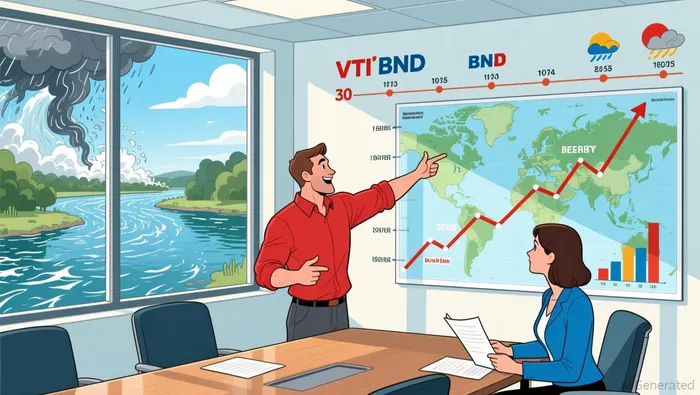
The 30-Year Perspective: Compounding and Market Cycles
The critical distinction lies in the compounding effect of equities over decades. From April 2007 to December 2025, VTI surged 551.66%, compared to BND's 76.24% total return. Annualized returns of 10.55% for VTI versus 3.08% for BND highlight the stark growth disparity. While BND's Sharpe ratio (1.58) and Sortino ratio (2.33) outperformed VTI's (0.92 and 1.41, respectively), these metrics prioritize risk mitigation over growth.
For buy-and-hold investors, the ability to endure short-term volatility is key. VTI's maximum drawdown of -55.45% during the 2007–2025 period pales in comparison to its long-term gains. In contrast, BND's -18.84% drawdown reflects its lower volatility but also its limited upside. Over 30 years, the higher returns of equities outweigh their volatility, particularly when investors remain committed through market cycles.
Strategic Allocation for a $100,000 Portfolio
A $100,000 portfolio allocating 70–80% to VTI and 20–30% to bonds or international equities can balance growth and risk. This approach leverages VTI's broad U.S. market exposure while hedging against downturns. For example, a 70/30 VTI/BND split would have grown to approximately $1.1 million by 2025, assuming VTI's 10.26% annualized return and BND's 4.03%.
International equities, while outperforming U.S. stocks in 2025, remain volatile and less liquid. The Vanguard Total International Stock ETF (VXUS) gained 8.7% from 2018–2025 compared to VTI's -5.5%, but such performance is inconsistent and subject to geopolitical risks. Real estate and bonds, while useful for diversification, cannot match the compounding power of equities over decades.
Conclusion
For buy-and-hold investors, VTI's broad U.S. market exposure offers a compelling combination of growth and diversification. While bonds and real estate may provide superior risk-adjusted returns in the short term, equities' compounding potential over 30+ years justifies their central role in long-term portfolios. By allocating a significant portion to VTI, investors can harness the resilience of the U.S. stock market while mitigating risk through strategic diversification.







Comentarios
Aún no hay comentarios