
Are Long-Term Bitcoin Holders Accumulating or Distributing? On-Chain Signals and Institutional Dynamics Signal a Transitioning Bull Market
The BitcoinBTC-- market in 2025 has been a tapestry of conflicting signals, with on-chain behavioral metrics and institutional dynamics painting a nuanced picture of a transitioning but still fundamentally bullish cycle. As the year draws to a close, the interplay between whale accumulation, short-term holder distress, and surging institutional demand offers critical insights into the strategic repositioning of long-term Bitcoin holders-and what this means for price stability and future upside in early 2026.
Whale Accumulation: A Reversal of Prior Distrust
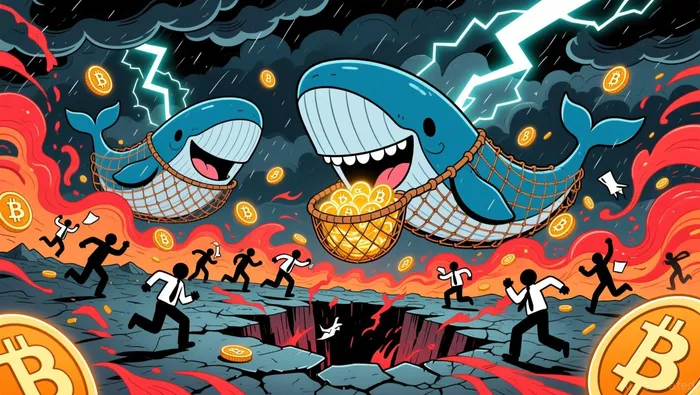
Bitcoin whales and sharks-wallets holding 10,000 BTC and 1,000–10,000 BTC, respectively-have exhibited a striking shift in behavior during Q3 2025. , these entities initiated a significant buying spree, . This reversal coincided with the emergence of 91 new wallets , a clear indicator of growing bullish sentiment among large holders. Analysts interpret this as a sign of confidence in Bitcoin's long-term trajectory, particularly as retail capitulation and short-term selling pressure create attractive entry points for strategic accumulation according to research.
SOPR and HODL Wave Shifts: A Bearish Undercurrent
While whale activity suggests optimism, on-chain metrics like the (SOPR) and analysis reveal a more complex narrative. By November 2025, Bitcoin's SOPR had dipped below 1.0, . This aligns with historical patterns where SOPR contractions often precede market tops.
Institutional Dynamics and ETF-Driven Demand: A New Bullish Catalyst
Amid this mixed on-chain landscape, institutional demand for Bitcoin has surged, acting as a stabilizing force. By Q3 2025, 68% of institutional investors had either invested in or planned to invest in Bitcoin ETPs, driven by regulatory clarity (e.g., the passed in July 2025) and Bitcoin's growing role as a store of value. U.S.-listed Bitcoin ETFs alone during the early part of the year, .
This institutional adoption is not merely speculative. With Bitcoin's inverse correlation to the U.S. dollar and its appeal as an , long-term institutional conviction remains robust. Analysts and potential price appreciation in 2026, even as macroeconomic uncertainties persist.
Synthesis: A Transitioning Market with Bullish Underpinnings
The 2025 Bitcoin market cycle reflects a strategic repositioning by long-term holders. While SOPR and HODL Wave data highlight distribution pressures from older cohorts of long-term holders, whale accumulation and institutional demand are creating a counterbalance. This duality-where short-term holders exit at a loss and large players accumulate-mirrors historical patterns preceding major bull runs.
For investors, the implications are clear: the market is transitioning from a phase of uncertainty to one of reaccumulation. The surge in whale activity, coupled with institutional ETF-driven demand, suggests that Bitcoin's long-term holders are not merely distributing but selectively accumulating at discounted levels. As these dynamics converge with regulatory tailwinds, the stage is set for a potential price rebound in early 2026.






Comentarios
Aún no hay comentarios