
London's Homebuilding Slowdown: Unlocking Undervalued Real Estate and Construction Opportunities in a Supply-Constrained Market
London's residential construction market is at a crossroads. A sharp decline in housing starts-now at their lowest level since 2010-has created a supply-demand imbalance that is reshaping investment dynamics. By 2027, the city could face a shortfall of nearly 170,000 homes due to stalled planning activity and construction bottlenecks, according to a CBRE report. Yet, this slowdown has also exposed pockets of undervalued assets, particularly in outer boroughs where affordability, public sector investment, and regeneration efforts are converging to create compelling opportunities for real estate and construction sector investors.
The Supply-Demand Imbalance: A Catalyst for Strategic Investment
The UK's housing market has long grappled with supply constraints, but London's situation is acute. In the 2024–2025 financial year, England (excluding London) recorded 38,308 housing starts and 36,872 completions, with 79% of starts allocated to affordable housing, according to GOV.UK housing statistics. However, London-specific data reveals a starker picture: 23 boroughs reported zero starts in Q1 2025, and construction activity has plummeted due to regulatory delays, rising input costs, and labor shortages, RLB's CMI Q1 2025 reports that RLB's CMI Q1 2025. The Building Safety Act, while critical for safety, has added 12–18 months to project timelines for high-rise developments, further straining the market, according to the RICS UK Construction Monitor.
This imbalance has created a paradox. While demand for high-quality and affordable housing remains robust-driven by both domestic and international buyers-supply is constrained by systemic challenges. The result? A market where prime central London properties sell at an average 8.6% discount to asking prices, according to a CliftonPF analysis, while outer boroughs offer yields exceeding 7%, according to GeoGlider property stats.
Undervalued Boroughs: Where Affordability Meets Growth
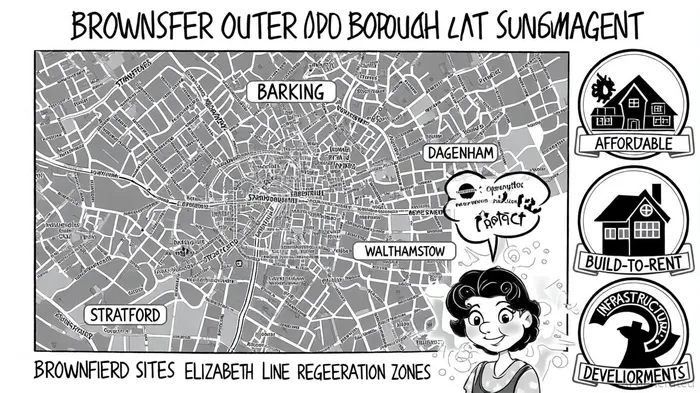
Outer London areas like Barking and Dagenham, Walthamstow, and Stratford are emerging as hotspots for value-driven investment. Barking and Dagenham, for instance, offers a gross rental yield of 6.2%, one of the highest in the capital, supported by its Barking Riverside regeneration project, following a London Councils announcement. This 443-acre brownfield site, now expanded to deliver 20,000 homes, has secured £124 million in government funding to build flood defenses, schools, and transport infrastructure, reported the Barking & Dagenham Post. Similarly, Walthamstow's redevelopment-anchored by a new town square, arts hubs, and improved transport links-has attracted investors with its 5.1% yield and average property prices of £480,000, according to London Insider.
Price trends underscore these opportunities. While central London's prime areas like Kensington and Chelsea remain dominated by international buyers (average prices > £1.2 million), outer boroughs like Bexley have seen 5.1% annual price growth, per Plumplot maps. Wandsworth, Hackney, and Victoria Park have also outperformed, with price increases of 2.9–6.3% in 2024, as noted by the CliftonPF analysis. Crucially, these areas benefit from lower price-to-income ratios (e.g., Barking Riverside: 5.2) and strong public sector backing, including £11.7 billion allocated for affordable housing over ten years, according to London Councils.
Construction Sector Opportunities: BTR and Affordable Housing Pipelines
The construction sector is pivoting toward models that align with London's supply constraints. Build-to-Rent (BTR) developments, which offer professionally managed long-term rentals, are gaining traction. As of Q1 2025, London alone has 39,000 BTR units in the planning pipeline, driven by infrastructure upgrades like the Elizabeth Line and demand for high-quality rental stock, according to an Entralon guide. Developers are also prioritizing affordable housing, with 77% of completions in 2024–2025 attributed to this sector, according to GOV.UK housing statistics.
Key projects in outer boroughs exemplify this shift. The Marsh Lane – 213 Flats in Waltham Forest (valued at £55.17 million) and Barking Riverside's 20,000-home expansion highlight the scale of investment. These projects are not only addressing housing shortages but also leveraging public-private partnerships to mitigate risks. For example, Barking Riverside's £124 million funding package from Homes England includes infrastructure for an energy center and flood defenses, reducing long-term operational costs, LQ Group reports in its coverage of the scheme LQ Group.
Regulatory Challenges and the Path Forward
Despite these opportunities, investors must navigate a complex regulatory landscape. The Building Safety Act's Gateway 2 and 3 approvals have delayed projects, while labor shortages and material costs remain persistent hurdles, the RICS UK Construction Monitor found. However, infrastructure-led regeneration zones-such as Old Oak Common and Stratford-are seeing faster approvals, supported by government streamlining efforts, according to RICS construction market intelligence.
The path forward lies in aligning with public sector priorities. Affordable housing and BTR schemes are increasingly prioritized in planning applications, and modular construction methods are gaining traction to reduce costs and timelines, per a ConstructAI analysis. Investors who focus on these sectors, particularly in outer boroughs with strong rental yields and regeneration momentum, are well-positioned to capitalize on London's evolving market.
Conclusion: A Market of Contrasts and Opportunities
London's homebuilding slowdown is not a sign of decline but a catalyst for strategic reallocation. While central London's prime properties trade at discounts, outer boroughs offer a compelling mix of affordability, yield, and growth potential. For construction sector investors, the key lies in targeting BTR and affordable housing projects that align with public sector funding and regulatory trends. As the market adjusts to supply constraints, those who act decisively in undervalued areas will find themselves at the forefront of London's next phase of development.







Comentarios
Aún no hay comentarios