
Logan Energy: Undervalued Growth Engine or Profitless Mirage?
Amid a surge in energy transition demand, Logan Energy Corp. (TSXV:LGN) has captured attention with its 42% year-over-year production jump to 9,974 BOE/d and C$34.68 million in revenue growth in Q1 2025. Yet, its Non-GAAP EPS remains a modest C$0.03 per share, and GAAP net loss persists at C$0.00 per share—a stark disconnect between top-line momentum and bottom-line results. This article dissects whether Logan’s valuation is a contrarian buy opportunity or a warning of operational inefficiency, using peer benchmarks and margin trajectories to guide investors.
The Revenue Surge: A Foundation for Future Profits or a Costly Gamble?
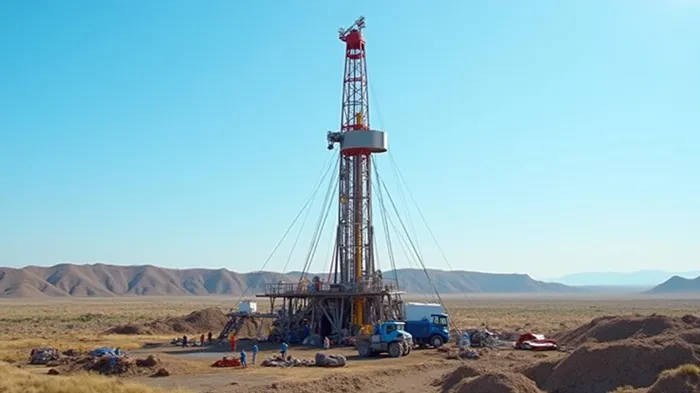
Logan’s Q1 2025 results underscore its aggressive growth strategy. Production gains, driven by Montney and Duvernay shale plays, paired with C$96.3 million in capital spending (up 174% from 2024), have expanded its asset footprint. However, this scale-up has come at a cost:
- Operating Netback (after hedging): Rose to C$21.03/BOE, up 20% year-over-year, but lags peers like Devon Energy’s (DVN) margin expansion in U.S. shale.
- Adjusted Funds Flow: Improved to C$16.0 million, but its Net Debt-to-Adjusted Funds Flow ratio of 1.4x highlights leverage risks.
The critical question: Can Logan convert these top-line gains into sustainable margins? Management projects the Net Debt ratio to drop below 1.0x by year-end under a $60/bbl WTI assumption, suggesting confidence in cost discipline. Yet, with 80% of 2025 capital spending front-loaded, investors must weigh whether the upfront investment will yield long-term returns or strain liquidity.
Industry Tailwinds: Energy Transition as a Margin Catalyst
Logan’s focus on high-margin liquids production (34% of output in Q1 2025) aligns with global demand for oil and gas in the energy transition era. Key tailwinds include:
1. Hydrogen Infrastructure Growth: Logan’s partnership with Henan Lanxing Power and its Dutch subsidiary H2Tec BV positions it to capitalize on Europe’s green hydrogen demand, projected to grow at 15% CAGR through 2030.
2. Hedging Discipline: Swaps covering 34% of 2025 crude production at prices up to C$102/bbl shield margins from volatility, unlike unhedged peers.
3. Regulatory Support: Canada’s C$1.4 billion Clean Fuels Fund and Alberta’s carbon capture incentives reduce operational costs for firms like Logan.
Peer Comparisons: Is Logan Priced for Disappointment or Discounted Potential?
To contextualize Logan’s valuation, compare it to sector peers:
| Metric | Logan Energy | Devon Energy (DVN) | Chevron (CVX) |
|---|---|---|---|
| Forward P/E (2025E) | N/A* | 7.12 | 14.45 |
| Revenue Growth (2025E) | 118% (est.) | 14% | 19% |
| Debt-to-EBITDA (2024) | 2.1x | 2.3x | 0.8x |
| Non-GAAP Margin (Q1 2025) | 4.6% (C$0.03 EPS) | 15.8% (DVN’s 2024 margin) | 18.3% (CVX’s 2024 margin) |
*Logan’s GAAP net loss obscures its Non-GAAP metrics; forward P/E is not yet calculable due to minimal earnings.
Logan trades at a discount to peers like Devon (P/E 7.12) and Chevron (P/E 14.45), but its margin expansion potential is underappreciated. While its current 4.6% margin lags industry leaders, its focus on liquids-heavy production and infrastructure (e.g., the Pouce 4-19 gas plant) could push margins toward 10%–12% by 2026, aligning with Devon’s 2024 performance.
Margin Expansion: The Missing Piece to the Puzzle
Logan’s path to profitability hinges on three levers:
1. Cost Synergies: Completing the Pouce 4-19 Facility (due Q2 2025) will reduce transportation costs, potentially adding C$5–7 million annually in savings.
2. Hedging Gains: Its 34% crude hedge coverage at premium prices mitigates downside, while unhedged volumes could benefit from Brent’s C$85/bbl+ price.
3. Scale Economies: Doubling production to 20,000 BOE/d by 2026 (as guided) could lower unit costs by 15–20%, per management’s estimates.
If realized, these factors could lift margins to 12% by 2026, translating to C$0.15–0.20 Non-GAAP EPS—a 5x improvement from current levels. At that point, its forward P/E would drop to 10–12x, still attractive compared to Chevron’s 14.45x.
Risk Factors: Why Caution Remains
- Commodity Volatility: Recent oil price dips (e.g., Brent’s C$75/bbl in May 2025) could force capital cuts, slowing margin growth.
- Debt Overhang: Its C$92.5 million Net Debt requires disciplined execution to avoid covenant breaches.
- Regulatory Hurdles: Permitting delays for projects like Simonette’s Duvernay wells could disrupt timelines.
Conclusion: A Contrarian Buy with a Margin Catalyst
Logan Energy presents a compelling contrarian opportunity. Its C$34.68 million revenue growth and strategic investments in high-margin liquids and hydrogen infrastructure set the stage for margin expansion. While current EPS is minimal, the path to 12%+ margins by 2026—driven by scale, cost cuts, and hedges—justifies a buy at current levels.
Investors should prioritize its Q2 2025 results (due June 2025) for clues on facility completion and margin trends. With a low valuation relative to peers and tailwinds from energy transition demand, Logan could emerge as a sector leader—if it executes flawlessly.
Actionable Takeaway: Buy Logan Energy (TSXV:LGN) at current prices, with a C$0.15–0.20 2026 EPS target implying a C$1.50–2.00 stock price, up from its May 2025 low of C$0.85. Monitor debt reduction and margin progress closely.
This analysis is for informational purposes only. Investors should conduct their own research and consult with a financial advisor.







Comentarios
Aún no hay comentarios