
Why Locking in High CD Rates Now Could Outperform Future Savings Strategies in a Downturning Rate Environment
The Federal Reserve's recent policy shifts and forward guidance have created a unique window for savers to capitalize on historically elevated certificate of deposit (CD) rates. As of December 2025, the Fed has cut the federal funds rate by 25 basis points, bringing it to a range of 3.5%–3.75%, while market analysts anticipate further reductions in 2026, potentially pushing rates toward 3%–3.25%. This downward trajectory, coupled with current CD rates peaking at 4.18% APY, presents a compelling case for locking in today's rates through strategic CD laddering.
The Fed's Rate-Cutting Path and Its Implications
The Federal Reserve's December 2025 Summary of Economic Projections underscores a cautious approach to monetary policy, with only one rate cut expected in 2025 and additional reductions likely in 2026. Chairman Jerome Powell emphasized that the fed funds rate is nearing its neutral value, but further adjustments will hinge on economic data, particularly labor market conditions and inflation trends. While the Fed projects GDP growth to stabilize at 1.7% for 2025 and PCE inflation to ease to 2.9%, the unemployment rate is expected to remain stubbornly high at 4.5%. These signals suggest a prolonged period of accommodative policy, increasing the likelihood of declining rates in the near term.
Current CD Rates: A Rare Opportunity
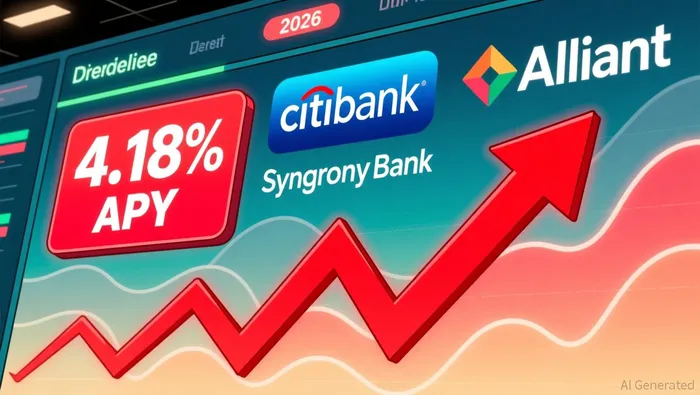 As of December 2025, the best CD rates available range from 3.50% to 4.18% APY, with institutions like Citibank, Synchrony Bank, and Alliant offering competitive terms. These rates are particularly attractive when compared to the Fed's projected trajectory, which implies a significant erosion of returns if savers delay locking in rates. For instance, a three-month CD at 4.18% APY currently outperforms the Fed's 3.5%–3.75% target range, and further rate cuts in 2026 could widen this gap. Experts warn that waiting to reinvest maturing CDs in a lower-rate environment could result in "opportunity costs" that are difficult to recover.
CD Laddering: Balancing Liquidity and Rate Security
To mitigate the risks of tying up capital in long-term CDs while still capitalizing on current rates, a CD laddering strategy is optimal. This approach involves purchasing multiple CDs with staggered maturity dates, ensuring periodic access to funds while maintaining exposure to higher rates. For example, a $2,500 investment split into one-, two-, three-, four-, and five-year CDs allows savers to reinvest maturing portions at prevailing rates without locking in all capital at once. In a rate-cutting environment, this strategy reduces the risk of reinvestment at lower yields and provides flexibility to adjust holdings as market conditions evolve.
The Case Against Waiting
While some may argue that delaying CD purchases allows for "timing the market," the Fed's forward guidance and historical patterns suggest this approach is fraught with uncertainty. The Fed's dual mandate-prioritizing maximum employment and price stability-means rate cuts are more likely to accelerate if inflation remains below target or labor market risks materialize. Given that PCE inflation is projected to dip to 2.9% in 2025 and 2.4% in 2026, the incentive to lock in current rates before further declines is strong. Additionally, online banks and credit unions are likely to reduce their CD rates in response to Fed policy, compounding the opportunity cost of inaction.
Conclusion
In a landscape where the Fed's rate-cutting path is both predictable and inevitable, locking in today's high CD rates through a laddering strategy offers a robust defense against future uncertainty. By securing current yields while maintaining liquidity, savers can outperform passive strategies that rely on the hope of higher rates in the future. As the Fed's policy pivot continues, the window to act is narrowing-making now the optimal time to secure long-term financial stability.







Comentarios
Aún no hay comentarios