
Lockheed Martin's Recent Contract Wins and Their Implications for Defense Sector Growth
In September 2025, Lockheed MartinLMT-- secured two landmark contracts that underscore its dominant position in the defense sector and its alignment with accelerating global security demands. The first, a $9.8 billion U.S. Army contract for 1,970 Patriot Advanced Capability-3 Missile Segment Enhancement (PAC-3 MSE) interceptors, marks the largest in the company's Missiles and Fire Control business history[1]. The second, a $10.855 billion Navy contract for Sikorsky's CH-53K King Stallion helicopters, spans deliveries from 2029 to 2034 and reinforces production stability[6]. Together, these deals reflect a strategic pivot toward high-demand areas—missile defense and heavy-lift aviation—while amplifying recurring revenue potential in a sector poised for sustained growth.
Strategic Positioning in a High-Demand Industry
The U.S. defense market, valued at $320.86 billion in 2025, is projected to grow at a 3.58% compound annual rate through 2030[2]. Globally, the sector is expected to expand at 6.8% annually, reaching $985.4 billion by 2034[5]. LockheedLMT-- Martin's recent contracts align with two critical drivers of this growth: modernization of aging military systems and the urgent need for advanced missile defense capabilities.
The PAC-3 MSE contract, for instance, addresses the U.S. Army's requirement to counter hypersonic threats and ballistic missiles—a priority highlighted by the National Defense Authorization Act (NDAA) 2025[6]. With production ramping up to deliver over 600 interceptors in 2025 alone[1], Lockheed is not only securing near-term revenue but also solidifying its role as a key supplier for allied nations operating the PAC-3 system. Seventeen partner countries, including the U.S., rely on this platform, creating a recurring revenue stream through maintenance, upgrades, and future procurement cycles[3].
Similarly, the CH-53K helicopter contract leverages the Marine Corps' need for heavy-lift capabilities in expeditionary operations. By securing a 5-year production timeline (2029–2034), Sikorsky ensures long-term supply chain stability and mitigates risks associated with fluctuating defense budgets[6]. This aligns with broader industry trends, as the Air Force and Marine Corps prioritize modernization of legacy fleets to counter peer adversaries[2].
Recurring Revenue and Market Share Dynamics
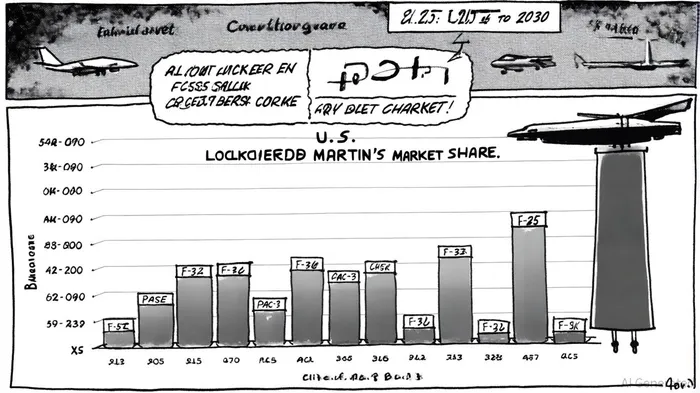
Lockheed Martin's market share in the aerospace and defense industry stood at 23.3% in Q2 2025, slightly down from 23.72% in Q1 but still reflecting its dominance[1]. The F-35 Lightning II program remains a cornerstone, accounting for nearly one-third of the company's revenue[4]. However, the PAC-3 MSE and CH-53K contracts diversify its revenue base, reducing reliance on any single program while enhancing cash flow predictability.
The PAC-3 MSE deal, with a 3-year delivery window (2024–2026), ensures steady production and inventory replenishment for the Army[2]. Analysts at Baird upgraded Lockheed to “Outperform” following these wins, citing strong demand for missile systems and the company's proactive production scaling[4]. Meanwhile, the CH-53K contract, though delayed in delivery, locks in revenue over a decade-long horizon, providing a buffer against short-term budget volatility[6].
Recurring revenue is further bolstered by the F-35 program's global expansion. With allied nations announcing additional purchases[2], Lockheed is on track to deliver 156 units annually through 2027[4]. This, combined with technology refresh upgrades, ensures long-term profitability. The company's $173 billion backlog, as of 2025, also provides a runway for sustained earnings growth[5].
Implications for the Defense Sector
Lockheed Martin's success highlights a broader industry shift toward high-technology, high-margin systems. The U.S. defense budget's 3.2% increase to $950.8 billion in 2026, driven by tensions with China and Russia, underscores this trend[6]. Research, development, and testing (RDT&E) now constitute 33.5% of the budget, favoring firms with advanced R&D capabilities like Lockheed's hypersonic missile programs[6].
Moreover, the company's dual focus on missile defense and heavy-lift aviation positions it to benefit from overlapping demand. For example, the PAC-3 MSE's combat-proven hit-to-kill technology is adaptable to future threats, while the CH-53K's cargo capacity supports distributed operations—a strategic imperative for the Marine Corps[1]. This versatility enhances Lockheed's competitive edge against rivals such as Boeing and Raytheon Technologies.
Conclusion
Lockheed Martin's recent contract wins are more than short-term victories—they are strategic investments in a defense sector primed for growth. By securing multi-year deals in missile defense and heavy-lift aviation, the company is diversifying its revenue streams, strengthening its market share, and aligning with long-term modernization priorities. As the U.S. and its allies continue to prioritize readiness against emerging threats, Lockheed's ability to deliver cutting-edge systems at scale will likely drive recurring revenue and shareholder value for years to come.







Comentarios
Aún no hay comentarios