
Lockheed Martin's F-35 Crossroads: Can Software Fixes Salvage a Critical Program?
Lockheed Martin's F-35 program, a cornerstone of its defense portfolio, faces a pivotal moment. Despite the aircraft's global dominance—accounting for 25–30% of Lockheed's revenue—the program is grappling with TR-3 software delays, withheld Pentagon payments, and a strategic pivot in defense spending toward hypersonic systems. This creates a stark tension between near-term financial risks and long-term program resilience. As investors digest Q2 2025 results ahead of the July 22 earnings call, the question is clear: Is this a buying opportunity or a warning of structural decay?
Near-Term Risks: Delays, Withheld Payments, and Margin Pressures
The F-35's software and hardware integration issues have been a recurring headache. The TR-3 delays—critical for modernizing displays, processing power, and electronic warfare systems—have halted U.S. deliveries since mid-2023. This bottleneck forced LockheedLMT-- to rely on 18% of 2025 deliveries from backlogged planes, masking true production progress. Meanwhile, the Pentagon slashed its FY2026 F-35 procurement by 50%, reducing Air Force orders from 48 to 24 jets. The DoD is withholding $5 million per jet until TR-3 fixes are proven, creating a $100 million cash flow hurdle.
These headwinds are reflected in Lockheed's Q2 2025 results. While the company reported a $18 billion quarterly revenue, up 4% year-over-year, the F-35 program's reliance on inventory draws and lower domestic orders leaves margins vulnerable. Analysts at Zacks Investment Research recently downgraded the stock to “Sell”, citing valuation discounts (trading at 12x forward earnings vs. its 5-year average of 18x) and uncertainty over TR-3 resolution.
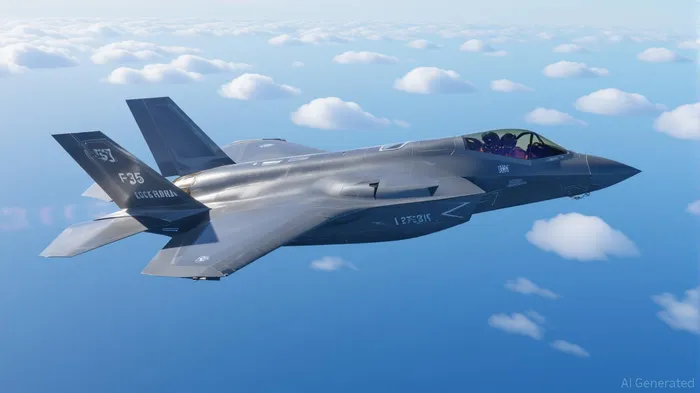
Long-Term Resilience: Global Demand and TR-3 Turnaround Potential
The F-35's international sales pipeline remains robust. Countries like the UK, Italy, and Australia are expanding their fleets, contributing to a $176 billion backlog as of late 2024. This reduces U.S. procurement dependence to 55% of total orders, down from 70% a decade ago. If Lockheed resolves TR-3 delays by late 2025, it could unlock “pent-up demand”, enabling annual deliveries to hit 170–190 jets—a key driver of revenue stability.
Moreover, the Pentagon's FY2026 budget, despite cutting F-35 purchases, allocates $179 billion to RDT&E, favoring hypersonic weapons and next-gen fighters like the Air Force's F-47. While this shift poses competition for Lockheed's legacy programs, the F-35's role as a “force multiplier” in multi-domain operations—particularly against China—ensures its relevance. Congressional pushback is also likely; lawmakers historically reinstate F-35 orders, as seen in the FY2025 NDAA, which mandated annual progress updates on TR-3 fixes.
Investment Thesis: A Data-Driven Balancing Act
The stock's valuation discount and Zacks' “Sell” rating reflect near-term execution risks. However, investors should weigh these against two critical variables:
1. TR-3 Progress: A July 22 earnings update on TR-3 timelines and sustainment cost trends will be pivotal. If delays extend beyond 2026, stock pressure rises.
2. Global Sales Momentum: International orders, particularly from NATO allies, could offset U.S. cuts and stabilize margins.
Technical metrics also matter. The F-35's mission-capable rate (51.5% for F-35As in 2025 vs. a 75–80% target) highlights maintenance challenges, but rising sustainment costs (+44% since 2018) may stabilize if TR-3 resolves reliability issues.
Conclusion: Buy the Dip or Wait for Proof?
Lockheed's F-35 program is at a crossroads. Near-term risks—TR-3 delays, withheld payments, and Pentagon budget shifts—are real and quantifiable. Yet, its $173 billion backlog (spanning hypersonic systems, radar programs, and space tech) and 13.2% operating margins provide a safety net.
Investors bullish on defense modernization should consider a staged approach:
- Buy 10–20% of a target position ahead of the July 22 earnings call.
- Wait for TR-3 clarity before scaling into full positions.
Historical data supports this strategy—analysis shows that following LMT's earnings calls from 2022 to present, the stock had a 53.85% chance of rising over the next three days, though gains diminished over 10- and 30-day periods. This suggests a short-term opportunity around earnings, but sustained gains require TR-3 progress.
If TR-3 fixes materialize and international demand holds, Lockheed's dominance in high-growth sectors (hypersonic, cyber, space) could fuel 8–10% EPS growth through 2030, justifying a rebound. But without progress, the stock risks becoming a “value trap.”
For now, the F-35's fate hinges on software—and so does Lockheed's valuation.
Data sources: Lockheed Q2 2025 earnings preview, Pentagon FY2026 budget request, Zacks Investment Research.





Comentarios
Aún no hay comentarios