
Lockheed Martin's $250M F-35C Contract: A Strategic Bet on Naval Dominance and Future Defense Spending
The U.S. Navy's recent $250.4 million contract modification for the F-35 Lightning II program marks a critical step in advancing the F-35C's role as the cornerstone of modern naval aviation. This funding, allocated to support low-rate initial production (LRIP) of the 11th lot of F-35 jets, underscores the aircraft's enduring strategic importance. For investors, the contract signals both near-term stability for Lockheed MartinLMT-- (LMT) and long-term opportunities tied to the F-35's evolving capabilities and global demand.
The F-35C: A Carrier-Based Game Changer
The F-35C variant, designed for aircraft carrier operations, is central to the Navy's vision of air dominance in contested environments. Recent milestones, such as the first-ever Field Carrier Landing Practices (FCLPs) at Iwo To, Japan, demonstrate the aircraft's readiness for frontline deployment. These drills, conducted by Strike Fighter Squadron VFA-147, highlighted the F-35C's ability to operate in demanding conditions, including nighttime carrier landings.
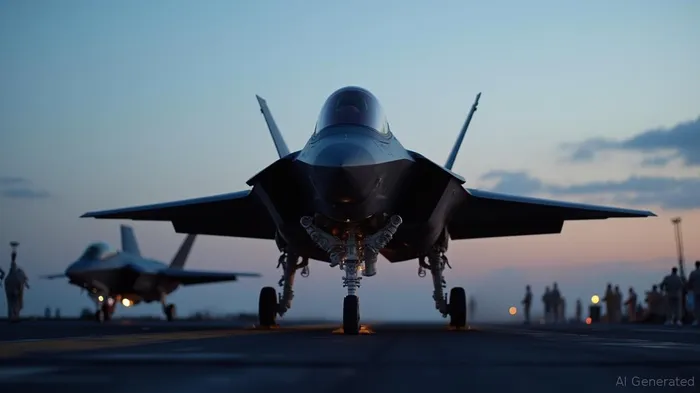
Beyond operational readiness, the F-35C's Block 4 upgrades—a multiyear modernization effort—are critical to its future relevance. These enhancements include:
- Weapon integration: The AGM-158LRASM anti-ship missile and "Six-in-the-Bay" internal air-to-air missile capability, boosting standoff strike and air combat prowess.
- Sensor improvements: New radar and electro-optical systems enhance situational awareness, while classified electronic warfare upgrades protect against advanced threats.
- Stealth and durability: Next Gen 2.0 stealth coatings reduce corrosion, extending service life and lowering maintenance costs.
Production Gains vs. Cost Challenges
Lockheed Martin aims to deliver 170–190 F-35s in 2025, a record pace driven by strong demand from the U.S. military and international partners. The contract modification supports this goal, with 14.7% of the funds allocated directly to the U.S. Navy. However, production delays for Lots 18/19—due to inflation and supply chain bottlenecks—pose risks. Unit costs for these later lots could exceed $100 million, intensifying scrutiny over the F-35's $2.1 trillion lifetime cost estimate.
Political Crosscurrents and Budgetary Realities
The F-35's future hinges on balancing its strategic value with rising costs. Congressional debates over the 2025 reconciliation package, which excluded additional F-35 funding, reflect concerns about prioritizing sixth-generation programs like the F-47. Yet the F-35C's role in forward-deployed air wings (e.g., CVW-5 in the Indo-Pacific) and its unmatched stealth capabilities make it indispensable for near-term conflicts.
Lockheed's proposal for an “Fifth-Gen Plus” upgrade—leveraging Block 4 tech to offer sixth-gen-like capabilities at a lower cost—could be a strategic counter to budget pressures. This approach aligns with the Navy's need to modernize without abandoning proven platforms.
Investment Implications: Steady Growth Amid Uncertainty
For investors, the $250M contract reinforces Lockheed's dominance in the fighter jet market, with F-35 sales expected to remain a core revenue driver. The stock's resilience—up 15% year-to-date amid geopolitical tensions—suggests market confidence in its defense backlog. However, risks persist:
- Upside: Strong international orders (e.g., Japan's recent F-35C purchase) and U.S. inventory targets of 2,456 aircraft provide a multiyear revenue runway.
- Downside: Delays in later lots and political pushback over costs could pressure margins.
Recommendation: Investors with a long-term horizon should view LMTLMT-- as a defensive play, benefiting from sustained global demand for fifth-gen fighters. Short-term traders may want to monitor congressional budget outcomes and production cost trends closely.
In conclusion, the F-35C's strategic importance to U.S. naval power and its evolving capabilities make LockheedLMT-- Martin's $250M contract a critical step forward. While challenges remain, the aircraft's role as the backbone of modern air forces positions it—and its manufacturer—for enduring relevance in defense spending.





Comentarios
Aún no hay comentarios