
Is Loblaw Companies (TSE:L) Significantly Undervalued or Mispriced? A Deep Dive into DCF Valuation and Market Sentiment
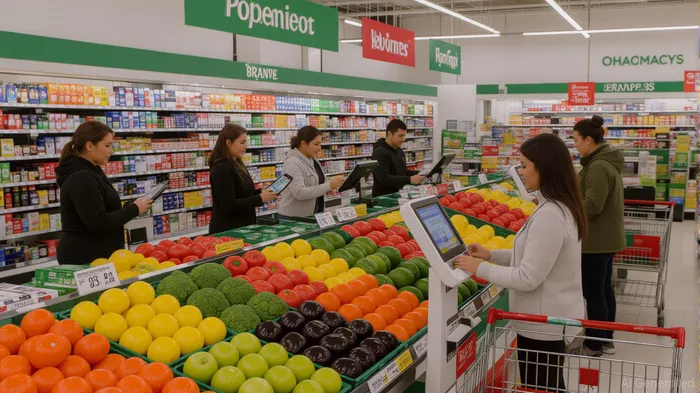
The grocery retail sector in Canada has long been a battleground of razor-thin margins and relentless competition. Yet, Loblaw Companies (TSE:L), the nation's largest food retailer, has consistently defied the odds. With Q2 2025 results showing 5.2% revenue growth, a 42.7% surge in operating income, and a 4-for-1 stock split, the company appears to be thriving. However, the question remains: Is the stock's current price of CA$56.88 a bargain, or is the market pricing in risks that DCF models overlook?
DCF Valuation: A Tale of Two Models
Discounted Cash Flow (DCF) models for Loblaw in 2025 yield wildly divergent intrinsic values, depending on the assumptions used. One model, using a two-stage growth framework, estimates an intrinsic value of CA$246.20 per share, implying a 77% undervaluation. This calculation assumes a 1.7% terminal growth rate (aligned with the 10-year government bond yield) and a 5.9% cost of equity. A second model, however, arrives at a fair value of CA$141.79, using a 2.0% growth rate and a 5.1% discount rate. The discrepancy highlights the model's sensitivity to inputs.
The key variables driving these differences are the terminal growth rate and discount rate. A 0.3% increase in the growth rate (from 1.7% to 2.0%) boosts the intrinsic value by 34%, while a 0.8% decrease in the discount rate (from 5.9% to 5.1%) adds another 12%. These adjustments underscore the fragility of DCF assumptions. For instance, if Loblaw's long-term growth is capped by industry cyclicality—such as margin compression from price wars or supply chain volatility—the 2.0% rate might be optimistic. Conversely, if the company's AI-driven efficiency gains (e.g., inventory optimization via “Robin”) or pharmacy clinic expansion outperform expectations, the 1.7% rate could be too conservative.
Market Sentiment: A Disconnect Between Fundamentals and Price
Despite robust financials, Loblaw's stock trades at just 24 times 2025 EPS estimates, far below its DCF-derived valuations. Analysts have set a price target of CA$161, suggesting the market is not fully pricing in the company's long-term potential. This disconnect could stem from several factors:
Industry-Wide Margin Pressures: The Canadian grocery sector is notoriously competitive. Loblaw's operating margin of 6.4% in 2024 is projected to fall to 5.7% over the next decade due to pricing constraints and consumer demand for value. While Loblaw's hard discount banners (e.g., Real Canadian Superstores) have outperformed, the broader industry's structural challenges may limit its ability to sustain high-margin growth.
Valuation Multiples vs. Intrinsic Value: Morningstar's fair value estimate of CA$148.00 aligns with the lower DCF model but still implies a 159% upside from current levels. However, this assumes a stable macroeconomic environment and no material shifts in consumer behavior. If inflationary pressures persist or GLP-1 drug patent expirations hit the pharmacy segment, the company's earnings could face headwinds.
Stock Split Impact: The 4-for-1 split, effective August 18, 2025, increased liquidity but did not alter the company's fundamentals. While it may attract retail investors, it does not address the core question of whether Loblaw's intrinsic value is being ignored.
Risk Factors: Can Loblaw Sustain Its Edge?
Loblaw's competitive position is strong, but not invulnerable. The company's value-driven strategy has driven market share gains, particularly in discount formats and pharmacy services. However, rivals like Sobeys and Metro are also expanding hard discount banners, and national chains like CostcoCOST-- and WalmartWMT-- are intensifying price competition. Additionally, Loblaw's reliance on AI and supply chain innovations introduces execution risk—if these tools fail to deliver promised efficiencies, margins could erode faster than expected.
Another critical risk is the pharmacy segment's exposure to drug patent expirations. While Loblaw's 23 new pharmacy clinics in Q2 2025 (bringing the year-to-date total to 23 of 100 planned) are a growth driver, the loss of exclusivity for key medications could pressure this division.
Investment Implications: A Calculated Bet
For investors, the key question is whether the market is underestimating Loblaw's ability to navigate these risks. The DCF models suggest a compelling upside, but the assumptions must be scrutinized:
- Growth Rate: A 2.0% terminal rate is reasonable for a mature company in a saturated market. However, if Loblaw's AI-driven cost savings or pharmacy clinic expansion outperform, this could be conservative.
- Discount Rate: A 5.1% cost of equity reflects a low-risk profile, but rising interest rates or sector-specific volatility could justify a higher rate.
- Margin Resilience: Loblaw's 32.0% retail gross profit margin and 12.2% adjusted EBITDA margin are strong, but maintaining these in a low-margin industry requires operational discipline.
Conclusion: A Stock for the Patient Investor
Loblaw Companies appears to be a compelling case of market underappreciation. While the DCF models suggest significant undervaluation, the assumptions must be viewed through the lens of industry dynamics and macroeconomic risks. For long-term investors who believe in the company's ability to execute its value-driven strategy, expand its pharmacy network, and leverage AI for efficiency, the current price offers an attractive entry point. However, those wary of sector-wide margin pressures or execution risks should approach with caution.
In the end, the answer to whether Loblaw is undervalued or mispriced depends on one's confidence in the company's ability to outperform its peers in a sector where survival is as much about agility as it is about scale. For now, the numbers tell a story of potential—but not without caveats.







Comentarios
Aún no hay comentarios