
The LNG Export Surge and Its Impact on U.S. Natural Gas Producers and Consumers
The U.S. liquefied natural gas (LNG) export boom has reshaped global energy dynamics, positioning the country as the world's largest LNG exporter. By 2025, U.S. LNG exports had surged to 11.9 billion cubic feet per day (Bcf/d), driven by robust global demand and rapid infrastructure expansion. This surge is not merely a short-term trend but a strategic shift with profound implications for producers, consumers, and investors navigating the evolving energy transition.
Impact on Producers: Growth, Revenue, and Infrastructure Challenges
The expansion of U.S. LNG export capacity has unlocked significant value for natural gas producers. With new projects like Plaquemines LNG Phase 2 and Golden Pass LNG nearing completion, U.S. LNG output is projected to exceed 30 Bcf/d by 2030. Producers are capitalizing on long-term contracts with Asian and European buyers, which provide stable revenue streams amid volatile global markets. Midstream companies, including Kinder MorganKMI-- and Williams CompaniesWMB--, are also benefiting from increased throughput as infrastructure connects production basins to export terminals according to market analysis.
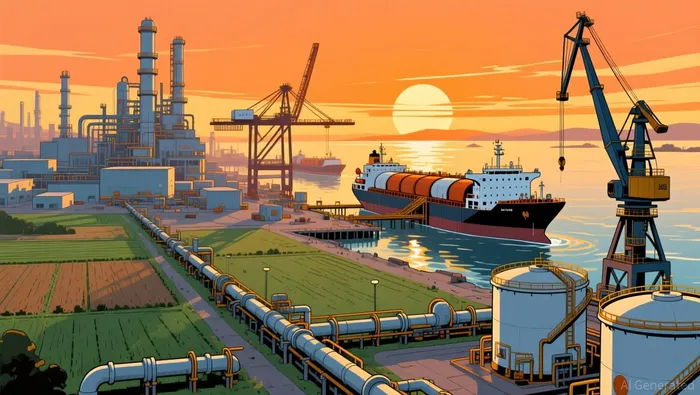
However, this growth comes with challenges. Domestic natural gas prices have risen sharply, with the Henry Hub spot price projected to hit $3.19 per million British thermal units in October 2025-a 58% increase year-over-year. This price pressure is partly due to the diversion of supply to export markets, which has reduced availability for domestic industrial consumers. Producers must balance the profitability of exports with the risk of overextending domestic supply chains.
Impact on Consumers: Rising Costs and Sectoral Disruptions
The surge in LNG exports has had mixed effects on U.S. consumers. While industrial sectors reliant on natural gas as a feedstock-such as chemicals and fertilizers-face higher input costs, the broader economy benefits from the geopolitical and economic advantages of U.S. energy leadership according to market analysis. Electricity prices have also risen, with natural gas accounting for over 40% of U.S. power generation in 2025. The average electricity price is expected to reach $47 per megawatt-hour in 2025, up 23% from 2024.
For consumers in emerging markets, U.S. LNG offers a critical alternative to Russian pipeline gas, enhancing energy security. Long-term supply agreements with countries like India and South Korea underscore the strategic value of U.S. LNG in diversifying energy portfolios.
Investment Trends and Strategic Positioning
The U.S. LNG sector is attracting record capital investments, with projects like Sempra's $10 billion Port Arthur LNG Phase 2 deal exemplifying the scale of opportunities. Strategic government actions, including fast-tracked permits and regulatory waivers, are accelerating project timelines. Investors are also diversifying business models, with niche players, tollers, and value chain optimizers adapting to global market dynamics.
Geopolitical partnerships further enhance strategic positioning. The Three Seas Initiative (3SI) has amplified U.S. LNG's role in Central and Eastern Europe, with countries like Poland and Croatia investing in LNG terminals to replace Russian gas. These partnerships are not just about energy but also reflect broader economic and security considerations.
Energy Transition and Decarbonization: LNG as a Bridge Fuel
As the energy transition gains momentum, LNG is increasingly viewed as a bridge fuel. Compared to coal, LNG emits approximately half the CO₂, making it a critical tool for countries aiming to reduce emissions while meeting rising energy demand. In South and Southeast Asia, LNG is being integrated with renewable energy to support decarbonization goals.
Technological innovations are further enhancing LNG's sustainability. Carbon capture and storage projects, such as the Tangguh LNG plant in Indonesia, are advancing rapidly, with global CCUS capacity expected to grow from 50 million tonnes of CO₂ capture in 2025 to 430 million tonnes by 2030. The U.S. Inflation Reduction Act and similar policies are incentivizing these technologies, creating new investment opportunities.
Risks and Opportunities in a Shifting Market
Despite its growth, the U.S. LNG sector faces risks. By 2030, global LNG markets could face an oversupply of up to 200 billion cubic meters, potentially compressing prices and reducing profitability for U.S. producers with higher production costs. Companies must also navigate infrastructure constraints and decarbonization pressures while leveraging opportunities in data center demand and industrial consumption according to industry analysis.
Investors are mitigating these risks through cost optimization, digital technologies, and hybrid energy strategies. For example, NextEra Energy is expanding renewable energy while maintaining a role for natural gas in meeting immediate power demands. Similarly, midstream operators are leveraging infrastructure proximity to supply reliable power to data centers according to market reports.
Conclusion: Strategic Positioning for the Future
The U.S. LNG export surge presents a unique window of opportunity for investors. Strategic positioning requires a balance between capitalizing on near-term growth and aligning with long-term decarbonization goals. Key strategies include:
1. Infrastructure Investment: Prioritize projects with proximity to production basins and export terminals.
2. Geopolitical Partnerships: Secure long-term supply agreements with emerging markets.
3. Decarbonization Integration: Invest in CCUS and green hydrogen to future-proof LNG assets.
4. Diversification: Adopt hybrid business models that blend LNG with renewables and storage.
As the energy transition unfolds, U.S. LNG will remain a cornerstone of global energy security. For investors, the challenge lies in navigating the dual imperatives of growth and sustainability-a task that demands both agility and foresight.





Comentarios
Aún no hay comentarios