
Livium Ltd's Strategic Position in the Semiconductor Supply Chain: Assessing Growth Catalysts and Execution Risks in LMMFF's Path to Scalability
Livium Ltd's Strategic Position in the Semiconductor Supply Chain: Assessing Growth Catalysts and Execution Risks in LMMFF's Path to Scalability
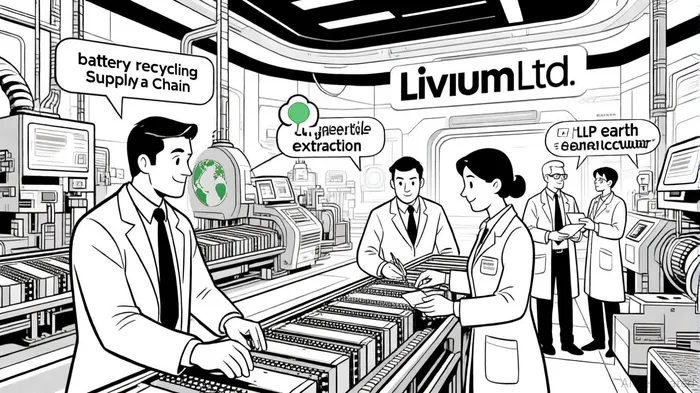
The semiconductor industry in 2025 is navigating a pivotal inflection point, driven by the exponential growth of generative AI, data center expansion, and the global energy transition. Amid this backdrop, Livium Ltd (ASX: LIT) has positioned itself as a critical player in the supply chain through its dual focus on battery recycling and advanced material innovation. This analysis evaluates the company's strategic initiatives, growth catalysts, and execution risks, particularly in the context of its Livium Materials and Mining Fund (LMMFF) scalability ambitions.
Strategic Partnerships and Technological Innovation: A Dual-Pronged Approach
Livium's strategic partnerships and technological advancements are central to its value proposition. The company has forged alliances with entities such as Iondrive and Won Kwang S&T to expand into high-growth markets like solar panel recycling and black mass processing, as described in Livium's recycling solutions. These collaborations are underpinned by a commitment to technological innovation, exemplified by its microwave-assisted leaching technology developed with the University of Melbourne. This technology enables the extraction of rare earth elements (REEs) from end-of-life batteries with over 95% recovery rates for neodymium and 80% for praseodymium, while reducing energy consumption by 85% compared to conventional methods, according to Livium's microwave technology.
The integration of digital tools further strengthens Livium's position. Its partnership with NoviqTech to tokenize battery recycling operations using blockchain-based platforms like Hedera's distributed ledger creates verifiable environmental assets, aligning with global regulatory demands for transparency in supply chains, per the NoviqTech partnership. This digital twin approach not only enhances traceability but also positions Livium to meet the evolving expectations of ESG-focused investors and regulators.
Market Position and Growth Catalysts
Livium's core battery recycling business, Envirostream, operates on a "fee for service" model, generating revenue from established industry partners. However, the company's true growth potential lies in its expansion into adjacent markets. The global lithium-ion battery recycling industry is projected to grow at a 20.6% CAGR, reaching $24.15 billion by 2032, according to the lithium-ion recycling market report, while the REE market is forecasted to reach $9.6 billion by 2026, per a rare-earth market forecast. Livium's ability to capture these markets hinges on its capacity to scale operations and leverage its existing infrastructure.
A key catalyst is the $30 million ARENA-funded LFP demonstration plant, which will produce lithium ferro phosphate (LFP) and lithium manganese ferro phosphate (LMFP) cathode powders. These materials are critical for high-performance batteries in electric vehicles (EVs) and energy storage systems, with LFP batteries expected to dominate 48% of the market by 2033, supported by the ARENA-funded LFP plant. Livium's proprietary VSPC technology, which combines solid-state and solution-phase synthesis, offers a competitive edge by enabling flexible, high-quality cathode production, via VSPC technology.
Regulatory tailwinds also bolster Livium's prospects. The 2025 ban on landfilling end-of-life solar panels and amendments to the Basel Convention are expected to increase demand for domestic recycling solutions, aligning with Livium's solar panel and REE recycling initiatives, according to Livium CEO strategy.
Execution Risks and Scalability Challenges
Despite these catalysts, Livium faces execution risks that could impede scalability. First, the company's reliance on strategic partnerships for technology development and market expansion introduces operational complexity. For instance, the success of its microwave REE extraction technology depends on seamless integration with existing processes, which could face technical or logistical hurdles, as noted in commentary on Livium's rare-earth ambitions.
Second, scaling operations to meet projected demand requires significant capital investment. While Livium has secured grants like the ARENA funding, additional financing may be necessary to triple its Victorian processing facilities and implement the "Spoke and Hub" model for national expansion, as reported by Proactive Investors. This raises questions about the company's ability to maintain profitability while managing debt or equity dilution.
Third, geopolitical and market dynamics pose risks. Livium's efforts to reduce Western reliance on Chinese REE processing are laudable, but geopolitical tensions could disrupt supply chains or create regulatory barriers. Additionally, competition from established players in battery materials and recycling could pressure margins, particularly as the market becomes more crowded.
Conclusion: A Calculated Bet on the Energy Transition
Livium Ltd's strategic position in the semiconductor supply chain is underpinned by its innovative recycling technologies, forward-looking partnerships, and alignment with global energy transition trends. The company's focus on REE recycling, LFP cathode production, and digital transparency addresses critical gaps in the supply chain, offering a compelling value proposition for investors. However, the path to scalability is not without challenges. Execution risks related to technological integration, capital requirements, and geopolitical dynamics must be carefully managed.
For LMMFF's scalability ambitions to materialize, Livium must demonstrate consistent operational execution, secure strategic funding, and navigate regulatory landscapes effectively. If successful, the company could emerge as a pivotal player in the circular economy, bridging the gap between battery recycling and semiconductor-grade material production.






Comentarios
Aún no hay comentarios