
LivePerson's 1-for-15 Reverse Stock Split: Strategic Rationale and Market Implications
LivePerson's (NASDAQ:LPSN) 1-for-15 reverse stock split, effective October 13, 2025, represents a high-stakes maneuver to stabilize its capital structure and preserve its Nasdaq listing. The move, approved by shareholders on October 2, consolidates every 15 shares into one, reducing authorized shares by 93% from 300 million to 20 million, according to a Panabee report. This drastic reduction aims to elevate the per-share price-trading at $0.54 before the split, per the MarketBeat chart-to meet Nasdaq's minimum $1.00 bid-price requirement, as reported by an Investing.com report. While the company's strategic refinancing in 2025, which deleveraged its balance sheet by $226 million and extended debt maturities to 2029, was detailed in a PR Newswire release and underscores its broader financial restructuring, the reverse split remains a critical short-term intervention.
Strategic Rationale: Compliance and Capital Efficiency
The reverse split is primarily a defensive measure to avoid delisting. Nasdaq's $1.00 bid price rule has long pressured LivePersonLPSN--, whose stock had fallen 64% year-to-date, according to MarketBeat. By reducing the share count, the company hopes to attract institutional investors, who often avoid low-priced stocks due to liquidity and transaction cost concerns. The split also simplifies capital management: with fewer shares outstanding, LivePerson can focus on deleveraging and aligning its equity structure with operational realities.
However, the move carries risks. A 1-for-15 ratio is exceptionally aggressive, potentially signaling desperation to investors. The company's cash-in-lieu policy for fractional shares further complicates shareholder value retention, as smaller investors face dilution. Yet, the company's simultaneous refinancing-capturing a $181 million debt discount as noted by Panabee-suggests a calculated effort to balance immediate compliance with long-term solvency.
Market Reaction: Mixed Signals and Analyst Skepticism
The stock's pre-split performance reflects investor uncertainty. From August 25 to October 8, LPSNLPSN-- traded between $0.50 and $1.08, with average daily volumes hovering around 7 million shares, per LivePerson investor relations. Post-announcement, trading volumes spiked on October 2–3, peaking at 12.6 million shares according to Yahoo historical prices, but prices remained volatile, closing at $0.50 on October 2 before rebounding to $0.56 by October 6, as shown in Yahoo's historical data. Analysts remain divided: Jeff Van Rhee of Craig-Hallum upgraded to "Buy" with a $1.40 target, as reported in a Nasdaq article, while Siti Panigrahi of Mizuho cut to "Neutral" at $0.50 in the same Nasdaq piece. The average 12-month price target of $1.03, per MarketBeat, implies a modest recovery, but the 40% gap between the pre-split price and Nasdaq's $1.00 threshold suggests the split alone may not resolve listing risks.
Capital Structure Optimization: Trade-offs and Long-Term Viability
LivePerson's capital overhaul extends beyond the reverse split. The refinancing initiative, which reduced debt by $226 million, was summarized in the PR Newswire release and provides a clearer path to positive cash flow by 2026, according to the company's earnings call highlights. Coupled with workforce reductions and cost-cutting measures, these steps aim to align expenses with revenue, which the company revised to a $235 million midpoint for 2025 in a Seeking Alpha note. Yet, the 93% reduction in authorized shares limits future fundraising flexibility, a potential constraint if growth opportunities arise.
The split's success hinges on its ability to catalyze a sustained price rebound. While the adjusted share price (theoretical pre-split value of $0.54 multiplied by 15, or $8.10) could attract new buyers, liquidity constraints and the company's $15.7 million Q2 2025 net loss, disclosed in a LivePerson press release, remain headwinds. Institutional investors may also scrutinize the lack of post-split volume data, as reduced liquidity could exacerbate volatility.
Conclusion: A Calculated Gamble
LivePerson's reverse stock split is a high-risk, high-reward strategy. It addresses immediate regulatory pressures and aligns with broader deleveraging efforts, but its long-term efficacy depends on operational execution and market confidence. Analysts' mixed ratings and the stock's historical underperformance highlight the challenges ahead. For investors, the split offers a glimpse of management's resolve but demands caution. The coming months will test whether LivePerson can transform its capital structure into a foundation for sustainable growth-or if the split will be remembered as a temporary fix for deeper structural issues.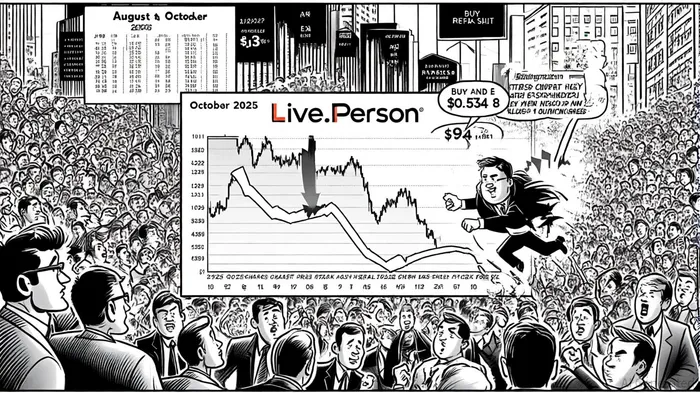





Comentarios
Aún no hay comentarios