
Live Nation's $1.3B Convertible Notes Offering: Strategic Debt Refinancing and Shareholder Value Implications
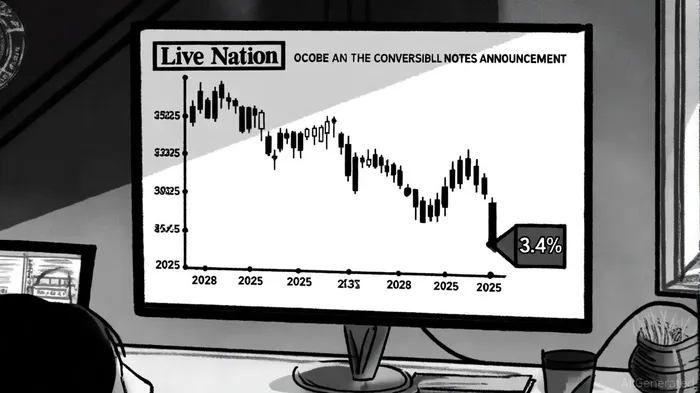
Live Nation Entertainment's recent $1.3 billion convertible senior notes offering has sparked significant debate among investors and analysts. The move, announced on October 8, 2025, aims to refinance existing high-yield debt, reduce interest costs, and fund long-term growth initiatives. However, the offering's potential to dilute shareholder value has triggered a 3.4% drop in the company's stock price, underscoring investor concerns about capital structure risks, according to a GuruFocus report. This article examines the strategic rationale behind the refinancing and evaluates its implications for shareholder value.
Strategic Debt Refinancing: A Cost-Saving Play
Live Nation's convertible notes, maturing in 2031, carry a 2.875% annual interest rate, significantly lower than the 5.625% rate on its existing senior notes due in 2026, according to a PR Newswire release. By redeeming the higher-yield debt, the company is projected to reduce annual interest expenses by approximately $46 million, assuming full utilization of the offering. The proceeds will also repay outstanding term loans and revolving credit facilities, further streamlining its debt obligations, per a Yahoo Finance article.
The offering aligns with broader refinancing goals. The company has simultaneously expanded its credit facilities, securing $1.3 billion in term loan B and multicurrency revolving credit lines, according to a MarketChameleon analysis. These measures enhance operational flexibility, particularly as Live NationLYV-- invests in venue expansions and digital ticketing innovations. MarketChameleon adds that the refinancing strategy is designed to "position Live Nation for sustained growth in a post-pandemic recovery phase."
Shareholder Value Implications: Balancing Dilution Risks
While the refinancing offers clear financial benefits, the convertible notes' structure introduces dilution risks. The notes are convertible into common stock at a price of $224.93 per share, a 50% premium to Live Nation's closing stock price of $149.95 on the announcement date, according to the PR Newswire release. If the stock price exceeds 130% of this conversion threshold ($292.41) for a sustained period after October 20, 2028, the company may redeem the notes, potentially triggering share issuance, according to a Live Nation announcement.
Such a scenario could dilute existing shareholders, reducing earnings per share (EPS) and pressuring the stock price. Data from GuruFocus indicates that the market reacted swiftly to these risks, with shares falling 3.4% post-announcement. Analysts at GuruFocus note that Live Nation's debt-to-equity ratio, already elevated at 1.2x, could rise further if the notes are converted, complicating efforts to improve credit metrics.
Strategic Trade-Offs and Market Sentiment
The offering reflects a calculated trade-off between short-term cost savings and long-term dilution risks. By locking in low-interest debt, Live Nation gains breathing room to invest in growth while avoiding near-term refinancing pressures. However, the 50% premium embedded in the conversion price suggests investors are skeptical about the stock's ability to sustain such gains, particularly in a volatile entertainment sector.
A visual comparison of the new notes' terms with existing debt highlights the cost advantages (see chart below). Meanwhile, the stock's post-announcement decline underscores market sensitivity to capital structure changes. As Yahoo Finance notes, "Live Nation's ability to balance debt reduction with shareholder returns will be critical in maintaining investor confidence."
Conclusion: A High-Stakes Refinancing Gambit
Live Nation's convertible notes offering is a strategic move to stabilize its debt profile and fund growth. The lower interest costs and expanded credit facilities provide tangible benefits, but the dilution risks and market reaction highlight the challenges of balancing debt management with shareholder value. Investors must weigh the company's growth potential against the likelihood of conversion and its impact on EPS. For now, the offering underscores Live Nation's commitment to navigating a complex financial landscape-though its success will depend on the stock's performance and the company's ability to execute its expansion plans.





Comentarios
Aún no hay comentarios