
Lithium Americas' Volatility: A Balancing Act Between Strategic Catalysts and Market Risks
Lithium Americas (LAC) has become a lightning rod for speculation in the lithium equity space, with its stock surging over 23% in early October 2025 following a landmark $2.26 billion loan agreement with the U.S. Department of Energy (DOE). The deal, which includes a 5% equity stake in both the company and its Thacker Pass project, has been hailed as a "game-changer" by Wedbush analyst Dan Ives, who upgraded LAC's price target to $8, citing deferred debt service costs and long-term financial stability, according to a Lithium Market Insight 2025 interview. Yet, beneath the headlines lies a complex interplay of catalysts and risks that investors must dissect to assess whether LAC's recent volatility signals a sustainable turnaround or a speculative overreach.
The Catalyst: Government Backing and Operational Progress
The DOE's investment is more than a financial lifeline-it's a strategic move to insulate the U.S. from China's dominance in the lithium supply chain. By deferring $182 million in debt service and providing $435 million in working capital, the loan agreement reduces LAC's near-term liquidity risks while accelerating Thacker Pass's development, according to a Metals Hub analysis. The project, now at 70% detailed engineering completion, is on track for first steel installation in September 2025 and commercial production by late 2027, with a projected output of 40,000 tons of lithium carbonate equivalent (LCE) annually-enough for 800,000 EVs, per a 2025 Q4 deep‑dive.
This operational progress, combined with the government stake, has triggered a surge in retail and institutional interest. Trading volume spiked to over 40 million shares, and social media buzz suggests optimism about future returns, per a StockAnalysis overview. However, LAC's fundamentals remain fragile: a negative P/E ratio and high cash burn underscore its speculative nature, even as the DOE deal improves risk perceptions, according to the StockAnalysis overview.
The Broader Market: EV Demand and Supply Chain Bottlenecks
LAC's fortunes are inextricably tied to the lithium market's ability to balance surging EV demand with constrained supply. Global EV sales are projected to exceed 20 million units in 2025, with lithium consumption dominated by batteries (90% of demand), as outlined in the Metals Hub analysis. The International Energy Agency (IEA) forecasts a fivefold increase in lithium demand by 2040, driven by EVs and energy storage systems. Yet, the market remains oversupplied, with lithium carbonate prices hitting a three-year low of $10,019 per metric ton in September 2025, a trend noted in the Lithium Market Insight 2025 interview.
Goldman Sachs' cautious outlook highlights a potential 2025 surplus, as supply grows faster than demand, according to a Goldman Sachs forecast. This dynamic creates a paradox: while EV adoption accelerates, lithium producers face margin compression and operational cutbacks. For LACLAC--, this means Thacker Pass's projected 2027 output must compete in a market where price stability-rather than hypergrowth-is the new norm.
Risks in the Lithium Equity Space
The lithium market's volatility is compounded by structural risks. Geographical concentration in Australia, Chile, and China creates vulnerabilities to geopolitical tensions and refining bottlenecks, as noted in the Goldman Sachs forecast. Brine-based projects like Thacker Pass also face environmental scrutiny, with water usage and processing delays posing operational risks. Meanwhile, the shift toward lithium iron phosphate (LFP) batteries in China has increased demand for lithium carbonate but reduced reliance on lithium hydroxide, altering the market's chemistry, according to the Metals Hub analysis.
For investors, these dynamics highlight the importance of cost structures and technological differentiation. Goldman Sachs' "briners over miners" thesis favors low-cost brine operators like LAC over hard rock miners, but this edge is only meaningful if prices stabilize above $20,000 per ton-a threshold not guaranteed in 2025, per the Goldman Sachs forecast.
Valuation and Sentiment: A Tale of Two Narratives
Analyst sentiment on LAC is split. While Wedbush's Ives sees a $8 price target, the average 12-month target across eight analysts is $4.15, implying a 43.35% upside from current levels. This divergence reflects differing views on whether the DOE deal can offset the company's high cash burn and whether Thacker Pass's output will arrive in time to capitalize on a rebound in lithium prices.
The market's mixed signals are further complicated by macroeconomic factors. The U.S. Inflation Reduction Act's EV tax credits, set to expire on September 30, 2025, may temporarily boost demand, but long-term growth hinges on global policy consistency and technological advancements like Direct Lithium Extraction (DLE), as discussed in the Lithium Market Insight 2025 interview.
Conclusion: A High-Stakes Bet on the Energy Transition
LAC's recent volatility encapsulates the lithium equity space's duality: a strategic government partnership and operational progress on one hand, and a fragile market with structural risks on the other. For investors, the key question is whether the DOE's stake and Thacker Pass's output can catalyze a sustainable turnaround in a sector still grappling with oversupply and price instability. While the company's government-backed profile reduces some risks, it does not eliminate the inherent volatility of a commodity market in transition.
In the end, LAC's story is not just about lithium-it's about the broader energy transition's ability to align political will, technological innovation, and market fundamentals. For now, the stock remains a high-stakes bet, where the upside is tantalizing but the path to profitability is anything but certain.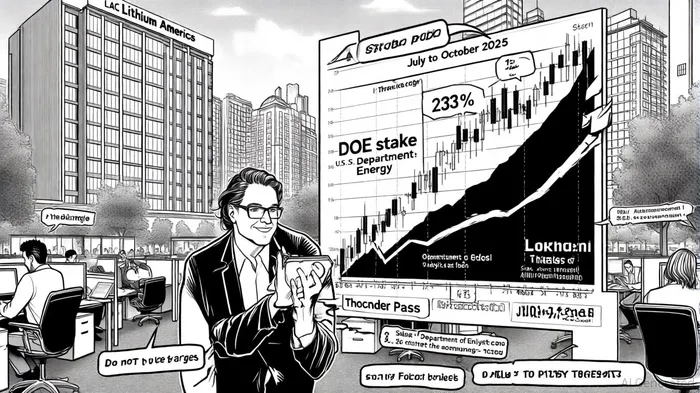





Comentarios
Aún no hay comentarios