
Litecoin's 2025 Price Potential: Is $150 Within Reach Amid Shifting Market Dynamics?
Litecoin (LTC) has long been positioned as "digital silver," a complementary asset to Bitcoin's "digital gold" narrative. But as 2025 unfolds, the cryptocurrency's fundamentals and market dynamics are evolving in ways that challenge-and perhaps redefine-its role in the crypto ecosystem. With on-chain metrics suggesting robust adoption and institutional interest on the rise, the question looms: Is a $150 price target for Litecoin feasible in 2025?
On-Chain Metrics: A Tale of Strength and Risk
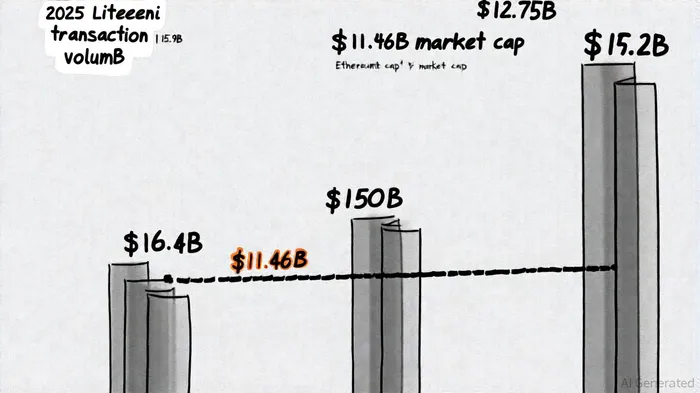
Litecoin's on-chain data in 2025 tells a story of resilience and niche appeal. Daily transaction volume surged to $12.75 billion, exceeding 140% of its market cap-a metric that underscores its utility as a fast, low-cost payment network [1]. This outpaces Bitcoin's 10-minute block time and $1.37 average fees, with LitecoinLTC-- offering 2.5-minute confirmations and fees of just $0.03–$0.05 [4]. Meanwhile, the network's hashrate hit 2.7 PH/s, reflecting growing miner participation and security [1].
However, centralization risks persist. The top 100 wallets control 40% of the total supply, a concentration that could destabilize the network if large holders decide to liquidate [1]. While Litecoin's Scrypt algorithm promotes decentralized mining compared to Bitcoin's ASIC-dominated SHA-256, this whale activity remains a wildcard.
Comparative Value Analysis: Niche vs. Dominance
Litecoin's market cap of $6.9 billion in 2025 pales in comparison to Bitcoin's $1.2 trillion and Ethereum's $658 billion [5]. Yet its value proposition lies in specialization. While BitcoinBTC-- dominates as a store of value and EthereumETH-- leads in smart contracts and DeFi, Litecoin carves out a role in microtransactions and cross-border payments. Its 1.2 million daily active addresses [3]-a 15% surge in 2025-suggest growing traction in this niche.
Ethereum's 123 million wallet addresses and Bitcoin's 54 million [2] highlight their broader adoption, but Litecoin's focus on speed and low fees could attract users seeking practicality over complexity. For instance, platforms like Telegram have integrated Litecoin for in-app transactions, signaling institutional validation [6].
The $150 Price Target: Feasibility and Constraints
To reach $150, Litecoin's market cap would need to hit $11.46 billion (76.4 million circulating coins × $150). Given its current $8.36 billion market cap [7], this represents a 37% increase. While ambitious, the math isn't impossible.
Litecoin's transaction volume already exceeds its market cap, a sign of strong real-world usage. If adoption continues to grow-driven by partnerships like Luxxfolio and MEI Pharma's investments [6]-demand could push the price higher. However, three factors temper optimism:
1. Competition: Bitcoin and Ethereum's dominance in institutional and retail markets limits Litecoin's upside.
2. Supply Concentration: Whale activity could trigger volatility, especially if large holders dump their holdings.
3. Market Cap Disparity: Litecoin's smaller size makes it harder to attract the same level of capital inflows as its peers.
Technical and Sentiment Indicators: A Mixed Bag
October 2025 price predictions range from $96.91 to $153.16, with an average of $134.90 [7]. While some models suggest $150 is within reach, others caution against over-optimism. The Fear & Greed Index oscillates between "Greed" (63) and "Fear" (34), reflecting market uncertainty [7]. Volatility metrics hover around 4.70–7.21%, indicating a high-risk, high-reward profile.
Conclusion: A Realistic but Conditional Outlook
Litecoin's $150 price target is technically feasible if adoption in microtransactions and cross-border payments accelerates, institutional interest solidifies, and whale activity remains stable. However, the broader market dynamics-Bitcoin and Ethereum's dominance, regulatory shifts, and macroeconomic factors-will ultimately dictate whether this niche player can break through.
For investors, Litecoin remains a compelling case study in specialization. It may never rival Bitcoin's or Ethereum's scale, but its role as a fast, low-cost payment layer could justify a $150 price tag-if the right conditions align.






Comentarios
Aún no hay comentarios