
The LIT Token Buyback Strategy and Its Implications for Long-Term Holder Value
In the rapidly evolving DeFi landscape, tokenomics have emerged as a critical determinant of long-term value accrual for holders. Lighter's LITLIT-- token buyback strategy, launched in January 2026, represents a novel approach to protocol-driven value creation, leveraging on-chain transparency and direct alignment between usage metrics and token demand. This analysis explores how the strategy's design, funding mechanisms, and market execution position LIT as a compelling case study for evaluating the interplay between tokenomics and investor confidence.
Protocol-Driven Buyback Mechanics
Lighter's buyback program is uniquely structured to allocate protocol-generated fees-primarily from its decentralized exchange (DEX)-directly into token repurchases. This model creates a self-reinforcing cycle: increased protocol usage generates higher fees, which in turn fund buybacks, reducing circulating supply and elevating token value. According to a report by , the treasury currently holds $1.35 million in USDCUSDC-- and 180,000 LIT tokens, providing immediate liquidity for market purchases. The fixed supply of 1 billion LIT tokens, with 50% allocated to the ecosystem and 50% to team and investor allocations, further stabilizes the supply-side dynamics.
The buyback's execution is also notable for its responsiveness to market conditions. As stated by Lighter's management, the allocation of fees between growth initiatives and buybacks will be adjusted based on real-time demand and strategic priorities. This flexibility ensures that the program remains adaptive to macroeconomic shifts, a critical feature for sustaining long-term holder value.
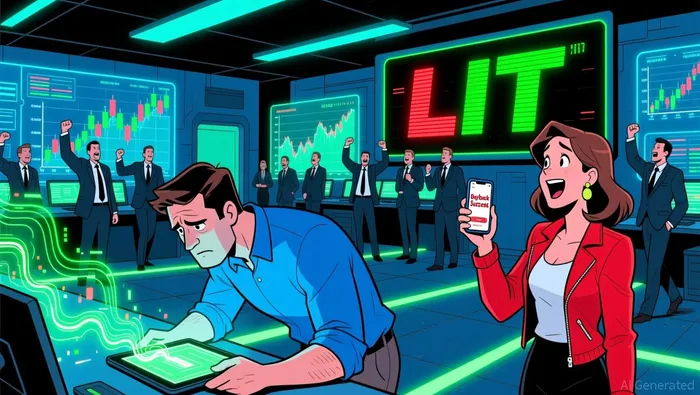
Treasury Strength and Execution Capacity
The treasury's current composition underscores Lighter's capacity to execute its buyback commitments. With $1.35 million in USDC and a projected ability to repurchase up to 30 million LIT tokens, the protocol demonstrates robust financial discipline. This level of liquidity not only supports immediate buybacks but also signals to the market that Lighter is prepared to act decisively to defend token value during periods of volatility.
Moreover, the transparency of on-chain fee tracking-a feature emphasized in Lighter's official roadmap-enhances trust among stakeholders. analysis, the visibility of revenue streams and treasury allocations reduces information asymmetry, a persistent challenge in DeFi. This transparency is likely to attract institutional and retail investors who prioritize accountability in their investment theses.
Market Confidence and Price Implications
The launch of the buyback program in January 2026 coincided with a 16% price rally for LIT, as reported by Crypto Briefing. This surge reflects the market's positive reception to the protocol's commitment to reducing supply while tying token value to measurable usage metrics. The strategy's success hinges on its ability to maintain this momentum, particularly as Lighter's 30-day trading volume recently surpassed $200 billion, overtaking key competitors.
However, the program's long-term efficacy will depend on sustained fee generation. With 25% of the ecosystem allocation reserved for future incentive campaigns and partnerships, Lighter retains the flexibility to balance buybacks with growth initiatives. This dual focus ensures that the protocol can scale its user base while maintaining a deflationary token supply, a rare combination in the DeFi space.
Token Distribution and Long-Term Supply Dynamics
The LIT token's distribution model further strengthens its value proposition. Team and investor tokens are subject to a one-year cliff followed by three years of linear vesting, minimizing the risk of sudden sell pressure. Additionally, the airdropping of 25% of the total supply to early users has fostered a broad base of aligned stakeholders, analysis. This distribution strategy not only democratizes access but also incentivizes long-term retention among holders.
The fixed supply cap of 1 billion tokens, combined with the buyback program's projected repurchase of 30 million LIT, creates a clear narrative of supply contraction. As Yahoo Finance observed, this has sparked debate within the DeFi community about the sustainability of such models. Yet, Lighter's approach appears to strike a balance between deflationary mechanics and utility-driven demand, with the token serving as a medium for staking, platform access, and fee payments.
Strategic Implications for Holders
For long-term holders, the LIT buyback strategy offers multiple avenues for value accrual. The reduction in circulating supply, coupled with the token's utility in governance and fee discounts, creates a flywheel effect where increased adoption directly benefits holders. Furthermore, the treasury's ability to act as a stabilizing force during market downturns-by purchasing tokens at discounted prices-adds a layer of downside protection.
That said, investors must remain cognizant of macroeconomic risks, such as broader market volatility or shifts in DeFi user behavior. Lighter's reliance on protocol-generated fees means that any decline in DEX activity could temporarily slow buyback execution. However, the treasury's current liquidity and the team's emphasis on adaptive allocation mitigate this risk to an extent.
Conclusion
Lighter's LIT token buyback strategy exemplifies the potential of protocol-driven tokenomics to enhance long-term holder value. By aligning token supply with protocol usage, maintaining transparent treasury practices, and structuring incentives for sustained growth, Lighter has positioned LIT as a compelling asset in the DeFi ecosystem. While challenges remain, the program's early success-marked by a 16% price rally and robust treasury liquidity-suggests that the model could serve as a blueprint for other protocols seeking to balance deflationary mechanics with utility-driven demand.






Comentarios
Aún no hay comentarios