
LIT Accumulation by a Whale: A Strategic Buy-and-Hold Opportunity in 2026
The cryptocurrency market has long been shaped by the actions of large institutional and individual investors-commonly referred to as "whales"-whose capital flows often signal broader market sentiment. In 2026, the LITLIT-- token, native to the Lighter decentralized exchange (DEX) protocol, has emerged as a focal point for such strategic accumulation. On-chain data and valuation metrics suggest that whale activity, coupled with protocol-driven initiatives like token buybacks, positions LIT as a compelling long-term investment opportunity.
Whale Accumulation: A Signal of Institutional Confidence
Recent on-chain activity underscores a deliberate effort by major holders to build positions in LIT. In late 2025, a whale wallet deposited $2 million in USDC into the Lighter platform to acquire 2.45 million LIT tokens, averaging $2.46 per token. This followed an earlier whale transaction in which 8.67 million USDC was used to purchase 3.44 million LIT at an average price of $2.52. These transactions, occurring at a premium to the broader market, indicate a strategy of capitalizing on undervalued entry points-a hallmark of institutional-grade accumulation.
The trend continued into 2026 with a landmark acquisition by Justin Sun, founder of TronTRX--, who spent $33 million to purchase 13.25 million LIT tokens, increasing his stake to 5.32% of the circulating supply. This move, occurring after a similar purchase in late 2024, reinforces confidence in LIT's long-term utility within the DeFi ecosystem. Such high-profile acquisitions by influential figures often act as catalysts for broader market adoption, as they validate the token's role in decentralized finance infrastructure.
Protocol-Driven Valuation and Buyback Momentum
Lighter's strategic initiatives have further bolstered LIT's valuation. In early January 2026, the protocol launched a token buyback program, channeling protocol fees into market purchases. This initiative drove LIT's price to a peak of $3.11, a 16% surge from its pre-buyback level according to MEXC data. The buyback not only reduced circulating supply but also aligned incentives between the protocol and token holders, creating a flywheel effect where increased TVL (total value locked) drives further demand for LIT.
As of early 2026, LIT's market cap stands at $662.93 million, with a TVL of $1.38 billion, yielding a TVL-to-market cap ratio of 2.08. This metric suggests that the protocol is securing more value than its current token valuation-a sign of potential undervaluation. Additionally, daily trading volume spiked to $157.8 million, reflecting heightened liquidity and institutional positioning in both spot and derivatives markets.
Technical and Fundamental Indicators of Accumulation
On-chain analytics further validate the narrative of strategic accumulation. A single investor's purchase of 1.63 million LIT tokens at $2.33 in early 2026-well below the subsequent $3.11 peak-highlights a patient, long-term strategy. Technical indicators like the Chaikin Money Flow also support this view, showing sustained inflows into large wallets rather than speculative momentum-driven trading.
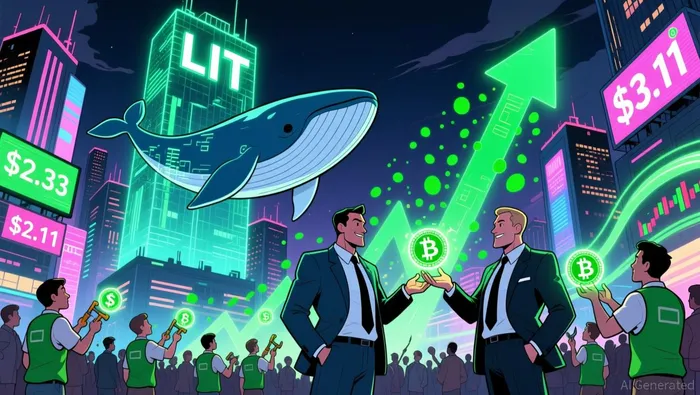
Price predictions for LIT from 2025 to 2030 reflect this optimism, with forecasts ranging from $2.16 to $6.54 by 2026, averaging $3.40. While volatility remains inherent to early-stage DeFi projects, the token's valuation is increasingly tied to tangible metrics such as protocol adoption and utility, rather than speculative hype.
Strategic Buy-and-Hold Rationale
For investors considering a long-term position in LIT, the convergence of whale accumulation, protocol-driven buybacks, and favorable valuation metrics presents a compelling case. The TVL-to-market cap ratio of 2.08 suggests room for re-rating as Lighter's ecosystem expands. Meanwhile, Justin Sun's $33 million acquisition and the buyback program's success demonstrate that institutional actors view LIT as a cornerstone of DeFi's future.
However, risks remain. The token's price is still subject to broader market cycles, and its long-term success hinges on Lighter's ability to maintain and grow its TVL. For those with a multi-year horizon and a tolerance for volatility, LIT's current valuation and accumulation trends offer a strategic entry point.






Comentarios
Aún no hay comentarios