
Liquidity Risks in DeFi Swaps: A $6M ADA Whale Error as a Wake-Up Call
The State of Cardano's DeFi Ecosystem
Cardano's DeFi landscape has seen a 28.7% surge in total value locked (TVL) in Q3 2025, reaching $423.5 million-the highest level since early 2022. Protocols like Liqwid and Minswap have driven this growth, with Liqwid's TVL rising 50.8% to $101.6 million and Minswap dominating 74.7% of DEX volume. However, this concentration of liquidity and TVL creates a fragile ecosystem. For instance, Minswap's TVL fell 22.3% to $53.4 million in the same period, revealing the volatility of user preferences and the risks of overreliance on a single platform.
The Mechanics of the $6M ADA Error
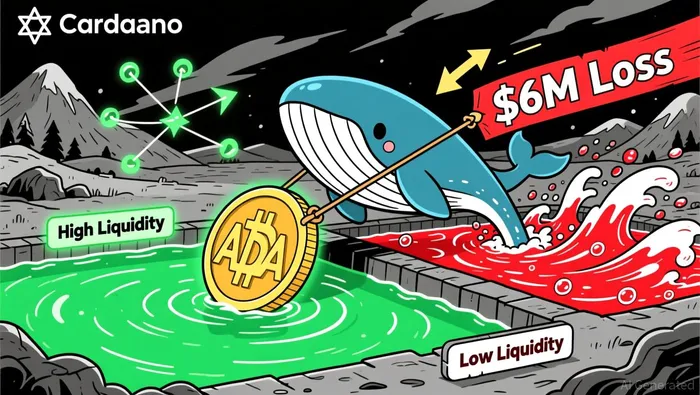
The ADA whale's mistake was twofold: executing a large swap in an illiquid pool and failing to account for slippage. Just 33 seconds before the $6 million trade, the wallet conducted a test transaction of 4,437 ADA for USDA. This test, while seemingly innocuous, likely triggered a temporary price distortion in the pool. When the full 14.4 million ADA swap followed, the pool's liquidity was insufficient to absorb the trade, causing the stablecoin's value to collapse. The ADA price plummeted post-swap, compounding the loss.
This event mirrors broader systemic risks in DeFi. Large trades in low-liquidity pools can create "fat-finger" errors, where a single transaction destabilizes pricing. For example, the swap caused a related token, ANZA to spike to $1.26 before retreating to $1.04-a 20% swing in mere minutes. Such volatility is notNOT-- unique to Cardano but highlights the amplified risks for large investors in fragmented DeFi markets.
Systemic Risks and the Path Forward
The ADA incident is a microcosm of DeFi's liquidity challenges. While Cardano's TVL diversification-from 9 to 10 protocols-reduces single-point failure risks, the dominance of Minswap and Liqwid still leaves the ecosystem vulnerable to concentrated liquidity shocks. Large investors must recognize that even minor errors can cascade into catastrophic losses when trading in pools with insufficient depth.
Mitigation strategies include:
1. Prioritizing Liquid Pools: Execute large swaps in pools with sufficient liquidity to avoid slippage.
2. Test Transactions: Conduct small trades to gauge market depth and identify potential distortions.
3. Diversification: Spread exposure across multiple protocols to reduce reliance on a single platform.
The Cardano Foundation's efforts to inject liquidity into stablecoin projects and expand venture funding are steps in the right direction. However, these measures must be paired with investor education and robust governance to address systemic fragility.
Conclusion
The $6 million ADA whale error is a wake-up call for the DeFi community. As TVL grows and protocols mature, liquidity risks will only intensify. For large investors, the lesson is clear: liquidity is not just a technical metric-it's a lifeline. Without it, even the most well-intentioned trades can become financial disasters.






Comentarios
Aún no hay comentarios