
Liquidity Risk in Small-Cap AI Tokens: How Whale-Driven Speculation Can Backfire
The small-cap AI token sector has emerged as a double-edged sword for investors, blending cutting-edge innovation with speculative fervor. While these tokens promise disruptive potential, their liquidity risks-exacerbated by whale-driven speculative narratives-have repeatedly triggered market meltdowns. In 2023–2025, the sector witnessed a series of collapses, with whale activity playing a pivotal role in amplifying volatility and eroding investor confidence.
The Fragile Foundation of Small-Cap AI Tokens
Small-cap AI tokens, by design, operate in a high-risk, high-reward environment. Their low market capitalizations and thin liquidity make them susceptible to sudden price swings, often driven by narrative hype rather than fundamentals. For instance, tokens like NillionNIL-- (NIL) and ChainOpera AI (COAI) saw over 59% and 33% declines, respectively, during the October 2025 "Uptober" crash, a period marked by geopolitical shocks and whale-driven dumping. These tokens, often marketed as "moonshots," rely on speculative narratives-such as AI-driven DeFi or decentralized machine learning-to attract retail investors. However, as one analyst noted, "The absence of robust infrastructure and institutional-grade liquidity makes these tokens prone to flash crashes when macroeconomic or whale-driven pressures emerge."
Whale Investments: Catalysts for Chaos
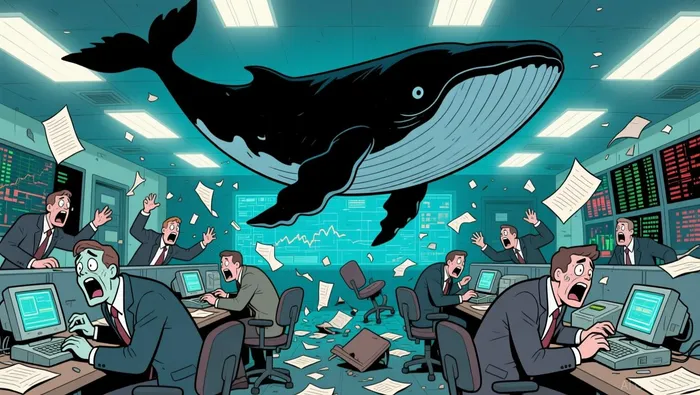
Whales-large holders of crypto assets-have historically acted as both stabilizers and destabilizers in the AI token market. During the Uptober 2025 crash, a single whale known as "BitcoinOG" capitalized on the turmoil by shorting BitcoinBTC-- and EthereumETH--, earning $142 million in profit. Simultaneously, a mysterious trader executed a $1.1 billion short position on Hyperliquid, perfectly timing the U.S. tariff announcement on Chinese imports. These actions, while profitable for the whales, triggered cascading liquidations, wiping out $19.37 billion in leveraged positions within 48 hours.
The October 2025 crash also exposed the fragility of small-cap AI tokens. For example, when early Bitcoin adopter Owen Gunden sold his 11,000 BTC holdings ($1.3 billion) in November 2025, it exacerbated market panic, leading to a $220 million liquidation of long positions. Such whale-driven exits highlight a critical flaw: small-cap tokens lack the depth to absorb large sell orders without triggering exponential price declines.
Structural Vulnerabilities and Market Fragmentation
The Uptober crash revealed deeper structural issues in the AI token market. During the crisis, liquidity fragmentation across exchanges became pronounced, with price discrepancies reaching up to 10%. Platforms like Hyperliquid, Bybit, and Binance bore the brunt of liquidations, with Hyperliquid alone accounting for $10.3 billion in forced closures. This fragmentation, coupled with mechanisms like Auto-Deleveraging (ADL), created a feedback loop of panic selling and forced liquidations, further destabilizing the market.
Moreover, the crash underscored the role of macroeconomic factors. The U.S. imposing 100% tariffs on Chinese software imports not only triggered immediate volatility but also exposed the AI sector's reliance on speculative capital. As one report noted, "The shift of venture capital into AI startups in 2025 siphoned liquidity away from crypto, weakening Bitcoin's price and exacerbating the sell-off."
Lessons for Investors
For investors, the Uptober 2025 crash serves as a cautionary tale. Small-cap AI tokens, while enticing, require rigorous due diligence. Key considerations include:
1. Protocol Robustness: Tokens with strong use cases (e.g., Bittensor's decentralized AI services) tend to outperform speculative projects.
2. Liquidity Depth: Tokens with shallow order books are more vulnerable to whale-driven dumping.
3. Regulatory Risks: Macroeconomic shifts and regulatory actions (e.g., SEC crackdowns) can amplify volatility.
Investors must also recognize the cyclical nature of whale behavior. During the Uptober crash, while mid-tier whales sold off positions, super-whales accumulated at lower prices. This dynamic suggests that disciplined investors may find opportunities in post-crash recoveries, provided they avoid overleveraged or fundamentally weak tokens.
Conclusion
The small-cap AI token market remains a high-stakes arena where speculative narratives and whale activity collide. While innovation drives growth, the sector's liquidity risks-exacerbated by whale-driven dumping and macroeconomic shocks-pose existential threats. As the Uptober 2025 crash demonstrated, even the most hyped tokens can collapse under the weight of concentrated selling pressure. For investors, the path forward lies in balancing optimism with caution, prioritizing fundamentals over hype, and hedging against the unpredictable whims of market whales.






Comentarios
Aún no hay comentarios