
Linea's Tokenomics: A Strategic Catalyst for Ecosystem Growth and Long-Term Value Accrual
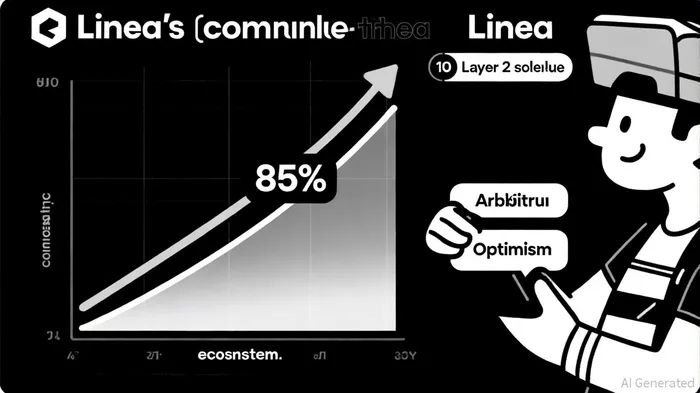
In the rapidly evolving landscape of EthereumETH-- Layer 2 solutions, tokenomics have emerged as a critical determinant of long-term success. Linea, a zero-knowledge (ZK) rollup, has recently unveiled a tokenomics framework that prioritizes ecosystem growth, deflationary mechanics, and aligned incentives. This analysis evaluates how Linea's strategic design positions it as a compelling investment, leveraging its 85% ecosystem-focused distribution and innovative utility mechanisms to drive sustainable value accrual.
Ecosystem Distribution: A Decentralized Foundation
Linea's tokenomics allocate 85% of its total 72 billion LINEA supply to the ecosystem, with 75% reserved for a 10-year Ecosystem Fund (LEF) managed by the Linea Consortium[1]. This structure ensures a prolonged, patient capital deployment strategy, contrasting sharply with competitors like Arbitrum and OptimismOP--, which typically allocate over 40% of their tokens to the community but lack Linea's decade-long vesting schedule[1]. The LEF's focus on Ethereum public goods, R&D, and shared infrastructure aligns with broader industry benchmarks, such as LiquiFi's 2025 tokenomics guidelines, which emphasize vesting periods of 3–5 years for community incentives[1]. By extending this to 10 years, Linea mitigates short-term dumping risks and fosters long-term stakeholder commitment.
Early contributors receive 10% of the supply, split into a 9% airdrop for users and 1% for strategic builders, both unlocked at the Token Generation Event (TGE)[1]. This approach, combined with a 15% Consensys treasury allocation locked for five years, underscores a governance model that prioritizes decentralization while ensuring institutional alignment[1]. Notably, the absence of venture capital or team allocations further reinforces Linea's community-driven ethos[2].
Token Utility and Deflationary Mechanics
The LINEA token is not used for gas fees—ETH remains the primary medium for transaction costs[1]. Instead, Linea employs a dual-burn mechanism: 20% of ETH gas fees are burned, reducing ETH supply, while 80% are used to buy back and burn LINEA tokens, creating deflationary pressure tied to network activity[1]. This model not only enhances Ethereum's scarcity but also links LINEA's value directly to usage growth. For context, projects like BitcoinBTC-- Hyper lack such mechanisms, raising concerns about sustainability[1].
Token utility extends beyond burn mechanics. LINEA is designed to fund public goods, incentivize liquidity providers, and support future staking and liquidity protocols[1]. The Linea Consortium, a council of Ethereum stewards, oversees these allocations without token-based voting, ensuring a collaborative governance model[1]. This contrasts with projects like Kraken's Ink network, which rely on large token mints for liquidity incentives but lack Linea's integrated deflationary framework[1].
Comparative Advantages in the Layer 2 Landscape
Linea's tokenomics stand out in a crowded Layer 2 market. While competitors like Polygon and Arbitrum allocate significant portions of their tokens to the community, their strategies often lack the structural safeguards of Linea's 10-year vesting and dual-burn model[1]. For instance, Linea's 4% Surge campaign—targeting liquidity providers—complements its broader ecosystem fund, creating a balanced approach to immediate liquidity and long-term sustainability[1]. This aligns with LiquiFi's 2025 benchmarks, which highlight the importance of phased incentives[1].
Moreover, Linea's airdrop strategy, which recycled unclaimed tokens into the LEF, demonstrates a nuanced understanding of decentralization. By integrating proof-of-humanity mechanisms, Linea ensures that token recipients are legitimate users, reducing the risk of bot-driven airdrop exploitation[1]. This approach mirrors best practices seen in projects like Etherex and Malda, which contribute to Linea's growing TVL and DEX volumes[3].
Post-Tokenomics Performance and Challenges
Despite its strategic design, Linea's token launch faced immediate volatility. The 9.36 billion airdrop to 750,000 wallets was marred by delays and high transaction fees, with some users on Binance claiming tokens before the broader community[3]. This led to a 27% price drop post-launch, driven by heavy selling pressure from airdrop recipients[3]. Critics also questioned the token's utility, noting that ETH—not LINEA—is used for gas fees[1].
However, these challenges are counterbalanced by long-term structural advantages. By mid-September 2025, Linea's TVL had surged to $2.5 billion, with DEX volumes reaching $800 million, driven by projects like Etherex and Malda[3]. Joseph Lubin, co-founder of Ethereum, has hinted at future rewards for long-term LINEA holders, suggesting potential incentives from Consensys or ecosystem projects[3]. Additionally, Linea's planned Type-1 zkEVM upgrade in Q1 2026—aiming for full Ethereum bytecode compatibility—could attract developers and projects, further boosting network activity[3].
Investment Thesis: A Long-Term Play on Ecosystem Resilience
Linea's tokenomics are engineered for resilience. The 10-year LEF vesting, dual-burn mechanism, and community-centric allocations create a flywheel effect: increased usage drives deflationary pressure, which in turn supports token value, incentivizing further participation. This contrasts with projects like Bitcoin Hyper, which lack deflationary structures and face transparency concerns[1].
For investors, the key risks include short-term volatility and execution risks around the Type-1 zkEVM upgrade. However, the strategic alignment of incentives—between the Linea Consortium, liquidity providers, and long-term holders—positions the project to weather these challenges. The 1.6 billion LINEA tokens allocated for liquidity providers on platforms like AaveAAVE-- and Euler[3] also signal a commitment to deepening market liquidity, though this could temporarily dilute value if demand does not scale accordingly.
Conclusion
Linea's tokenomics represent a bold reimagining of how Layer 2 solutions can balance immediate liquidity needs with long-term sustainability. By prioritizing ecosystem growth, deflationary mechanics, and aligned incentives, Linea has crafted a framework that addresses many of the pitfalls seen in earlier Layer 2 projects. While the post-launch volatility and airdrop challenges highlight the risks of rapid token distribution, the underlying design—rooted in Ethereum's ethos of decentralization and public goods—positions Linea as a compelling long-term investment. As the network progresses toward its Q1 2026 upgrade and expands its TVL, the strategic advantages of its tokenomics will likely become increasingly evident.






Comentarios
Aún no hay comentarios